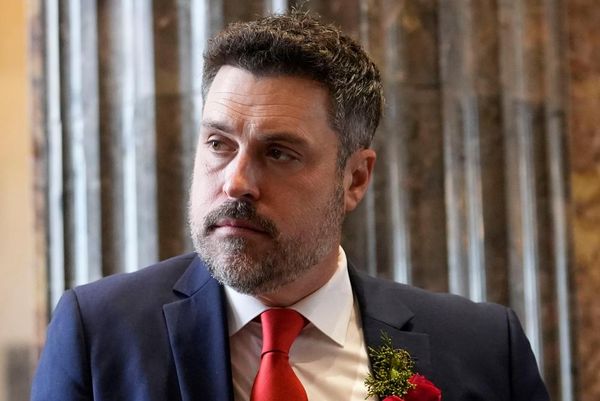
I feel so thrilled after recently finishing a 3,500-kilometer nationwide journey on foot called the "Trans-Japan Walk in Support of Cancer Survivors." I launched this personal endeavor as the president of the Japan Cancer Society in February this year and completed its last leg in July.
The trail-blazing campaign was specifically aimed at raising the public's awareness of the importance of supporting people who have experienced cancer at least once in their life. In this column, I would like to share my experiences in the long-distance challenge with readers.
With the arrival of an era in which our population is aging fast, one out of every two Japanese people is likely to develop cancer at some point in their life. In fact, more than 1 million Japanese have been diagnosed with cancer annually in recent years. The five-year survival rate for cancer patients used to be less than 40 percent, but it now exceeds 60 percent. This means there has been and will be an increase in the number of people overcoming or living with cancer in our society.
Despite the improved survival rate, however, many people still feel grieved once they are diagnosed with cancer, suffer from a sense of alienation and loneliness, and, when undergoing treatment, fear their cancer will recur or metastasize.
To prevent cancer survivors from feeling alienated, the Japan Cancer Society inaugurated a survivors club in June 2017. We coined a hybrid name -- "the Gan Survivors Club (GSC)" -- for the special purpose entity, using the Japanese word "gan" (cancer). The GSC provides on its website (https://www.gsclub.jp/) a variety of accurate and reliable information that cancer survivors and their family members need to know.
The cancer society has also strengthened its existing "Cancer Hotline" telephone consultation service with certified labor and social security attorneys to help cancer patients who want to continue working while being treated. So we now offer both a website and a person-to-person hotline to help and connect cancer survivors.
The GSC relies on donations from individual and corporate members who support its mission, so its activities depend largely on membership growth. The club currently has only 250 individual members. Nevertheless, I am optimistic that the effort to support cancer survivors has the potential to emerge as a national movement if the GSC sees its membership reach 1 million in 10 years' time.
However, the phrase "cancer survivor" and the existence of the GSC remain little known in society. Therefore, I thought I should do something specific to increase the GSC's membership and give myself more opportunities to listen to cancer survivors and medical staff across the country.
I subsequently decided to visit all of the 32 hospitals in the country that comprise the Japanese Association of Clinical Cancer Centers to ask for their greater cooperation in supporting cancer survivors. To do so, I drew up a route that connected all the destinations like calligraphy drawn with a single stroke of the brush, and determined to walk as long as possible.
From Kyushu to Hokkaido
On Feb. 5, I set out on my nationwide journey from the Kyushu Cancer Center in Fukuoka. I walked east and then north across the Japanese archipelago. About 5-1/2 months later, on July 23, I completed the last leg to reach the Hokkaido Cancer Center in Sapporo. Overall, I traveled the equivalent of about a quarter of the diameter of Earth.
People around me in the Japan Cancer Society were initially negative when I first consulted with them about my ambitious plan in the autumn of 2017. They cited my age -- I turned 77 in April -- and the fact that I've survived colon cancer and kidney cancer.
But I remained so firmly determined to go ahead with my initiative that I began preparations for the nationwide walk, including the creation of a banner bearing an awareness promotion message reading "Let's support cancer survivors." My secretary kindly compiled an elaborate itinerary. The cancer society finally shared my enthusiasm.
I lost my wife in late 2007 to cancer. As I spoke to cancer survivors and their families from a bereaved relative's standpoint during the walk, they frankly talked about their troubles.
Some of them were having difficulty because cancer treatment had brought a heavy financial burden to patients and their families. Doctors engaging in state-of-the-art cancer care pointed to the serious shortage of oncologists in their regions.
I was also able to meet and talk with many people as they learned about my campaign from newspaper or TV reports, or happened to spot the banner I was carrying. I listened directly to many people and wrapped up my nationwide walk with a renewed determination to tackle the various issues cancer survivors face.
Throughout the journey, I urged people to join and donate to the GSC. At the same time, I kept emphasizing that anyone can develop cancer but that the age in which "cancer meant death" has gone. I really wanted to correct the public's general perception of cancer. Moreover, I repeatedly referred to the health benefits of quitting smoking, especially in terms of cancer prevention, and the importance of being screened to detect cancer early on.
As I traveled through various parts of the country, I had many memorable experiences. When I visited the Kyushu Cancer Center in Fukuoka on my first leg on Feb. 5, we had heavy snowfall due to a major cold wave in the area. Nonetheless, about 100 people, including Japan Medical Association President Yoshitake Yokokura, joined me there and attended a meeting with cancer survivors. Despite my determination to travel on foot as long as possible, I regrettably had to go some distance by car during the first leg because I temporarily became ill while I was in the Kanto area.
I had to interrupt the journey many times to return to Tokyo, as I had to attend conferences and meetings as previously scheduled. I then started again where my trip had been interrupted.
On July 23, I reached the Hokkaido Cancer Center to complete the walk. Hokkaido Gov. Harumi Takahashi was among the people there to welcome me. She gave me an encouraging message: "I promise that the Hokkaido government will enhance its cancer control measures."
A subject of global importance
On July 11, I was in Lyon to speak about my ongoing campaign at the International Prevention Research Institute (iPRI). The institute, based in the third-largest French city, provides independent authoritative evidence and guidance on critical health risk issues. Prof. Peter Boyle, the founding president of the iPRI, invited me to Lyon to give a presentation because he believes supporting cancer survivors "is a subject of global importance." In October, I will also speak about my walk at the Mayo Clinic, a leading U.S. health care institution.
The fact that I have been invited to speak in France and the United States about my experiences in connecting cancer survivors in Japan means that the importance of supporting cancer survivors is now recognized around the world.
During my journey across the Japanese archipelago, I thought "walking" might be a timely theme to pursue in today's world.
Just in the past year or so, Japanese translations were published of U.S. author and essayist Rebecca Solnit's book, "Wanderlust: A History of Walking," and U.S. author Robert Moor's book, "On Trails: An Exploration." These books inspire us to enjoy the philosophical thoughts that walking induces.
For my part, while striding ahead on each segment of my walk from February to July, I mused over a variety of things, past and present. When I felt badly tired, I became less conscious of time and space. In this state of mind, I casually thought: "The time may have finally come for me to read German philosopher Martin Heidegger's 1927 masterpiece "Sein und Zeit" (Being and Time). Further, as my campaign route covered some of the paths and places Matsuo Basho trailed, I thought perhaps I should re-read the Japanese haiku poet's travelogue "Oku no Hosomichi" (The Narrow Road to the Deep North). In this way, I think I was able to spend a lot of blissful time during my journey.
The trans-Japan walk was an opportunity for me to have firsthand experiences of each region's unique seasonal features, subtle region-by-region differences in the residents and the help extended to people in trouble. All in all, I came to the conclusion that I need not be pessimistic about the future of our country.
I will continue working toward an environment where it will be common for people to support cancer survivors -- and each other member of society as well -- and where people's perception of cancer will change. I believe this will help make our country a place where people feel happy to have been born here.
Special to The Yomiuri Shimbun
Kakizoe is president of the Japan Cancer Society and a past president of the National Cancer Center.
Read more from The Japan News at https://japannews.yomiuri.co.jp/