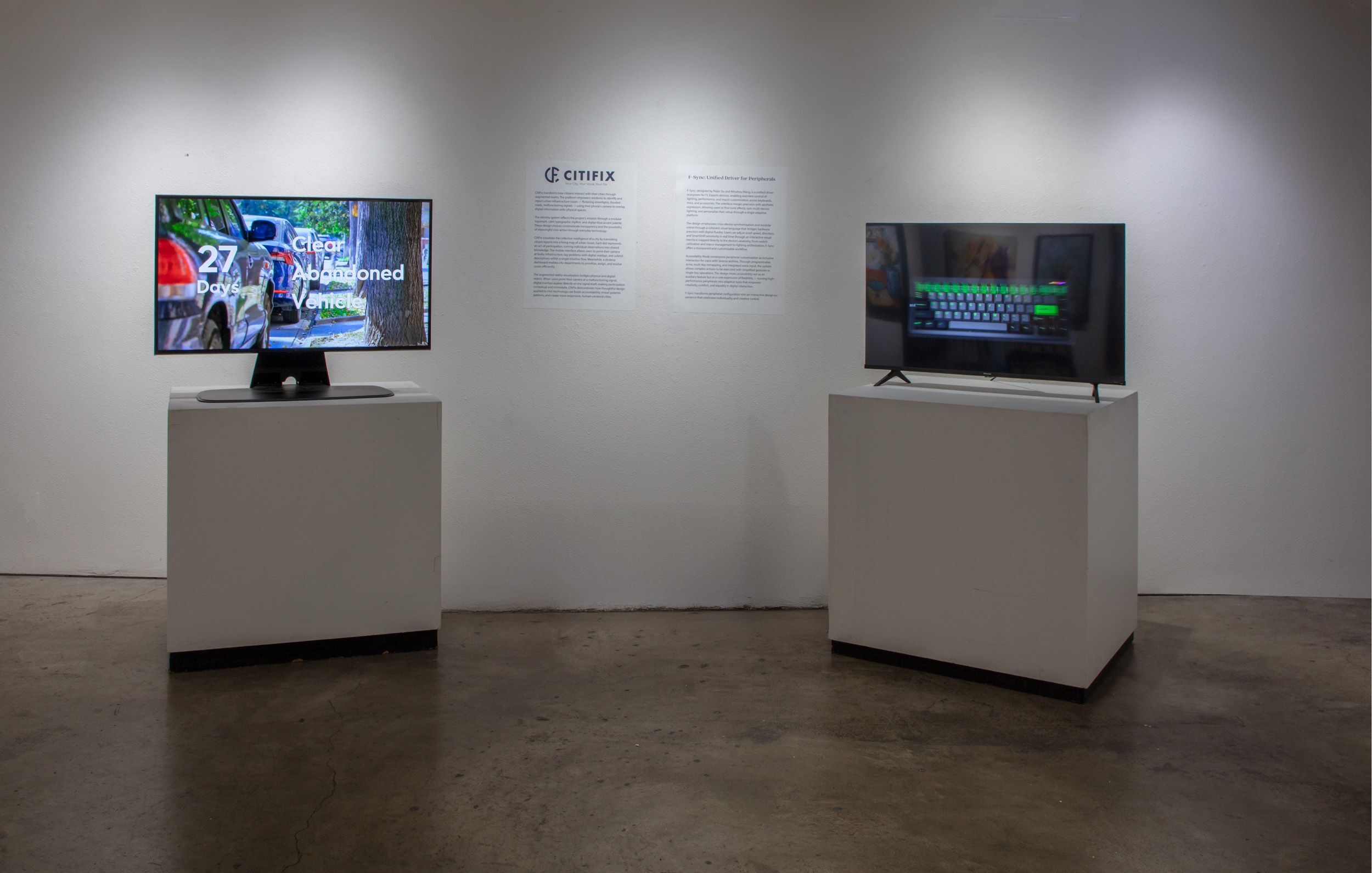
The Sasse Museum of Art presents Inside the System: Two Ways of Seeing, a dual exhibition by product designers Minzhou Wang and Peijin Du, showcasing their collaborative exploration of how individuals perceive and negotiate the increasingly complex technological systems that structure contemporary life. Centered on their two jointly created works—CitiFix and F-Sync—the exhibition positions the artists as observers situated within the very systems they examine, asking how people navigate and make sense of the intertwined domains of algorithms, cities, data flows, and intelligent devices. Rather than treating systems as invisible backgrounds, Wang and Du argue that systems have become the primary sites in which perception and agency unfold. Their shared inquiry emerges from a simple yet profound question: How do we perceive a system when we are already inside it? Do we see the world itself, or do we see a system’s computation of the world? This tension frames the entire exhibition, inviting viewers to consider how digital tools alter human judgment, reshape physical environments, and condition our understanding of reality.
The Sasse Museum of Art is a nonprofit, public-oriented art museum and cultural hub based in Pomona, California, dedicated to advancing the study, appreciation, and public engagement of contemporary art through exhibitions, educational initiatives, and publications. Known for its community-centered philosophy, the museum emphasizes direct dialogue between artists, artworks, and audiences, creating an open and immersive environment that encourages meaningful cultural exchange. With a substantial permanent collection encompassing a wide range of media and a strong focus on both Southern California artists and internationally active practitioners, the Sasse Museum of Art has established itself as a respected platform within the contemporary art ecosystem. As a result, having one’s work exhibited at the Sasse Museum of Art is widely regarded as a mark of exceptional professional recognition and a significant honor, reflecting an artist’s artistic merit, curatorial relevance, and standing within the contemporary art field.
Before encountering their distinct conceptual lenses, it is worth noting the backgrounds that shape Wang and Du’s collaboration. Minzhou Wang is a professional designer and researcher working across UX, HMI, and system design, with a practice centered on how individuals understand and navigate complex technological environments. Her work frequently bridges digital interfaces, service systems, and embodied user experiences. Peijin Du is a UX and product designer exploring how people interact with complex systems—from geospatial tools to AI-assisted interfaces. Her work brings clarity to intricate workflows, blending systems thinking with a deep commitment to usability and accessibility. She transforms complex technical processes into intuitive, cohesive experiences that help users navigate information-rich environments with confidence and ease.
CitiFix, the first of the two exhibited works, reimagines urban experience as a negotiated interface rather than a passive environment. Drawing from real civic pain points—cracked sidewalks, poor lighting, obstructed visibility, unsafe cycling routes—the artists transform these municipal issues into interface-level events that can be perceived, interpreted, and acted upon. Throughout the gallery, layers of UI screens, flow diagrams, and data visualizations translate raw urban information into legible human situations. In doing so, CitiFix addresses longstanding gaps in municipal systems: opaque reporting channels, unclear responsibilities, and repair processes that citizens cannot track. The work does not simply digitize the city; it renders the city newly perceptible, participatory, and open to negotiation. To viewers, CitiFix functions simultaneously as a tool and a critical device. Its purpose is not efficiency but inquiry: How does a city acknowledge individual perception, and who holds the authority to define what counts as a problem?
If CitiFix explores the city as an interface, F-Sync turns inward, examining how the human body itself becomes an object of computational analysis. Using everyday peripherals such as keyboards and mice, the artists build an AI-driven system capable of learning from micro-gestures, motion ranges, force differences, and behavioral patterns. In the gallery, the system’s predictions, visualizations, and adaptive layouts form a model of how technology “sees” a person and how it decides what assistance to provide. F-Sync thus exposes both the promise and the power dynamics of adaptive design. It demonstrates how technology can tailor itself to human needs while revealing that to be “understood” by a system is to enter into a relationship shaped by invisible decisions and encoded assumptions.
Although the two works are co-created, they carry the distinct perspectives of the artists. Wang brings a design-oriented lens focused on user experience, behavioral structure, and clarity of interaction—an interest in how humans converse with systems and how systems might explain themselves rather than force users to interpret opaque logics. Du, by contrast, approaches from a systemic and conceptual angle, probing how data constructs reality, how authority manifests through platform structures, and how the boundaries of a system define the limits of human action. Together, these lenses create a productive tension—a dual way of seeing from inside the system—that enriches the exhibition’s conceptual depth and invites multiple readings.
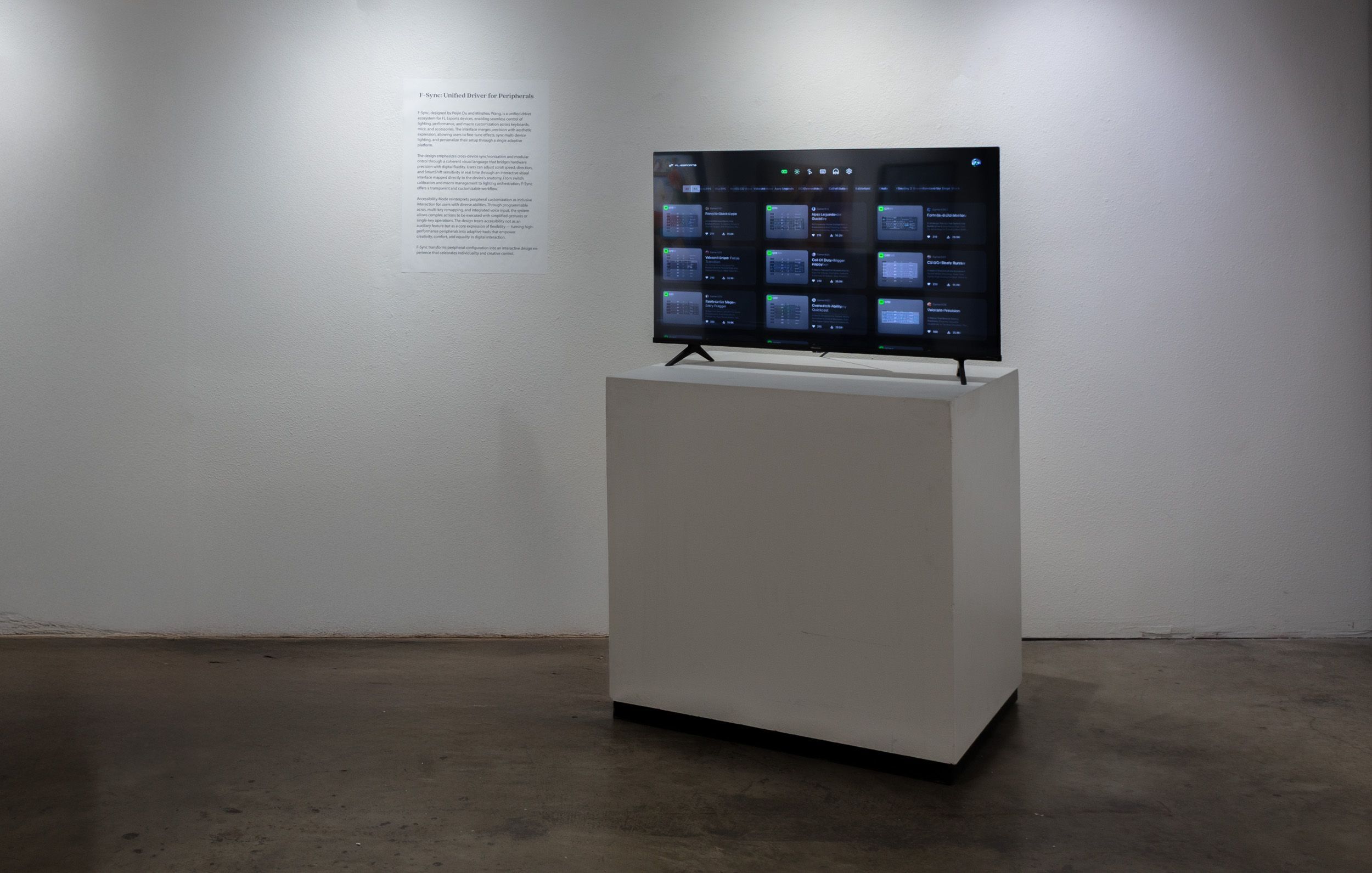
The exhibition is presented by the Sasse Museum of Art, a nonprofit institution in Pomona, California, known for championing experimental, cross-disciplinary, and forward-looking artistic practices. Unlike monumental or traditional museums, Sasse operates as an intimate and dynamic cultural hub, offering space for emerging and established artists alike to explore new forms of expression. The museum emphasizes slow looking, direct engagement, and dialogue—qualities that resonate strongly with the reflective, system-oriented nature of Wang and Du’s work. Under the curatorial direction of Gene Sasse, the museum’s founder and director, the exhibition is framed not merely as a showcase of technological projects but as a deeper inquiry into how systems—urban, digital, computational—shape the conditions of contemporary life. With decades of experience as a photographer and arts organizer, Sasse is known for arranging artworks in thoughtful juxtapositions that open conceptual dialogue. His curatorial approach situates Inside the System: Two Ways of Seeing within the museum’s ongoing exploration of how technology influences perception, agency, and the production of meaning. By positioning CitiFix and F-Sync within this broader narrative, Sasse underscores their significance as investigations into how humans understand, negotiate, and potentially reshape the systems that govern them.
Ultimately, Inside the System: Two Ways of Seeing is not an exhibition about technology but an exhibition about our position within technology. Whether through the civic lens of CitiFix or the embodied lens of F-Sync, Wang and Du illuminate a shared truth: we can no longer stand outside the systems that shape our world. Yet within these systems, we retain the ability to choose how we see, interpret, and act. Through this exhibition, viewers are invited not simply to use technological systems but, perhaps for the first time, to truly see them—to recognize their structures, question their assumptions, and understand their influence on our lives. In doing so, the exhibition opens a space for rethinking human agency in an age when systems mediate nearly every aspect of experience.