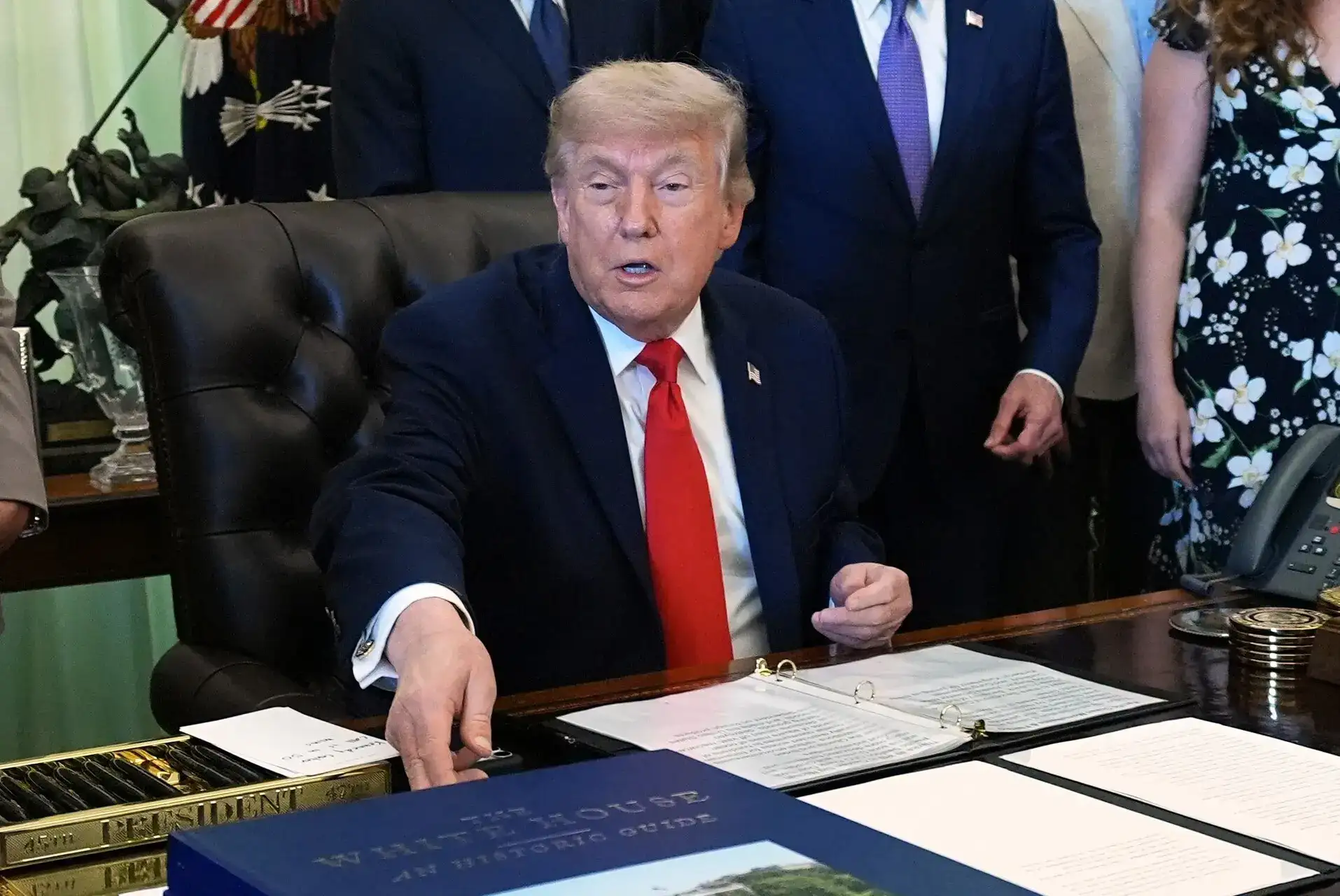
It was fight night on the White House lawn. Beneath a great steel canopy nicknamed “the Claw,” Justin Gaethje did a backflip off the caged ring in the center of the South Lawn after winning the Ultimate Fighting Championship title card. In the audience, the president, newly 80, had just announced that the Iran war was over, and the Strait of Hormuz was open.
Hours earlier, around when he was gathering for a birthday dinner with family inside the White House, Donald Trump had fired off a social media post announcing a deal to end the Iran War he’d started nearly four months earlier: “The Deal with the Islamic Republic of Iran is now complete. Congratulations to all! I hereby fully authorize the toll free opening of the Strait of Hormuz, and, simultaneously herewith, authorize the immediate removal of the United States Naval blockade,” he declared on Truth Social. “Ships of the World, start your engines. Let the oil flow!”
Also read: Trump signs Iran ceasefire deal, warns of renewed bombing if Tehran violates pact
But as with so much of the war, Trump’s rhetoric ran ahead of the facts on the ground. The text hadn’t been released, the formal signing was still days away and the hardest questions – nuclear, sanctions, Lebanon – had been kicked down the road.
It almost didn’t happen. That morning around 6:45am in Washington, Israel bombed southern Beirut – exactly the kind of move that Iranian negotiators warned would blow up the talks. Israel said it was responding to projectiles fired by Tehran-backed Hezbollah.
Across the West and the Gulf, critics saw something else: a last-ditch effort by Prime Minister Benjamin Netanyahu to scuttle a deal he’d been shut out of. Iran balked, but four hours later, Trump took to social media to criticize the Israeli attack, which he said “should not have happened.”
His frustration with his wartime partner was no longer secret. He told Axios that afternoon that the signing was delayed a few hours because of the strikes, and that he’d called Netanyahu to berate him over it. “I was so pissed off. I let him know,” he said in a expletive-laden tirade. Within a few days, the US president would be echoing some of Israel’s staunchest critics. But first he needed Iran to agree to sign.
Three hours later, Trump had the thing he’d been promising for months: a deal, or at least the framework for one. There were no details beyond leaked drafts that suggested a financial bonanza for Iran: immediate oil waivers, potentially imminent sanctions relief, and a possible $300 billion reconstruction fund backed by Gulf money. For Washington, the gains were narrower: a reopened Hormuz, an end to the fighting, and another pledge that Iran wouldn’t pursue a nuclear weapon.
The war had already cost the US tens of billions of dollars, strained munitions stocks and its alliances, sent pump prices soaring and roiled the global energy market – all to achieve a deal that risks falling short of the JCPOA struck by President Barack Obama that Trump had long criticized and tore up during his first term.
As the cage emptied on the South Lawn, Trump prepared to fly to the Group of 7 meeting in Evian, France, where European leaders were ready to lavish praise on a deal they had not read.
This account is based on interviews with Western and Middle Eastern officials familiar with the talks, who requested anonymity in order to discuss sensitive matters, as well as draft language, White House talking points and contemporaneous accounts of the mediation efforts.
As UFC fighters spattered blood on the canvas in front of the White House, Qatari mediators were in Tehran grinding through 17 hours of shuttle diplomacy, carrying messages between Iranian officials and the Americans, according to people familiar with the discussions. It was the culmination of four weeks of quiet mediation the wealthy Gulf state had undertaken at the request of both sides, each seeking a deal to end the war that had become a burden back home.
Until mid-May, Qatar had played a supporting role, alongside Pakistan, Egypt and Turkey, in the search for an off-ramp. Doha had long made itself indispensable as a regional intermediary, but it had deliberately avoided taking the lead here, in part because Tehran had targeted it and its Gulf neighbors, including hitting the $20 billion Ras Laffan LNG facility, the people said. But after Tehran and Washington asked it to get involved more directly, it secretly sent a delegation to Tehran – via Turkey, in order to evade detection – led by senior mediators Ali al-Thawadi and Hamad al-Kubaisi, to get a better understanding of Iran’s position, the people said.
They were in Tehran working on the contours of a deal on May 17 when Trump again publicly floated bombing Iran, posting on Truth Social that “the clock is ticking” for Iran. The next day, he said he’d told his military to call off “the scheduled attack of Iran tomorrow,” at the request of the leaders of Qatar, Saudi Arabia and the UAE, because “serious negotiations are now taking place.”
On May 19, the Qataris flew directly to Washington, again without publicity, where they met with Vice President JD Vance, and Trump’s lead negotiators, son-in-law Jared Kushner and real estate magnate Steve Witkoff, the people said.
Soon after they departed, according to the people, the Qataris and Pakistanis heard from two Western states that Israel was considering attacking Iran. It would mark yet another potential spoiler, but after a US intervention, Israel backed down. The Qataris landed back in Tehran on May 22, later joined by Pakistan’s army chief, Field Marshal Asim Munir, who spent hours locked in discussion with Iranian Speaker Mohammad Bagher Ghalibaf and Foreign Minister Abbas Araghchi.
The key issues were Iran’s demand for a commitment to permanently end the war, Tehran’s willingness to discuss handing over its highly enriched uranium, and the fate of the Strait of Hormuz. Iran agreed to commit to discuss diluting the uranium or handing over the stockpile. In return, the US agreed to a phased process of sanctions relief tied to the progress of talks towards a final deal – an extraordinary financial lifeline for a regime under severe economic pressure.
Two days later, Ghalibaf and Araghchi flew to Doha, along with Iran’s central bank governor, the people said. But they left without signing. In Washington, Trump was growing increasingly impatient, so the Qataris travelled to Miami, where they spent a day in talks with Witkoff and Kushner in a bid to keep the process on track.
Meanwhile, Israel’s invasion of Lebanon kept bleeding into the Iran talks. It had already killed thousands and displaced more than 1 million people, a fifth of the population, while Hezbollah fire kept northern Israel under threat, and Netanyahu insisted on full autonomy to pursue the war.
As May wore on, Trump’s anger increasingly shifted from Tehran to Jerusalem. Netanyahu, backed by widespread domestic support, insisted that he would continue to bombard Lebanon. As Israel continued to ramp up its campaign, Trump exploded at his Israeli counterpart in a profanity-laced phone call in which he told Netanyahu he was “crazy,” as first reported by Axios and later confirmed by the president.
But talks were continuing behind the scenes. The war, never widely supported in the US, was becoming harder to defend, as inflation accelerated in May to the fastest pace in more than three years amid spiking gas prices.
Since the start of the conflict, the closing of the Strait of Hormuz and Iran's attacks on regional energy infrastructure have whipsawed oil prices, even after the first ceasefire was agreed in April. While prices have declined in recent weeks as the two sides negotiated a peace deal, both crude futures and the price of gasoline at the pump remain well above pre-war levels.