When cash-rich industrial conglomerates spot a high-value manufacturing business trading at a steep discount to the public market, a strategic acquisition usually follows fast. On Aug. 10, 2026, Teledyne Technologies Incorporated (NYSE: TDY) announced a definitive agreement to acquire Varex Imaging Corporation (NASDAQ: VREX) in an all-cash transaction valued at approximately $1.1 billion. Under the terms of the deal, Teledyne will purchase all outstanding common shares of Varex Imaging for $18.90 per share in cash.
This is a textbook consolidation within the industrial and medical imaging markets. By integrating specialized X-ray tube and detector hardware into an already established sensor portfolio, Teledyne aggressively expands its presence in high-margin healthcare diagnostics and industrial non-destructive inspection.
For retail and institutional investors, the deal is a masterclass in capital allocation, valuation arbitrage, and corporate growth strategy. When looking under the hood of this buyout, the fundamentals reveal exactly why a leading technology conglomerate is willing to deploy over a billion dollars to lock up this niche supply chain.
Diagnosing the Discount: Varex's Market Mispricing
Public equity markets often underprice specialized mid-cap manufacturers during a temporary rough patch or supply chain realignment. Prior to the takeover announcement, Varex traded near $12.41 per share, representing a market capitalization of roughly $522 million. Despite annual sales of over $844 million and operating cash flow of around $5.77 per share, the broader market valued Varex Imaging at a modest price-to-sales ratio below 0.92x. Wall Street had seemingly penalized the equity for trailing GAAP net losses of about $70 million, allowing those headline numbers to cloud the core cash generation of the underlying manufacturing infrastructure.
Teledyne recognized this valuation disconnect and executed an all-cash buyout at $18.90 per share, implying an attractive enterprise value multiple of roughly 8.7x EBITDA. From an investor standpoint, acquiring a cash-flowing competitor at a single-digit EV/EBITDA multiple is a classic value-investing maneuver. Following the announcement, Varex stock jumped roughly 48% in a single trading session, closing near $18.46 per share as traders adjusted to the cash buyout floor.
Teledyne plans to fund the entire $1.1 billion purchase using its existing revolving credit facility, completely avoiding equity dilution for current shareholders. The agreement includes zero financing contingencies and contains a $25.3 million termination fee if Varex Imaging accepts a superior proposal. Unanimously approved by the boards of directors of both companies, the deal establishes a smooth pathway toward a planned closing in early 2027.
A Perfect Match: Scanning the Tech Overlap
Beyond the financial metrics, the acquisition unites two highly complementary technology stacks with minimal product overlap. Teledyne previously built its digital imaging footprint through the strategic purchases of Teledyne DALSA in 2011 and Teledyne e2v in 2017. While those divisions focus heavily on low-dose complementary metal-oxide-semiconductor sensors and radiotherapy magnetrons, Teledyne lacked direct internal manufacturing capabilities for high-power X-ray tubes and specialized radiation detectors.
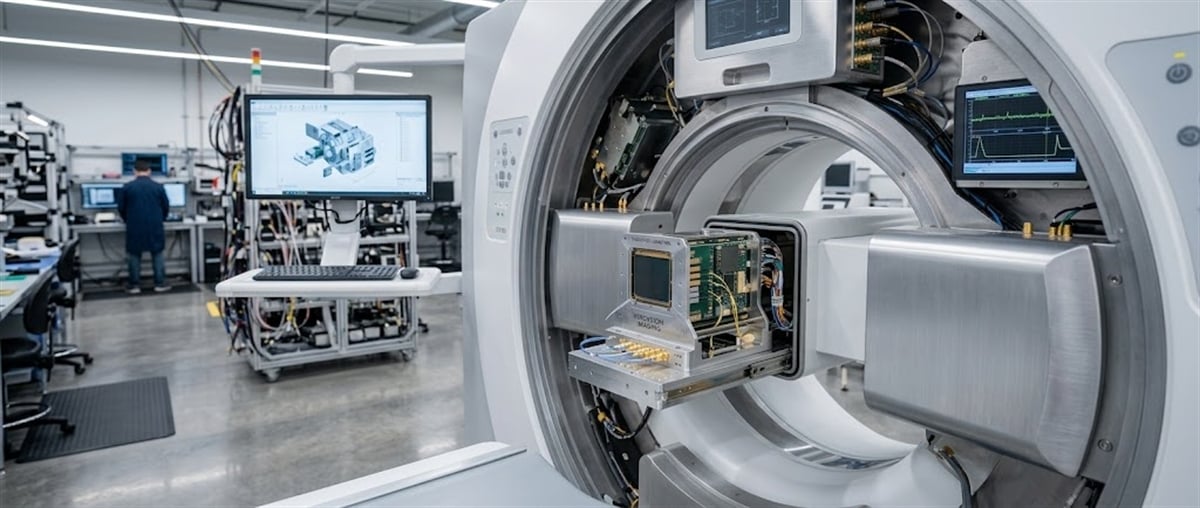
Varex Imaging fills these critical technology gaps as a pioneer in advanced photon-counting detectors. Photon-counting technology represents the next generational leap in medical computed tomography imaging and industrial cargo inspection.
These specialized sensors deliver superior spatial resolution and spectral clarity at significantly lower radiation doses compared to traditional imaging methods. As global healthcare infrastructure upgrades its diagnostic equipment, owning the proprietary photon-counting technology provides a wide competitive moat.
Varex also manufactures high-voltage interconnects, specialty radiographic tubes, and radiation detectors engineered specifically for high-radiation oncology environments. By acquiring Varex Imaging, Teledyne brings key original equipment manufacturer components under its corporate umbrella. This aggressive vertical integration strengthens Teledyne's competitive position in medical diagnostics, aerospace defect testing, automotive component validation, and border security screening, enabling the enterprise to capture greater value across the entire supply chain.
Checking the Vital Signs: Margins, Debt, and Revenue
Teledyne enters this transaction from an enviable position of balance sheet strength. The firm maintains a lean debt-to-equity ratio of about 0.19, supported by a healthy current ratio of 2.18. Over the trailing 12 months, Teledyne recorded revenues of approximately $6.12 billion and net income near $894 million, yielding a robust net profit margin of roughly 15% and cash flow of $28.90 per share. This reliable cash generation easily supports both the new credit facility utilization and Teledyne's active $2 billion stock buyback program.
Varex Imaging also brings rapidly improving underlying fundamentals to the combined entity. In a recent quarterly earnings release, Varex reported non-GAAP adjusted earnings of 31-cents per share. That figure represents a 138% year-over-year increase, beating analyst consensus estimates by 10-cents per share. Quarterly revenue reached $210.50 million, while non-GAAP gross margins expanded to 37%, driven by strong operating cash flow of roughly $21 million.
While Varex recorded trailing net losses due to past operational restructuring, its core operations have reached a clear inflection point. As Teledyne integrates Varex into its decentralized corporate structure, shared operational efficiencies are widely expected to lift Varex's operating margins closer to Teledyne's double-digit corporate average.
The Post-Op Prognosis: Wall Street's Prescription
Wall Street analysts immediately responded to the announcement by adjusting ratings to reflect the acquisition terms. Several sell-side research firms downgraded Varex Imaging to Hold or Neutral ratings, aligning their price targets with the $ 18.90-per-share cash offer. This is standard procedure during a buyout, as the acquisition price effectively caps the stock price.
Meanwhile, consensus analyst ratings for Teledyne Technologies remain firmly at Moderate Buy, with long-term price targets extending upward toward $775 per share. Analysts are actively factoring in accelerated revenue growth, projecting a compound annual growth rate of approximately 10% as the integration of Varex unlocks new cross-selling opportunities and drives margin expansion.
For current Varex Imaging shareholders, the transaction provides immediate cash certainty, leaving a minor arbitrage yield available until the formal closing in early 2027. For long-term investors evaluating Teledyne, the acquisition acts as a clear structural catalyst.
By absorbing a highly specialized, cash-flowing competitor at an attractive valuation, Teledyne continues to build a resilient, high-margin portfolio capable of weathering broad macroeconomic shifts. Market participants seeking durable exposure to industrial technology and healthcare infrastructure may find it beneficial to monitor Teledyne closely as integration milestones unfold over the coming quarters.
The article "Inside Teledyne's Bold Bet on the Future of Medical Imaging" first appeared on MarketBeat.