A Russian missile powered towards the heart of Kyiv before it was knocked out of the sky by a Ukrainian air defence rocket.
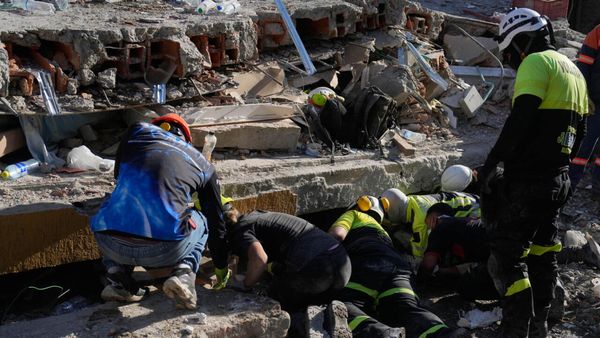
The debris scissored to earth on the east bank of the Dnipro river, away from the centre of the city, blasting the top of a ten-storey apartment block, killing one person and injuring two, shattering windows in the whole neighbourhood, including a school, a local clinic and a kindergarten. Thankfully, most people were hiding in bunkers and survived.
Maria, 33, and her little girl, Olga, four, were woken up by the explosion: “We felt it.”
Maria pointed out a low building with very single window blown out: “That’s where Olga has her dancing classes.”
But the most striking thing about the east bank was the absence of crumps and bangs.


The Russian army has stopped moving forwards. Far from encircling the city, the eastern claw of Vladimir Putin ’s forces is weakening its grip. To the west, the Russians and the Ukrainians are locked in mortal combat, fighting for every street, every house. The difference is simple: the Ukrainians are fighting for their homes and their kids; the Russians are fighting for one man in a high castle.
The killing continues in Kyiv and across the whole of Ukraine but the big picture is that Vladimir Putin’s dogfood army is not winning the war. I call it the dogfood army because, a while back, a Russian army officer was sacked because he complained his boys were being fed “prime quality beef” which was, in fact, dogfood relabelled.
The Ukrainians have found abandoned Russian tanks equipped with food rations with “eat-by” dates from 2015. There are multiple videos of Russian soldiers scavenging for food in Ukraine. An army marches on its stomach. If it doesn’t eat, it doesn’t march.

It’s not just the food. “Any army who doesn’t look after its dead is in trouble,” said Johnny Mercer, the Tory MP for Plymouth and, in a previous life, a British army commando, who passed through Kyiv last week.
The litter of Russian dead has become a commonplace; the fact that the Russian soldiers don’t bother to pick up and bury their fallen comrades shows their morale is rock bottom.
The second great weakness of the dogfood army is corruption. Michael Weiss, an American journalist who is writing a book on Russia ’s military intelligence service, the GRU, says: “there is mounting evidence that the Kremlin are fielding a Potemkin army. Their soldiers don’t want to fight. They’re abandoning tens of millions in kit. And there have been credible allegations of rampant corruption in the military with billions stolen by crooked officers.”

The Russian army’s third great weakness is that its ultimate leader, Vladimir Putin, trusts no-one, like Stalin, not even himself. He was so paranoid about the army leaking his invasion plans that he told them two nights before D-Day. That meant that the generals have had to make it up as they were going along.
The Ukrainians believe in their cause and are fighting like tigers. The dogfood army is hungry, scared, cheated by corrupt generals and led by a paranoiac who he sits at a table that screams the length of his fear.
Don’t be surprised, then, that the Russian army is not moving forwards.