A NSW parliamentary committee has backed up complaints that Newcastle misses out on millions in state funding because the government does not regard it as metropolitan or regional.
A Legislative Council public accountability committee report on the integrity, efficacy and value for money of NSW grants programs found the situation "unacceptable" and called on the government to standardise such schemes so the large regional cities did not fall through the cracks.
The report, handed down on Tuesday, also recommended the government investigate whether to include a third category of "gateway city" in its classification of regions in the state.
It noted Newcastle and Wollongong were ineligible for complementary grants programs such as the Greater Sydney Sports Facility Fund and Regional Sports Infrastructure Fund.
Politicians in the Labor strongholds of Newcastle and Wollongong have railed against sports and cultural grants programs which routinely exclude both cities.
Newcastle lord mayor Nuatali Nelmes told the committee in November that she believed the council did not have equal access to state grants as its local MPs tended to be opposition members.
In the news
- Scone TAFE sold to Racing NSW for $4 million
-
'Distinct clusters': Brisbane COVID tally rises
-
Man's body found on beach at Hawks Nest
- Maitland man pleads guilty to fraud: accountant stole from $1m loan
- Hunter Drug Court celebrates a decade of making a difference in fight against drugs
- Tough break as Jets skipper sidelined for four weeks
She highlighted the stalled Newcastle Art Gallery expansion and regional basketball stadium, lost to Lake Macquarie, as examples of large projects which had failed to attract funding.
Newcastle MP Tim Crakanthorp told the committee that the "Kafkaesque" situation led to the city being ineligible for metro programs such as the Metropolitan Greenspace Program as it was classified as regional but also ineligible for the Growing Local Economies Fund and Regional Cultural Fund, which classified Newcastle as metropolitan.
Wollongong MP Paul Scully said his city's chances of receiving grants depended on who was overseeing them.
"The simple guide that has emerged under successive programs administered by this government is 'no' if it is a Nationals minister and 'maybe' if it is a program administered by a Liberal minister," he told the committee.
In one of its key findings, the committee said the Stronger Communities Fund, designed to help councils which had amalgamated, had "morphed into a brazen pork-barrel scheme".
"Ultimately the Coalition designed a scheme with so few checks and balances that $252 million of public money was handed out on a purely political basis to sort out the Coalition's political problems, to gain an advantage in the 2019 state election and to punish any council that had objected to being forcibly merged."
The committee comprises chair David Shoebridge (Greens), Shooters, Fishers and Farmers Party deputy chair Robert Borsak, two Labor MPs, two Liberals and a Nationals representative.
A Hunter Research Foundation Centre report prepared for City of Newcastle last year and presented to the committee found the local government area should have received an extra $170 million in state grants in 2019 based on its share of NSW's economic output.
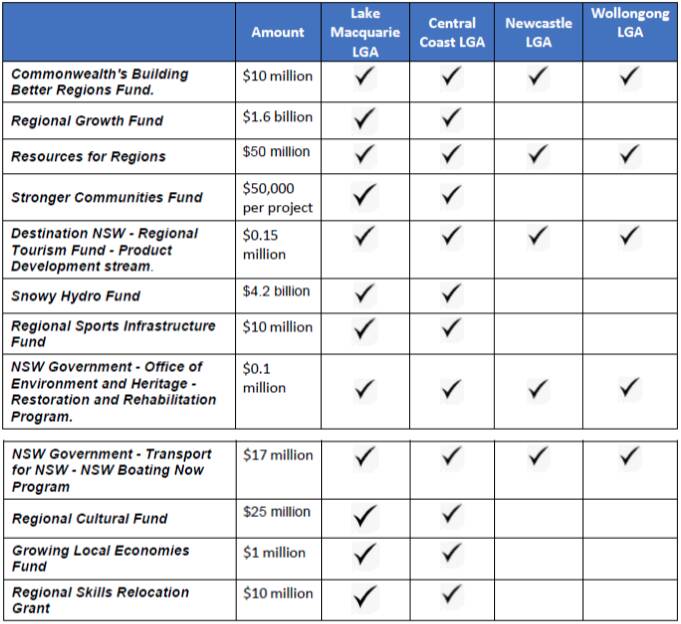
The report found Newcastle was ineligible to apply for regional funding schemes totalling $5.85 billion and received only a tiny fraction of what it was due under the Restart NSW fund.
Newcastle, but not Lake Macquarie nor the Central Coast, was ineligible for the $4.15 billion Snowy Hydro Legacy Fund and $1.6 Regional Growth Fund.
It said Newcastle was eligible for Restart NSW funding, which totalled $1.6 billion a year ago, but had received only 0.06 per cent of the cash, which amounted to one 35th of its share of the state's population (2.11 per cent) and one 49th of its share of gross state product (2.91 per cent).
The Coalition argues it has spent considerably more on Newcastle than previous Labor governments by virtue of the light rail line and other Newcastle Urban Renewal Strategy projects, funded in part by the privatisation of the city's port.
The HRFC report, prepared by economists George Pantelopoulos and Dr Anthea Bill, argued "gateway" cities such as Newcastle, Wollongong and Geelong were "underestimated" by public policy and should be grouped in a new "mid-tier" funding classification between regional and metropolitan.
The researchers found key government policy documents "firmly reference Newcastle and Wollongong within the context of regional NSW" yet major regional funding streams "routinely exclude" them.
Our journalists work hard to provide local, up-to-date news to the community. This is how you can continue to access our trusted content:
- Bookmark: newcastleherald.com.au
- Download our app
- Make sure you are signed up for our breaking and regular headlines newsletters
- Follow us on Twitter
- Follow us on Instagram
- Follow us on Google News