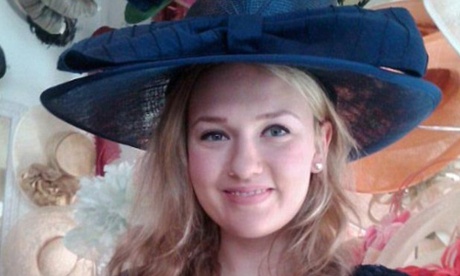
A young woman with bipolar disorder who killed herself days before being put on trial for making a false rape allegation, had her counselling for rape stopped and became severely depressed as a result, her father has told an inquest.
Eleanor de Freitas, 23, died in April last year, three days before her trial was set to start at Southwark crown court. She was due to stand trial for perverting the course of justice after the crown prosecution service decided to continue with a prosecution originally instigated by the man she had accused of rape.
The family received a blow when the coroner decided to reject its calls for a fuller inquest to examine whether the CPS decision to prosecute had caused de Freitas’s death, as well as the wider public interest of prosecuting rape complainants for perverting the course of justice, instead ruling that it was not “an interested party”.
De Freitas’s father, David, told Fulham coroners’ court that in the months after the CPS decided to press charges, his daughter had been very depressed and her behaviour had become increasingly bizarre. “She felt odds were stacked against her, and no matter what, it was steam-rolling ahead. She was massively distressed by that,” he told the court.
She had been receiving counselling for rape, which was stopped when private prosecution proceedings were started against her. “Her behaviour [after the end of the counselling] did change,” he said. “In some instances it made her more depressed and alarmed, because she didn’t have the avenues to discuss what she needed to discuss, in other instances it made her behaviour more bizarre.”
She was hugely concerned about being exposed during a trial and had often taken to wearing a burka, telling people that she believed she was being followed and her phone was being tapped, said David de Freitas.
Her bipolar disorder was such that when she was in a depression, she would not leave the house in daylight hours, but when she was in a mania she was “extremely disinhibited, would spend money like there was no tomorrow, she would indulge herself”.
In notes left for her family, she described her overwhelming fear of giving evidence as a motive for taking her life.
Her consultant psychiatrist Dr Christopher Bench told the court that on previous occasions de Freitas had had suicidal thoughts, but she was a conscientious patient who took her medication and never missed an appointment.
The court heard that de Freitas was a “loyal, kind and caring” girl, who was confident and liked to take part in school plays while growing up. A statement by her family, read to the court, said: “She would go out of her way for anyone and do anything to make them feel better.” They added: “She packed more experiences into her short life than most people do in 90 years.”
The grade-A student made a rape allegation to police on 4 January, 2013 but after conducting an investigation, they told her there was not enough evidence to proceed.
On the day after the alleged rape, on 23 December, said David de Freitas, his daughter had driven to Northamptonshire for Christmas. Despite being a good driver and very familiar with the route, she had took a wrong turning and continued driving until she ran out of petrol. “She must have gone through something very traumatic to be so distressed to do what she did,” he said.
De Freitas was told on the 13 August that the man she had accused was bringing a private case against her for perverting the course of justice; inquest papers revealed this was at a cost of £200,000.
The news shocked the 23-year-old and her mental health deteriorated, according to her family, who said she was particularly worried that as a defendant she would have no protection and would not be able to remain anonymous. In an email to her defence solicitor before the start, she wrote: “I am in utter disbelief about the decision of the CPS… I will regret reporting this to the Sapphire ‘team’ for the rest of my life. I did that as my duty to this country, and to women… Can we get reporting restrictions? This is of extreme importance to me.”
Her legal team took the case to the CPS, thinking it would be discontinued, but on 5 December 2013 the CPS took the decision to take over the case and continue with the prosecution, despite police refusing to mount an investigation into the claims and knowledge of her psychiatric condition.
In December last year, after investigating the decision, the CPS said that de Freitas’s mental health was taken into account before the decision to prosecute was taken and argued that it was “clear there was sufficient evidence for a realistic prospect of conviction”. The decision was based on “strong” evidence and was not “based on her behaviour or actions which fall into myths and stereotypes about how alleged rape victims should behave”, it argued.
“There was also a strong public interest in prosecuting due to the seriousness of the alleged offence which was maintained by the defendant for some time and which led to the arrest of an individual,” said the director of public prosecutions, Alison Saunders.
Saunders dismissed speculation that the police did not agree with the prosecution, stating they had not investigated the allegation of perverting the course of justice and had not considered the evidence collected in the private prosecution. “They were therefore not in a position to form a view on whether there was sufficient evidence to prosecute,” she said.
Speaking before the inquest, David de Freitas said in a statement that he wanted lessons to be learned from the death of his daughter. “We need to make sure that existing guidelines and practices were adhered to and that any shortcomings in these guidelines and practices are identified and remedied so that no other vulnerable young women and their families have to suffer as we and Eleanor did,” he said.
Deborah Coles, co-director of inquest, said the case raised important issues about the treatment of rape complainants and people suffering from mental illness. “There must now be a robust and thorough inquest in order to appropriately consider whether Eleanor received adequate support under the care of West London mental health care trust, and to what extent the prosecution of Eleanor impacted on her life,” she said.