Aiming to boost their chronically low number of customers, taxi companies have introduced a variety of new car models and unique services, including taxis with a spacious, comfortable interior and a local gourmet guide service provided by drivers.
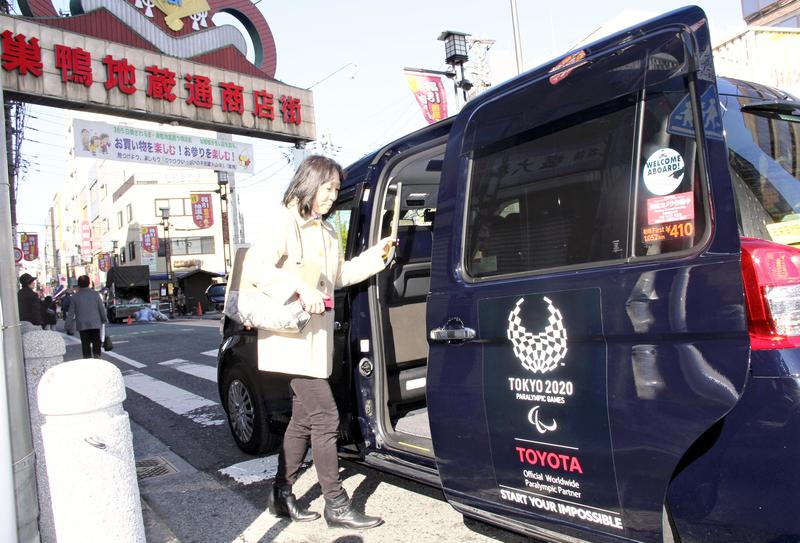
In December, two women in their 60s were pleased when they got into a new taxi model introduced by Tokyo-based company Nihon Kotsu Co., after shopping in Tokyo's Sugamo district.
"The taxi has a high ceiling and more spaces where I can put my shopping bags and relax," one of the women said. The new model is a universal design (UD) minivan taxi called JPN Taxi.
Toyota Motor Corp. began selling the model in October last year. Compared to sedan taxis, the floor is about five centimeters lower, so elderly people and children can easily get in and out. It also has a higher ceiling and a wider space between the front and back seats.
Wheelchair users can get in from the left door by using a ramp, and safety has been increased through an automatic braking system and other functions.
Nihon Kotsu has introduced about 300 JPN Taxi vehicles in Tokyo.
"We can improve our service with the new car model to show our hospitality. We've also received favorable responses from foreign tourists and company employees," an official of the company said.
Nissan Motor Co. has likewise sold a car model called NV 200 as a UD taxi since 2012. The fare system for UD taxis is the same as for ordinary sedan taxis.
The Land, Infrastructure, Transport and Tourism Ministry established an authorization system for UD taxis in 2012, and has worked to promote them. The Japan Federation of Hire-Taxi Associations aim to introduce 10,000 UD taxis in Tokyo by 2020, when the Tokyo Olympics is held.
The Tottori prefectural government plans to introduce 200 UD taxis by March this year.
Going gourmet
"Gourmet taxi" services have become widespread in regional cities, allowing passengers to take a tour guided by drivers recognized as being well-informed about local food.
In December last year, a 35-year-old male company employee traveling alone from Kobe visited Tsubame and Sanjo, both in Niigata Prefecture, and used the local taxi company Chuetsu Traffic Corp.
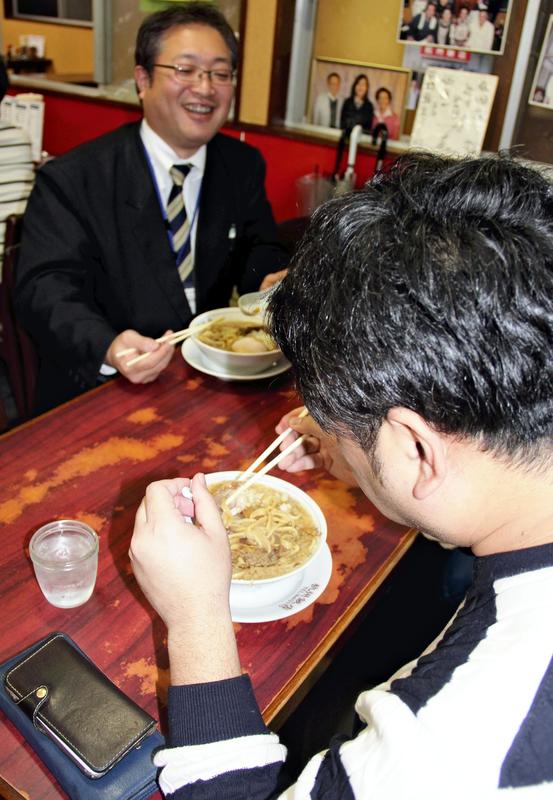
Both cities are fierce battlegrounds among different kinds of ramen, such as seabura ramen, which features very thick noodles and a broth with a lot of pork fat, and curry ramen. The company's taxis take passengers to popular restaurants offering these dishes in special vehicles. Reservations are required for the tours, which start at 12,000 yen and last at least two hours.
Soon after the service started, recognized gourmet guide driver Masahiro Funakubo, 46, began imparting information, such as: "Seabura ramen contains a lot of fat and doesn't cool quickly. Originally, it was produced as a delivery food for busy metalworkers."
The company employee and Funakubo ate a dish recommended by Funakubo at the Koshu Hanten restaurant in Tsubame, which is said to be the originator of seabura ramen.
"I was excited by the information that only local people people know. The ramen tasted good, and I'm satisfied with the tour," he said.
On Jan. 5, an organizing committee comprising the Sapporo municipal government, the Sapporo Chamber of Commerce and Industry, a local taxi association and others launched a ramen taxi service for tourists.
There are other gourmet taxi services across the nation, such as those for udon noodles in Kagawa Prefecture; sushi in Kanazawa; tamago kake gohan (a dish consisting of cooked rice topped or mixed with raw egg and soy sauce) in Kumamoto Prefecture; and sweets in Tokyo and Kobe.
There are other unique services. Sanwa Koutsu Group based in Yokohama offers the "Turtle Taxi" service. If a passenger pushes a "Slow" button, the driver slows down the speed to drive more safely. Fukuoka-based Daito Motor Co. has introduced a "lady taxi" service to drive female passengers to the entrances of their homes. Women use the service at midnight after work.
Taxi companies are introducing such services because the number of customers has been on a decline. In fiscal 2015, an aggregate 1.466 billion people used taxis, down 56 percent from fiscal 1989 when 3.301 billion used taxis. In order to survive, taxi companies need to implement their own measures.
Kazusei Kato, a professor of transport economics at Keio University, said: "Even though there are convenient transportation services, only a small number of people may use them due to the lack of visibility and high prices. Taxi companies should devise ways to improve their services and increase the experience value from a users' perspective by enhancing cooperation with local governments, travel agencies and others."
Fare system reviewed
Japan's first incorporated taxi company was founded in 1912, and the taxi industry has developed as public transportation comparable to trains and buses in the postwar period. However, the taxi industry has experienced hardships in recent years, prompting companies to review their fare systems along with the introduction of new services.
Last year, the initial taxi fare was reduced to 410 yen for the first 1.052 kilometers from 730 yen for the first two kilometers in Tokyo's 23 wards and other places, aiming to encourage people to more readily use taxis for short-distance journeys.
On Jan. 24, a feasibility test was launched in Tokyo for a new ride-sharing service using a smartphone app to dispatch cars, participated in by the transport ministry and two major taxi companies. If a user inputs pickup and drop-off locations and other information on the app, it finds other people going in the same direction and hoping to share a ride.
The taxi fare is split between the passengers according to their respective travel distances, which reportedly reduces the fare for each person by 20 to 40 percent from a solo ride. The test ran through March 11.
Efforts to make taxis into an alternative form of public transportation are also underway.
The Tokushima prefectural government is operating a ride-share, flat-rate taxi service until March that connects Tokushima Awaodori Airport with locations that have limited bus services. Prior reservations are required. According to the prefectural government, the fare is 500 yen to 1,500 yen lower than an ordinary fare.
Automotive commentator Masayuki Moriguchi said: "Populations are shrinking more and more in regional areas, and more and more railways and bus lines are closed or cut back. We will need convenient taxis as a means of transportation from here on."
Read more from The Japan News at https://japannews.yomiuri.co.jp/