If Tokyo Games events were held at full capacity and most spectators went home directly from venues, without stopping off at eateries or entertainment districts, it would have the same impact on daily coronavirus tallies as if venue capacity was halved and few people went straight home, according to a study by a University of Tokyo-led research team.
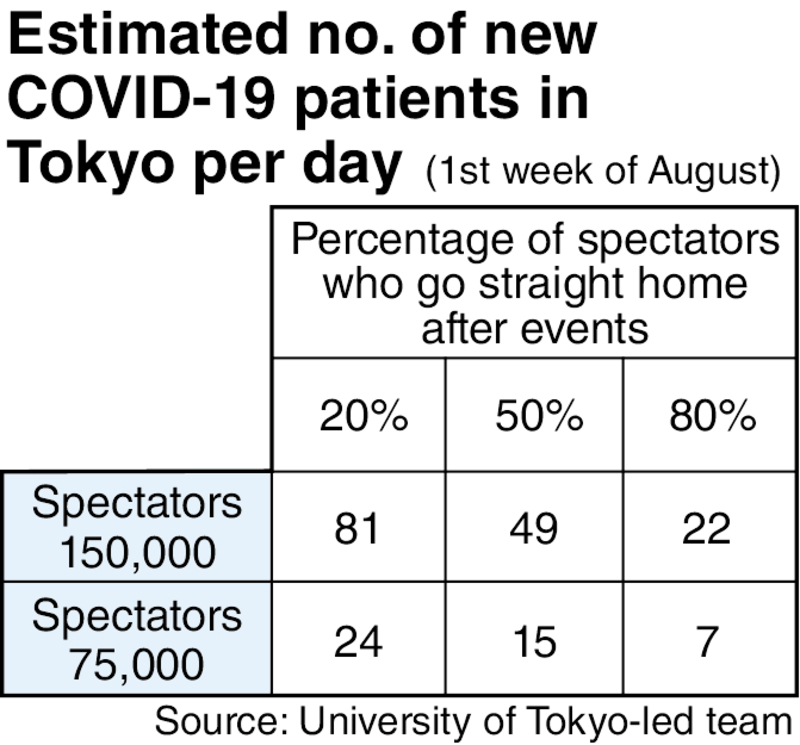
The average daily number of Olympics spectators in Tokyo would be 150,000 if all ticket holders were admitted to venues.
The team's forecast was based on a condition in which, of the spectators who do not go home directly, 60% visit restaurants with adequate COVID-19 measures, while 40% visit establishments with insufficient measures.
The team then varied the percentage of those who go straight home to analyze how the variation would affect the number of newly infected people reported per day in Tokyo.
According to the study, in the first week of August, the number of new COVID-19 patients would increase by 81 if events were held at full capacity and 20% of spectators went straight home. The number would go down to 22 if 80% of spectators went straight home.
Meanwhile, for events held at half capacity, the number of new COVID-19 patients would increase by 24 if 20% of spectators went straight home -- about the same as for full-capacity venues if 80% of spectators went straight home.
The team also pointed out that in addition to the behavior of spectators, other factors -- such as public viewings, watching events with people outside of usual circles and lacking vigilance amid the festive mood -- could significantly affect the spread of the virus.
Data from soccer games held amid the pandemic indicate that from 50-70% of spectators went straight home, according to the study team.
"In addition to the issue of venue capacity, how to increase the number of spectators who go straight home will also be important," said a member of the research team.
Read more from The Japan News at https://japannews.yomiuri.co.jp/