U.S. President Donald Trump's recent announcement of his plan to impose heavy tariffs on imports of steel and aluminum products prompted a wary response from Japanese business circles, as the decision may not only have a direct impact on exports to the United States, but could also lead to a slowdown in the global economy, starting a chain reaction of protectionist moves.
At the Tokyo Stock Exchange on Friday, Nippon Steel & Sumitomo Metal Corp. (NSSMC) closed down 3.81 percent from the previous day, and some other steel stocks also fell across the board.
NSSMC President Kosei Shindo, chairman of the Japan Iron and Steel Federation, said at a press conference Friday: "We are concerned about unilateral measures that were taken in the name of security. The free trade system, which has served as a prerequisite for the growth and prosperity of each country, should be maintained."
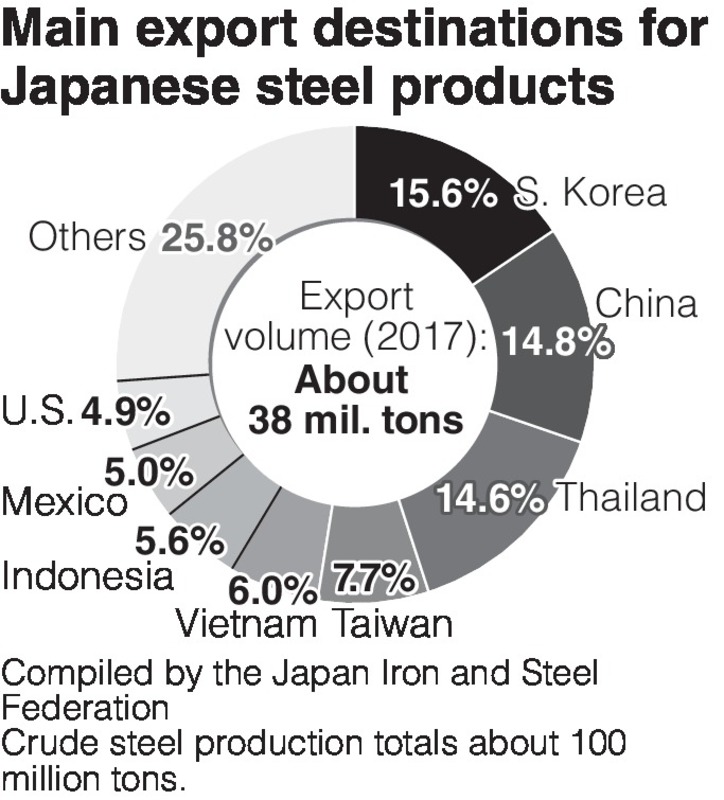
According to the federation, Japan's steel industry exports about 40 percent of its crude steel output. Japan exported about 1.9 million tons of steel products to the United States in 2017, which accounts for about 2 percent of the nation's entire crude steel output.
These products from Japan are mainly items that require advanced technological capabilities to manufacture, such as strong lightweight products to be used in vehicles, and seamless steel pipes for the development of oil fields.
"Many such items cannot be produced by U.S. steelmakers. U.S. customers will have no choice but to rely on imports from Japan, even if they have to pay steep tariffs," said a senior official of a major steelmaker.
However, many Japanese companies manufacture products in the United States, so steep levies may increase their financial burden.
On Friday, Toyota Motor Corp. released a statement saying: "The [U.S.] Administration's decision to impose substantial steel and aluminum tariffs will adversely impact automakers, the automotive supplier community and consumers, as this would substantially raise costs and therefore prices of cars and trucks sold in America."
Yuji Matsumoto, a senior analyst at Nomura Securities Co., said, "If moves to protect domestic industries become widespread, trade will stagnate in various industries, possibly leading to a slowdown in the global economy."
Japan seeks exemption
The Yomiuri Shimbun
In the wake of Trump's announcement, the government has been scrambling to avoid adverse effects on domestic companies.
Trump has cited a threat to U.S. security as a reason for the latest move. Economy, Trade and Industry Minister Hiroshige Seko said at a press conference on Friday, "The import of steel and aluminum from U.S. ally Japan will never impact the security of the United States."
According to a senior Foreign Ministry official, the Japanese government requested the U.S. government not to include Japanese products in the list subject to import restrictions through diplomatic channels.
At a press conference on the same day, Foreign Minister Taro Kono expressed his intention to watch future developments, saying, "There has been no official decision made yet."
A senior ministry official said: "We can't see the entire picture until Mr. Trump actually signs relevant documents. We'd like to ask the U.S. side for their understanding so that the latest move won't adversely affect Japan."
Read more from The Japan News at https://japannews.yomiuri.co.jp/