As everybody in Kolkata will tell you, Ho Chi Minh Sarani (the last word means thoroughfare) used to be called Harrington Street; mischievously, the city changed the name during the Vietnam war purely to upset the US, which has its consulate there. Perhaps not coincidentally – American stomachs and the Kolkata water supply being what they are – it also has a fine little chemist’s shop, which I visited last week in search of a mild laxative. The phrase was hardly out of my mouth when I saw a familiar green packet on a nearby shelf and asked the young man behind the counter if that would do the trick. “Sat-Isabgol? Sure, sir. It certainly will.” So I bought 50g of what must be the most charmingly packaged aid to digestion in the history of medicine, including California syrup of figs. I’ve admired the packet for many years; at last I had a good reason to buy it and try the contents.
Many things about Sat-Isabgol are mysterious. The name sounds as if it might come from the same dictionary of patent medicines as HG Wells’s Tono-Bungay, the salesman for which eventually judged it “a damned swindle”. But Sat-Isabgol isn’t a phoney. The brand first went on sale in 1937, 10 years before British rule ended in India, and has commanded the loyalty of generations of Indians since. It stresses the natural rather than the chemical or magical. In English and Hindi, the sides of the packet announce that it’s a vegetable product derived from the upper coating of Plantago ovata (Ispaghula), which has been “highly purified by sieving and winnowing” and can be freely taken with a glass of water, milk, salted curd or lassi.
Confusingly, the packet’s front goes off in another direction. “Psyllium Husk!” it exclaims opaquely, above a drawing of the kind of upright telephone you might see Laurel (or Hardy) talking into, but that in India must have had more serious purposes, such as spreading sedition or suppressing a riot. So not any old psyllium husk but “Telephone Brand” psyllium husk, and winnowed not by some rural miller but in a factory that, to judge by the drawing, comes from roughly the same era as the telephone. Two chimneys trail smoke above a purposeful ridged roof. Capital letters announce it proudly as The Sidhpur Sat-Isabgol Factory. The location is Gujarat – Plot 503, State Highway, Kali, Sidhpur to be precise.
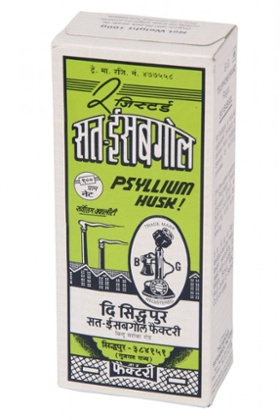
Before the days of search engines, which consumers other than botanists could have said with any certainty what Sat-Isabgol was? Who would know of psyllium husk or why it deserved an exclamation mark? The words are impressive in their strangeness, but the manufacturer presumably realised that potential customers needed to be reassured – that the product wasn’t a snake-oil remedy, boiled up in a big pot in a filthy backyard – as well as intrigued. Industrial rather than artisanal production was then the marker of quality and reliability, in India as elsewhere, and we can reasonably speculate that the drawings of the telephone and the factory suggested the modern world and all the fine things that came with it: laboratories, cleanliness, regular bowel movements. The Shredded Wheat packet used to do something similar when it illustrated the company’s smart new plant in Welwyn Garden City; it may have been British packaging’s last example of a common Victorian pride in the place of manufacture, the factory. Globalisation and modern advertising techniques have put an end to that. Where things are made is a question with embarrassing or complicated answers, while a redesigned Sat-Isabgol packet would almost certainly show a glowing field of Plantago ovata, whatever that may be.
In India at least, the lure of the industrial and the artificial can still be found in neglected places such as Kolkata’s New Market, which has been drained of many of its middle-class customers by suburban, air-conditioned shopping malls. I went there last week to try to buy a canvas holdall. The stall owner took down a shiny bag from the shelf and stroked it lovingly. “Feel it. Pure nylon! Straight from the factory.”
❦
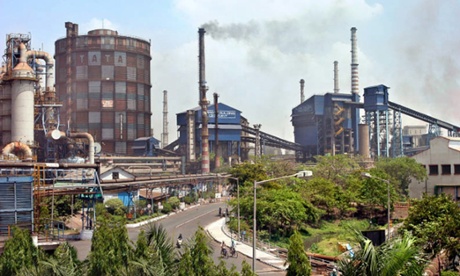
At Jamshedpur, factories of a far grander kind lay steaming on the horizon. Jamshedpur is a steel town. People in Kolkata told me it was “a beautiful place”, but I have to say that I didn’t attach much credence to this. Beautification in India tends to mean the placement of a few saplings protected by high circles of brick, on a patch of scrubland where you will see a few tired dogs and, with bad luck, an unattractive piece of public art.
Fresh off the morning Ispat (steel) Express, I at first saw nothing to puncture this scepticism. The streets leading from the station were as frenetic and jumbled, and as carelessly ugly, as in any other Indian town. But in the afternoon, we saw another Jamshedpur. Our guide, a Sikh sea captain called Harneet, drove us down tree-lined avenues of elderly bungalows and across a large public park that had a vista of distant blue hills. Eventually, we came to a lake that had a promenade, an oriental kiosk and a zoo – all of it built long ago by the Tata company to keep their workforce healthy and happy, and neatly maintained through the decades since.
I realise I’m describing what in Britain is a humdrum sight. Even the ugliest of our industrial towns usually managed to alleviate working-class lives with a park, a bandstand and a library, while the diluted results of the garden city movement – which inspired Jamshedpur – can be seen in council housing estates from Inverness to Plymouth. But India, apart from its military cantonments and richest suburbs, rarely attains handsomeness or harmony in its urban developments; the more urban it becomes, the uglier it gets. Jamshedpur in this context remains a remarkable place.
After half an hour’s drive, I noticed something else. We hadn’t been jolted by a single pothole and Harneet hadn’t once used the horn. An island of European decorum – or at least of European roads and traffic manners – persists (uniquely in my experience of India) in this company town.
We stayed in one of Jamshedpur’s half-a-dozen clubs where a small British delegation was having drinks in the bar. “From Scunthorpe,” a Tata executive said. “They’re the lucky ones.” I think he meant that they weren’t being sacked in the great rundown of Tata’s British steel plants; hundreds, perhaps thousands, of others will be less lucky. The executive said this was a shame – Britain was losing skills it would probably never replace. It was odd – if I lived in Scunthorpe, I might say chilling – to hear the future of a British steel town discussed so far away. Our companion wasn’t unsympathetic, but all over the world the die has been cast long since. China makes cheap steel. Irresistibly, in a process that began as long ago as the mid-nineteenth century, factories continue their migration east.
As to Sat-Isabgol, an unsolicited testimonial: it works. In fact, later developments have shown that it works just as well for the opposite of my original condition. Mention it to people, and they will give you chapter and verse of their own wonderful recoveries. And yet the packet makes no claims for the efficacy of the content - it doesn’t even say what ailments it can be taken for. Long may its factory continue to smoke.