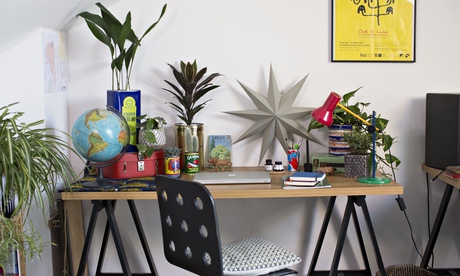
Apparently, I need an aspidistra. I am still reeling from the sudden death of my cactus. It looked dry, so I watered it a bit. Then a bit more. Then one day it shrivelled horribly and collapsed in on itself like a deflated lung.
“You over-watered it,” says the gardener and star of ITV’s Love Your Garden, Katie Rushworth. Katie has come round to give me a houseplant makeover. “Too much love – it’s the houseplant owner’s classic mistake. After neglecting them entirely, that is.”
I have a small collection of house plants: a raggedy, lopsided aloe; a big gangly rubber plant; and a dwindling cactus family, now down to two trembling survivors. Katie says she can help, and begins to plot three designs for three different rooms – starting with the hardiest of houseplants, the aspidistra, aka “the cast iron plant”.
1. An invincible garden for my desk
George Orwell may have written off the aspidistra as fatally suburban but, says Katie, they are the chilled-out housemate of the plant world – relaxed about temperature, watering and area.
My attic office room is hot and dry in summer, but cold in winter, so I need plants that can cope with temperature change. “The golden pothos is another tough all-rounder that anyone can grow,” says Katie. On to the shopping list it goes.
To help the aspidistra shake off its frumpy image, Katie suggests potting it in a modern tin. I choose an old oil can that I get from a restaurant. I team it with a cordyline, a philodendron, an ivy, a cactus and a succulent, also potted in colourful containers. I’m convinced it will encourage me to spend more time at my desk
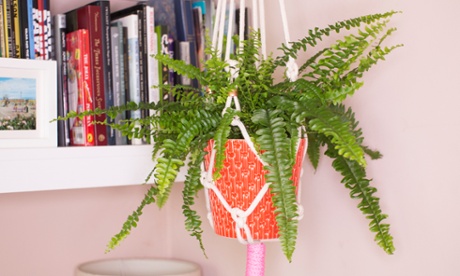
2. A hanging basket for a corner
Macramé hanging baskets are the second outmoded trend that Katie is determined to revive, and she says it will add interest to the corner of my sitting room. She picks a Boston fern for the macramé, as they “are one of the best houseplants for removing unpleasant chemicals like formaldehyde from the air”. I attach the macramé to the ceiling using wall plugs, screws and a hook and chain.
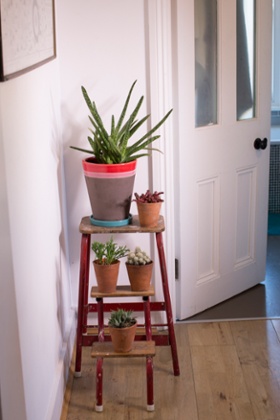
3. A stepladder of succulents
Katie gives a quick diagnosis to my sad aloe. “He’s outgrown his pot,” she says, showing me the tangle of roots escaping through the bottom. He’s also lopsided, and Katie advises me to right him when I move him into his new home. We decide I can use an old stepladder for display and that I should organise the aloe with other types of succulents.
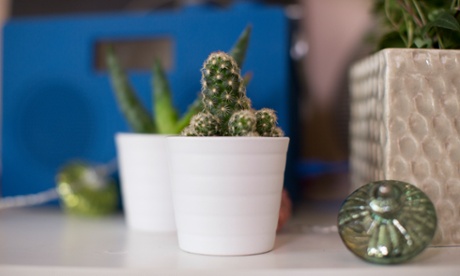
I choose a colourful pot from Habitat and some vintage terracotta pots from eBay. “Always group plants in threes and fives,” Katie tells me. “It is the gardener’s oldest trick.”
The makeover is complete, the house transformed. I promise Katie I will wipe the dust off the plants’ leaves every couple of weeks, mist them regularly with a sprayer – and try not to kill them with kindness.
Plants supplied by: Botany, 5 Chatsworth Road, Hackney, London. E50LH - Telephone: 07583934366. Love Your Garden returns to ITV in June. Contact Katie Rushworth at thequeenofspades.com
Pots from habitat.co.uk
And here are some other interesting ideas:
4. A desktop garden
Take any large jar – a fancy storage jar, or an old Kilner – and wash it well. Then fill the bottom 2cm or so with pebbles. Add a little houseplant compost, about 5cm or so. If you have a lid for your jar you can make a closed terrarium. The best plants for this are mosses, ferns and air plants. It’s important you open the lid once a week for air circulation. You should rarely, if ever, need to water. The plants will provide their own moisture. Add more pebbles, small people, castles, dinosaurs – whatever your miniature world needs. Alys Fowler
5. Epiphytes: plants without pots
Tillandsia – air plants – are tiny epiphytes (a plant that derives its moisture and nutrients from the air) whose roots never sit in soil; instead they live above the ground growing on whatever they can. I’ve seen them on shells, hanging glass, baubles and driftwood. If they’re going to survive, they’ll need good light, plenty of air circulation and to be misted until they drip two to four times a week. Try justairplants.com Alys Fowler
6. Kokedama
Kokedama are the hot new property in houseplants. The name translates literally as “moss ball”. They can be tricky to create but a beginner’s shortcut is to use a florist’s foam ball. Soak it thoroughly, then use a knife to cut out a central reservoir for your plant’s rootball to sit in. Choose a low-maintenance, shade-loving plant such as a small asparagus fern, remove from its pot and brush away any excess soil, then insert into the hole in the foam ball using some of the cut pieces of foam to secure it in place. Cover the ball with damp sphagnum moss (commonly known as peat moss) and wrap twine around to secure everything in place. Hang somewhere out of direct sunlight, using a ceiling hook to attach securely above head height. Take down once a week in the growing season to soak for half an hour – leave to drain and then rehang. Jane Perrone