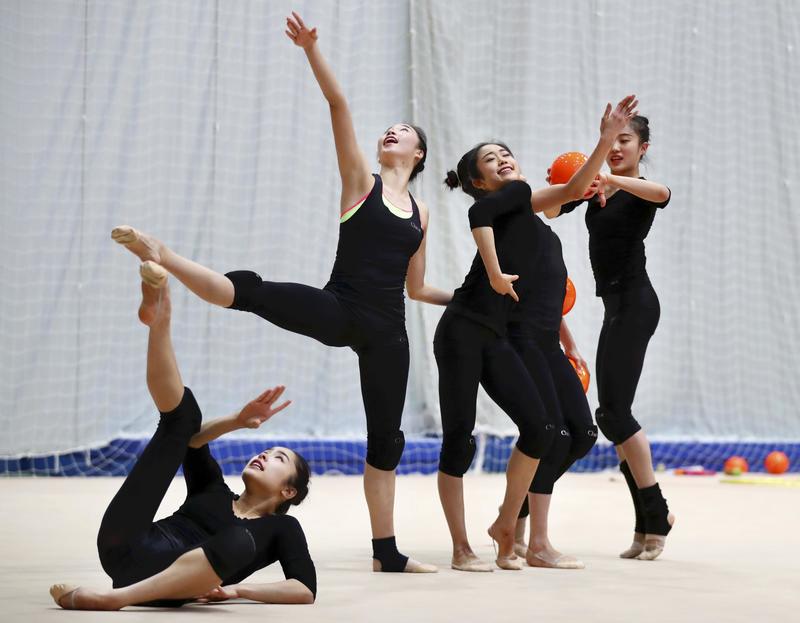
The Japanese national rhythmic gymnastics squad, nicknamed "Fairy Japan," resumed its work at a training camp in June.
The athletes met for the first time in about two months after being told to temporarily vacate their housing facility because of the outbreak of the new coronavirus.
There has reportedly been no individual decline in their movements, though. Even in an environment in which training was extremely limited, the athletes appeared to have maintained their pride as a member of the national team and trained well.
On June 10 -- the first day of the return to camp -- 11 athletes were at the training hub in Tokyo, the Japan Institute of Sport Sciences (JISS).
"In order to to compete, let's create a new foundation and go forward by remaking ourselves," Hiroko Yamasaki, head of team development, told the squad.
The team is focusing only on work to improve individual skills over about the first two weeks of the camp so the athletes can avoid contact among each other.
The highlight of the group performance is the coordination of five athletes who toss around and exchange apparatuses while energeticly darting around.
Japan's performance has received high marks worldwide, earning the silver medal at the all-around competition at last year's world championships.
The members have enhanced their sense of unity by living together for as long as 350 days out of the year.
However, members of the team were forced to go their speparate ways on April 8 when JISS closed down. Some of the athletes who lived in adjoining rooms returned to their hometowns.
The team lost the opportunity to add the finishing touches its program for the Tokyo Olympics, a routine Yamasaki prouldly said was one of the most difficult in the squad's history.
Even that kind adversity did not deter Yamasaki's determination.
"If we find something we can only do in this moment and take on that challenge, we can discover a new perspective,'" was her mind-set.
They have continued with lessons that combine a focus on strength and flexibility, as well as having ballet lessons. Through these lessons, which are each held twice a week via videoconferencing, they worked hard on executing smooth movements, with particular attention to establishing a strong base.
Yamasaki also required the athletes to perform core training on their own to develop physical strength for refined movement.
"[A strong core] leads to a more dynamic and expressive performance, and the precise handling of apparatuses we have been cultivating will be more compelling," Fairy Japan coach Runa Yamaguchi said.
She regarded it a good opportunity to add not only technique, but also strength.
"Judging from everyone's movements, we will be back to where we were if we proceed ahead little by little," team captain Sayuri Sugimoto said.
Added Yamasaki: "We were able to spend time on doing things that we can't do when we are pressed to work on our performance. We look forward to seeing the effect this has."
Fairy Japan might have reached the next level of development in the midst of tumult during their quest for gold at the Tokyo Olympics.
Read more from The Japan News at https://japannews.yomiuri.co.jp/