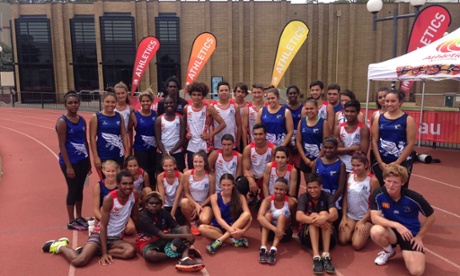
A group of Indigenous high school students from remote parts of Australia are visiting Melbourne this week for a three-day athletics camp to learn about balancing studies with training.
The inaugural Raise the Bar summer camp program, a partnership between Athletics Australia and Melbourne University, offers Indigenous students from remote and regional areas the chance to learn from some of the country’s highest achievers in sport.
Seventeen-year-old Mitchell Michael has traveled to the camp from Cooktown, more than 300km past Cairns in far north Queensland. He is midway through year 12, having spread his studies across two years so he could still concentrate on athletics as well as study.
The student is a state finalist for hurdles, and is also talented at the long jump. He is currently boarding at Ipswich grammar school on an Indigenous scholarship, and says he would not have the same opportunities available to him through his school and the camp if he had stayed in his small home town.
“If I was back home I wouldn’t have a coach that was willing to show up to every training session like I would,” he told Guardian Australia.
“I wouldn’t have as many kids as interested and wanting to train with me.”
One of 34 students selected for the training camp, Mitchell will get advice from Australian sporting successes including Olympian-turned-senator Nova Peris, Olympic pole vaulter Steven Hooker and 800m national record-holder Alex Rowe. Rowe is also a biomedicine student at Melbourne university.
“I was speaking to Alex, and he’s on top of his study, and he’s also gotta find time to train,” said Michael.
“He said there is that many hours in the day … you have to set your priorities.”
Michael took particular inspiration from meeting Aboriginal and Torres Strait Islander long jumper Robbie Crowther.
“It’s good because at our school and around the place we don’t see as many Indigenous athletes at that elite level, so to meet Robbie, who’s doing incredibly well with his long jump is an inspiration. We’re not really used to seeing Indigenous athletes come and speak to us about how well they’re doing and how achievable it is.”
He says it’s made him realise his goals are more achievable than he had though. “It’s just average people, you don’t have to be extremely talented, you just need to be committed.”
Bridgid Junot, Athletics Australia’s Indigenous participation coordinator, told Guardian Australia that students living in remote areas “don’t get the same opportunities … so we really wanted to expand our reach to teenagers in rural and regional areas.”
“Partnering with the uni seemed like a very good idea because we wanted to give the message that young people shouldn’t put all their eggs in one basket and want to be the next Cathy Freeman – there’s nothing wrong with that of course, but they need to balance out their education with their sport.”
She said the organisation received 111 applications from students, demonstrating their leadership skills, passion for athletics and other sports, and a desire to finish year 12 and potentially apply for university.
The 34 who are chosen gain the insight of mentors, including Peris, who will be part of a panel discussion on Wednesday evening.
Peris told Guardian Australia Raise the Bar is an example of Athletics Australia’s federally funded Athletics for the Outback program, which “combines sport and education to provide a platform for the continued development of indigenous school-aged children.”
“It will be a fantastic opportunity to share my experiences with the 35 students in attendance, and I hope that the camp goes a long way to ensuring that the participants remain engaged at high school, consider their options with regard to tertiary education in the future and be able to work with their communities on programs that encourage school-based participation in sport, and hopefully athletics on their return home,” she said.