A Cat That Rewrote the Anatomy of Climbing
The clouded leopard's canine teeth are the longest, relative to skull size, of any living cat on earth. That single biological fact has been confirmed, measured, and published, and it is one of the few things about this animal that science can state without a qualifier. The rest of what researchers know about Neofelis nebulosa, the species found across northeastern India and into Southeast Asia, comes mostly from camera trap images, captive individuals, and educated inference. Wild population data for India is thin enough that the Wildlife Institute of India has flagged it as a species requiring urgent survey work. No reliable national estimate exists.
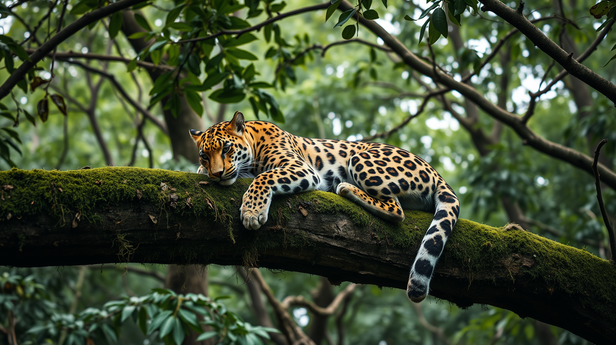
What the anatomy does tell us is significant. The clouded leopard's ankle joints rotate backward, a trait shared with squirrels and not with most other large felids. This lets it descend trees headfirst and hang from branches by its hind feet. Its legs are short relative to its body, lowering its centre of gravity in the canopy. The skull is elongated and the jaw opens to a wider gape than a tiger's, proportionally. These are not incidental details. They describe an animal that has spent its evolutionary history in a vertical world, which is part of why ground-level camera traps miss it so often.
Where It Lives, and Why That Makes Study So Hard
In India, confirmed clouded leopard sightings cluster in the northeastern states: Arunachal Pradesh, Meghalaya, Mizoram, Nagaland, and Sikkim. There are historical records from the Himalayan foothills of West Bengal and from parts of the Western Ghats, though recent verified records from the Ghats are sparse enough that researchers treat them cautiously. The animal's preference for dense, closed-canopy forest, primary or near-primary, means it occupies exactly the kind of terrain where fieldwork is hardest and camera trap placement requires the most guesswork.
A 2019 study published in Oryx, the international conservation journal, reviewed camera trap data from multiple sites across the species' range and found detection rates so low that standard density-estimation models could not produce reliable outputs. The clouded leopard simply was not triggering cameras at the frequency required. Researchers concluded that the species is either genuinely rare at most sites, or that it moves through the canopy and mid-storey at heights where ground-level traps are irrelevant. Probably both.
Home range data from GPS-collared individuals, almost all of them from Thailand and not from India, suggests adult males may range across 40 to 45 square kilometres. Females appear to use smaller areas. Whether those numbers apply to populations in the Himalayan foothills or the northeastern hill forests is unknown. The habitat structure is different, the prey base is different, and the elevation is different. Extrapolating from Thai forest data to Arunachal Pradesh is a stretch researchers are careful to flag.
What Captive Study Has, and Has Not, Revealed
Much of what is known about clouded leopard behaviour comes from captive populations, particularly from breeding programmes run by institutions including the Smithsonian's National Zoo and facilities in Thailand. Captive study has confirmed several things: the species is largely solitary, males are significantly larger than females, and captive males have a documented history of aggression toward females during pairing attempts, a problem serious enough that breeding programmes developed specific introduction protocols to reduce female mortality.
What captive study cannot tell us is how the animal actually uses time in the wild. Activity pattern data from a small number of radio-collared individuals in Thailand suggests the clouded leopard is active across both day and night, with no strongly crepuscular peak of the kind seen in leopards and tigers. Whether it is an opportunistic hunter or a specialist is debated. Stomach content analysis from individuals killed in road accidents or found dead has turned up small deer, wild pigs, monkeys, porcupines, and birds. The variety suggests generalism, but sample sizes are too small to be conclusive.
Vocalisation in this species is also poorly documented. It does not roar. It produces a range of calls including prusten, the soft chuffing sound associated with non-threatening communication in some felids, and a low moan. Systematic acoustic study in the wild has not been done at any Indian site.
The Conservation Status and What It Actually Means
The clouded leopard is listed as Vulnerable on the IUCN Red List, a classification that reflects declining population trend and habitat loss rather than a precise count. The Sunda clouded leopard, Neofelis diardi, found on Borneo and Sumatra, was only confirmed as a separate species in 2006 through genetic analysis, a reminder that even the taxonomy of this group was unsettled within living memory. For India, Neofelis nebulosa is listed under Schedule I of the Wildlife Protection Act, 1972, giving it the highest level of legal protection available. That protection exists on paper in some of the most difficult terrain in the country to monitor or enforce.
Threats are the standard suite for a forest-dependent species in South Asia: habitat loss from shifting cultivation and logging, road kills on expanding highway networks through the northeastern hills, and hunting. Clouded leopard pelts and bones appear in wildlife trade seizures documented by TRAFFIC, the wildlife trade monitoring network, with some frequency in markets along the India-Myanmar border. The demand is real. The enforcement capacity in remote northeastern forests is limited.
The gap between what the law says and what the forest floor looks like is not unique to the clouded leopard, but the species' combination of low detectability and restricted range makes it particularly vulnerable to losses that go unnoticed until they are irreversible. A population can decline substantially before any monitoring system registers the change, if a monitoring system exists at all.
The clouded leopard's very elusiveness, the trait that makes it so striking as a subject, is the same trait that leaves it so exposed. Science has documented the teeth, the ankles, the rotating joints, the wide jaw gape. It has not documented how many there are, where exactly they go, or what a stable population in Indian forest actually looks like. The animal keeps its own numbers.