
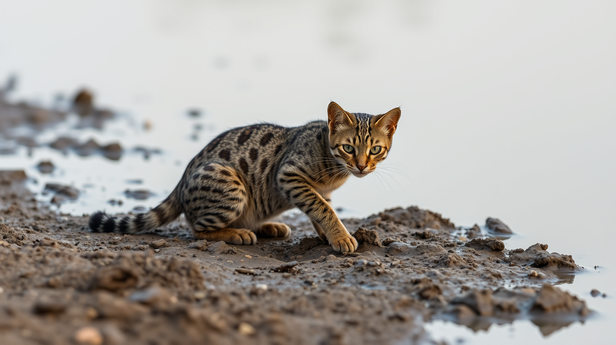
A Cat Built for Water
The fishing cat, Prionailurus viverrinus, is not a cat that occasionally wades in. It is built for water the way a tiger is built for cover. Its forepaws are partially webbed. Its coat has two layers, a dense, water-repelling undercoat beneath longer guard hairs, so it surfaces from a dive without losing body heat. It swims with its hind legs and uses its flattened tail as a rudder. When it hunts, it either plunges directly into a stream or crouches at the bank and uses one paw to scoop fish upward in a single, precise strike.
This is the only wild cat in India that actively hunts underwater. Most felids avoid submersion. The fishing cat seeks it. That specialisation, extraordinary as it is, is also the trap: the animal is so tightly calibrated to wetland ecosystems that it has no viable alternative habitat. When the water goes, the cat has nowhere to recalibrate.
Where It Still Survives, and Why Bengal Matters
The fishing cat's range once extended across a wide arc from Pakistan to Java. That range has collapsed. The IUCN lists the species as Vulnerable, and population surveys conducted across its former territory show it has vanished from large parts of Southeast Asia where it was once common. In India, the Sundarbans mangrove delta and the wetland corridors of West Bengal remain among the most significant strongholds.
The Bengal connection is not incidental. The Sundarbans, shared between India and Bangladesh, is the world's largest mangrove forest and one of the few places where fishing cat density remains high enough to sustain a breeding population. Studies by the Fishing Cat Project, which has conducted camera-trap surveys across Bengal's wetlands, have documented the animal in village ponds, tidal channels, and agricultural marshes well outside protected areas. The cat has adapted to human-adjacent water bodies out of necessity. It is not thriving in those spaces, it is surviving in them because the undisturbed wetlands are gone.
The Fastest-Disappearing Habitat in the Region
Wetlands are being lost faster than any other habitat type in South and Southeast Asia. According to the Ramsar Convention's global wetland outlook, the world lost roughly 35% of its wetlands between 1970 and 2015, a rate three times faster than forest loss over the same period. In India, the situation is acute. The country has 75 Ramsar-designated wetlands, but designation does not equal protection. Encroachment, drainage for agriculture, aquaculture conversion, and urban expansion have reduced wetland cover across Bengal's floodplains and deltaic zones at a pace that outstrips the rate of formal monitoring.
For the fishing cat, this is not a gradual pressure. It is a structural collapse of the only environment it can use. The species does not migrate to drier ground. It does not switch prey. Remove the wetland and you remove the cat, not through direct hunting, but through the quieter violence of making its existence physically impossible.
The Pressures Stacking Against It
Habitat loss is the primary driver, but it operates alongside several other pressures that compound the damage.
Fishing communities in Bengal's wetland zones sometimes trap or kill fishing cats that raid fish ponds or nets. The conflict is real: a fishing cat can take a significant quantity of fish from a small pond in a single night, and for a family running a marginal operation, that loss is not trivial. Retaliatory killing is documented but not systematically measured across the region.
Prey depletion is a secondary problem that rarely gets named separately. Wetland fish populations have declined alongside the wetlands themselves, partly from overfishing and partly from water quality degradation. A predator that depends on a specific prey base in a specific habitat faces a double constraint, shrinking territory and shrinking food within that territory.
Road and rail infrastructure cutting through Bengal's wetland corridors fragments the habitat into patches too small to sustain viable territories. Male fishing cats hold large home ranges. When a corridor is severed, the population on one side cannot replenish losses on the other.
What Conservation Looks Like on the Ground
The Fishing Cat Project has worked with fishing communities in West Bengal to shift retaliatory killing toward coexistence, partly through compensation schemes and partly through reframing the cat as a marker of healthy water, which it is. A wetland that holds a fishing cat is a wetland with sufficient fish, clean enough water, and intact bank vegetation. The cat is, functionally, a water quality indicator with claws.
State-level wetland protection in West Bengal has improved on paper but enforcement remains inconsistent. The Sundarbans Tiger Reserve provides indirect protection to fishing cat habitat, but the species is not a named conservation target in most management plans, it lives in the margins of tiger conservation, benefiting from it without being the focus of it.
Community-based monitoring, where local fishermen record sightings and camera-trap data, has produced some of the most reliable population estimates available. That data matters because the fishing cat is nocturnal, secretive, and rarely photographed, conventional survey methods miss it repeatedly.
The fishing cat's fate is tied to a broader question about how India classifies and protects its wetlands. A forest has a constituency. A wetland, historically, has been treated as land waiting to be drained. Until that changes at the policy level, the camera traps will keep recording a species contracting toward the edges of a habitat that is itself contracting.