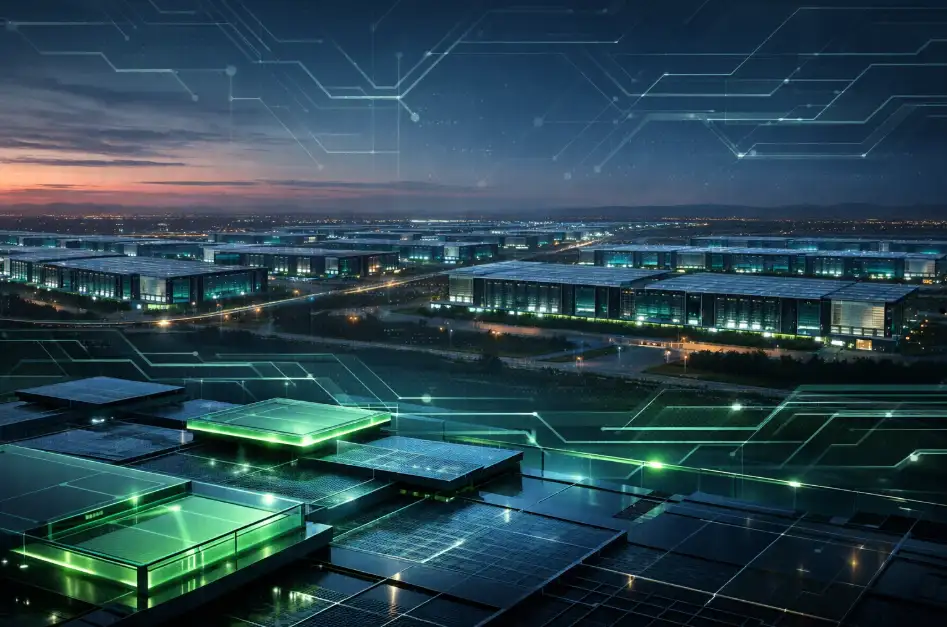
India's data centre industry could expand faster than previously expected, with installed capacity potentially reaching the upper end of the projected 5-8 GW range by 2030 from around 1.5 GW currently, according to international brokerage firm Bernstein.
The brokerage said industry discussions suggest the ongoing Middle East crisis is accelerating interest in India's data centre ecosystem, with demand for land and power infrastructure emerging as the key determinants of future growth.
Bernstein noted that competition for land in Navi Mumbai has intensified significantly, with transaction values rising above previous benchmarks. Access to substations and power connectivity has also become increasingly critical as developers race to secure capacity for future projects. The brokerage estimates that data centre construction costs, excluding compute infrastructure, stand at around Rs 50 crore per MW in India, which it said is lower than comparable costs in the United States.
According to Bernstein, the Indian market is increasingly being shaped by a simple framework: land and power availability. Using that lens, the brokerage believes the Adani Group holds a significant advantage given its position as India's largest renewable energy producer, private thermal power operator and transmission player, combined with a land bank of more than 1,000 acres in Panvel. Reliance Industries was identified as another major contender, with around 0.5 million acres of land holdings and more than 5,000 acres in Navi Mumbai.
The report highlighted two primary operating models in the global data centre industry. The first is the colocation model, where operators build and lease data centre infrastructure to hyperscalers, neocloud providers and enterprises that bring their own computing hardware. Bernstein noted that such projects typically offer a payback period of around five years.
The second model involves cloud providers and neocloud operators that own GPU infrastructure and provide fully developed computing clusters. While these businesses can generate eight to ten times higher revenue per IT MW compared with colocation operators, they also require substantially higher capital expenditure, operate with shorter contract durations and face technology obsolescence risks.
Drawing parallels with the United States, Bernstein said access to power remains the biggest competitive advantage for data centre operators. The report pointed to an average wait time of around six years for power interconnection in the U.S., prompting even some crypto miners with existing power offtake agreements to pivot towards the data centre colocation model.
The brokerage also highlighted a sharp divergence in the performance of U.S. utility companies over the past four years. Companies with dispatchable power capacity in major data centre markets such as PJM and ERCOT significantly outperformed peers, benefiting from rising demand and higher capacity prices.
Applying those lessons to India, Bernstein believes the Adani Group is particularly well positioned to benefit from a surge in data centre investments. Across power generation and renewable energy businesses, the group's combination of land availability, transmission connectivity, merchant power capacity and access to thermal equipment gives it a distinct advantage in supporting future data centre demand.
Within Bernstein's coverage universe, Adani Green Energy and Adani Power were identified as having an unmatched ability to supply power to data centres. The brokerage also sees Larsen & Toubro as a beneficiary, citing opportunities across data centre construction, power plant development and potentially as a data centre owner and operator.
The report added that data centre operators appear largely indifferent to the source of electricity, whether renewable or thermal, as long as reliable power is available. While operators may not directly contract with thermal power producers, Bernstein said they are willing to procure such power through intermediaries such as distribution companies or power traders.
( Disclaimer : Recommendations, suggestions, views and opinions given by the experts are their own. These do not represent the views of The Economic Times)