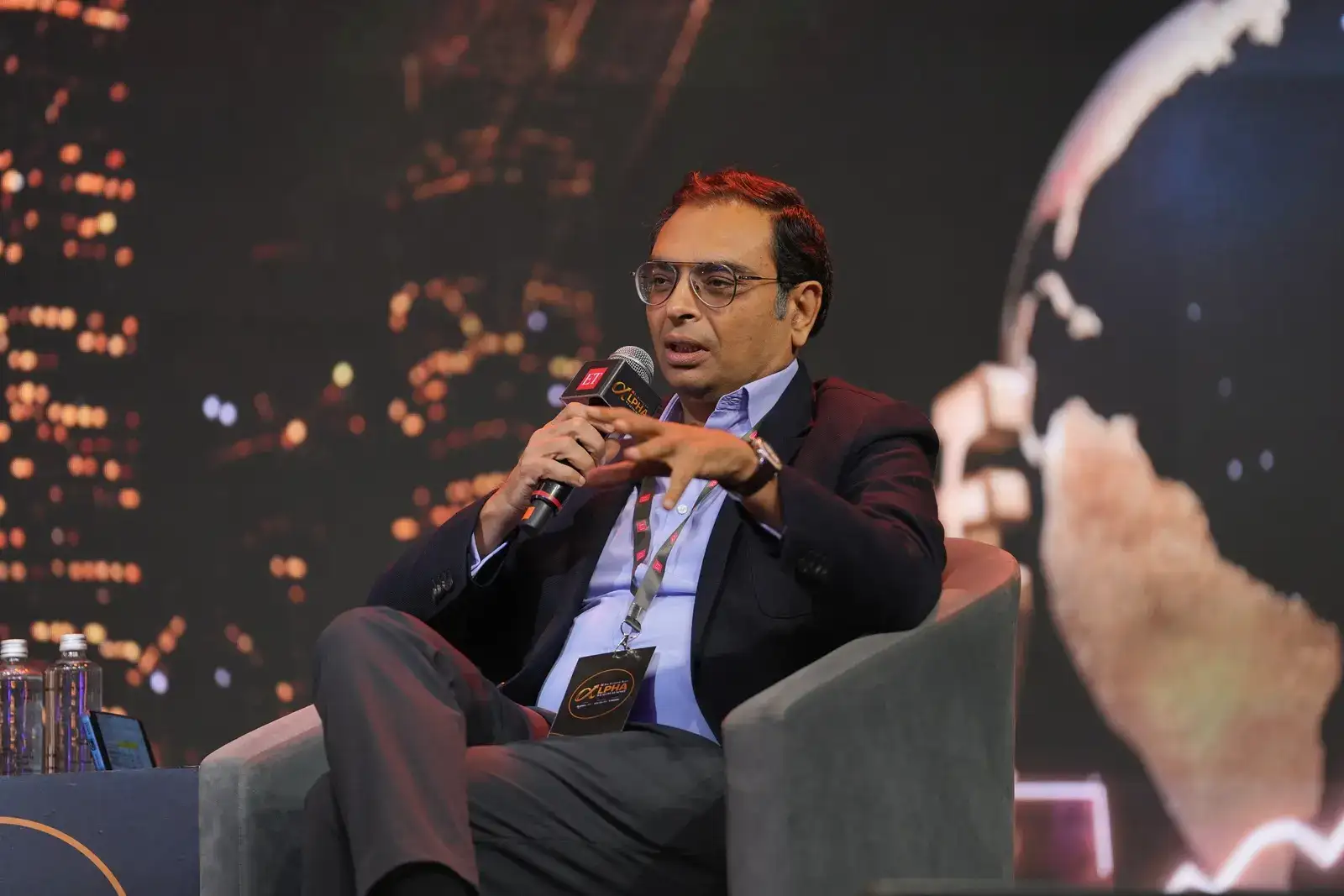
India does not lack an AI story, investors are just not looking hard enough. That was the blunt message from Hiren Ved, Director and CIO of Alchemy Capital Management, speaking at the ET Alpha Wealth Summit in Mumbai.
While the broader panel including Vikas Khemani, Founder & Chief Investment Officer, Carnelian Asset Management & Advisors, Saurabh Mukherjea, Founder & Chief Investment Officer, Marcellus, and Kailash Kulkarni, CEO, HSBC Mutual Fund, India, debated whether the next decade is India's 'Amritkaal' or 'AI-Kaal', Ved reframed the question entirely, calling it 'Opportunity Kaal'.
India's AI index vs Mag-7: the numbers that surprised everyone
Ved arrived at the summit with data that challenged a dominant market narrative — that India has no meaningful AI play and that foreign institutional investors are right to stay away. He constructed a proprietary India AI index of roughly 12 reasonably large mid-to-large cap stocks and compared it against an equal-weighted basket of the Magnificent 7 plus Nvidia.
India AI index: 1 yr (USD)
45%
Mag-7 + Nvidia: 1 yr (USD)
19%
India AI index: 3 yr CAGR (USD)
52%
Mag-7 + Nvidia: 3 yr CAGR (USD)
24%
The outperformance held across every time frame, one year, two years, and three years, all measured in dollar terms, after accounting for currency depreciation. "If you think hard, if you think creatively, there are ways to make money," Ved said, dismissing the headline-driven view that India is being left behind in the AI race.
"Capital is very smart. Capital will go where the returns are the best. And everybody gets their time," said Ved.
The AI adopters vs the laggards; a widening gap
Ved's more urgent warning was for stock-pickers: the divide between companies that actively use AI and those that ignore it will become decisive within three to five years, even if it is not visible in year one. He cited Bajaj Finance as a live example, noting the NBFC has already deployed AI across six to seven core processes, improving cost-to-income ratios, revenue potential, and credit risk management simultaneously.
For investors, this means a new due-diligence question must enter every portfolio review: what is this company actually doing with AI? Those that leverage it well will compound their competitive advantage; those that do not will, in his words, "fall by the wayside."
Disruption as a driver, not a disaster
Beyond markets, Ved offered a philosophical lens on disruption itself, arguing that both incentives and shame are equally powerful motivators for reform. The gradual disappearance of conventional office career ladders, he suggested, will push more Indians toward entrepreneurship and sharper thinking about what skills actually matter in the decade ahead.
His bottom line: stop lamenting what India lacks and start identifying where it quietly leads. "I become very happy when there are disruptions," he said, "because there is an impulse to change."