Federal health officials helping to contain an HIV outbreak in Indiana issued an alert to health departments across the US on Friday, urging them to take steps to identify and track HIV and hepatitis C cases in an effort to prevent similar outbreaks elsewhere.
Indiana health officials said on Friday that the number of positive HIV tests has jumped to 142 in 2015 in Scott County. That number includes 136 confirmed cases and six preliminary positives.
The county saw just three new HIV cases between 2009 and 2013.
Indiana governor Mike Pence last month declared a public health emergency in Scott County because of the HIV outbreak that began in December and is primarily centered in Austin, a city of 4,300 people.
Dr Joan Duwve, chief medical consultant for the Indiana department of health, said four out of five people infected in the outbreak have acknowledged using injectable drugs, mostly the painkiller Opana.
The Centers for Disease Control and Prevention recorded a 150% increase in acute hepatitis C cases from 2010 to 2013, said Dr Jonathan Mermin, director of the National Center for HIV/Aids, Viral Hepatitis, STD and TB Prevention. Health officials say high rates of hepatitis C are a key indicator of needle-sharing and a potential HIV outbreak.
Beth Myerson, co-director of the Rural Center for Aids/STD Prevention at Indiana University, has been working with state officials and medical workers to respond to the outbreak.
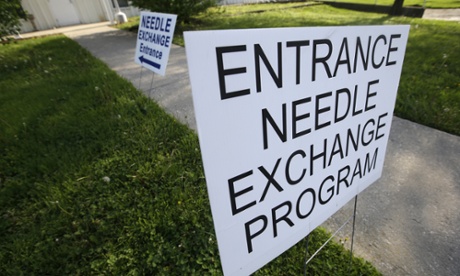
She said that while the needle exchange program is important, it is being used by the state’s top lawmakers to distract from the region’s inadequate public health system.
“The legislature has said nothing about increasing investment in public health,” said Myerson. “That to me is the biggest shame – it is almost Malthusian, frankly.”
Myerson said that there has been a tremendous public health effort in the past 30 days since the temporary needle exchange program was enacted, but it is unclear how it will be sustained once the outbreak is contained.
And though there are no signs yet of the outbreak abating, people like Myerson are thinking about phase two of the public health response.
She said a key to building a public health system in southern Indiana, which did not have one before, is for the community to also think differently about medical care and how they talk about substance abuse issues. The people abusing Opana and getting infected with HIV are almost entirely cloistered from the rest of the community, which, Myerson noted, is common for users in communities across the US.
“It sounds kumbaya, but it’s serious,” Myerson said. “They can’t be separate communities and live, and live well.”