Somebody put something in someone’s chai last week, because Indian Summers has ramped up its game, and the good news is it’s still there. This week, allegiances were broken and rearranged like musical sedan chairs, a grief-stricken Ralph went off the rails, and a hero emerged. Saddle up!
The opening is upsetting: Jaya’s drowned, tortured corpse floating past, in the stolen wedding sari. Ralph, called to identify the body, keeps up his smooth facade with the police, denying he knows her. Alone, his sorrow breaks through, tears dropping on her cold cheek. Jaya had an effect on him that no one else did, and it holds true in death – after this, Ralph isn’t quite Ralph.
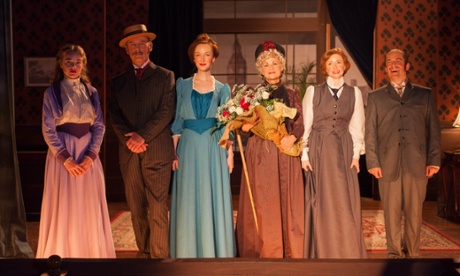
The spine of the episode comes with the Royal Club’s production of The Importance of Being Earnest, a laughably ironic choice by the manipulative Cynthia. Coffin’s adding her own jokes, which are about as funny as measles. We’re also treated to acting more wooden than the mahogany furniture, particularly from the Viceroy himself, who forces everyone to rearrange rehearsals around his moustache.
Away from that game of silly buggers, the temperature is rising. Gandhi has started his hunger strike, determined to unite India in protest at British rule. Ralph realises that opening a comedy of manners in this context is as appropriate as waving a foam thumb at a state funeral. He storms into rehearsals, telling Coffin and Viceroy they must engage with what is happening or lose the support of the Untouchables. “It’s their affair. We will keep our heads down,” insists the Viceroy, who clearly picked up his governing style from a Keep Calm and Carry On mug.
(Coffin & Viceroy sounds like a terrifyingly old-school firm of solicitors. You wouldn’t like them as people, but no one handles probate better.)
I haven’t really been paying too much attention to Ian’s storyline, as his Scottish fish-out-of-water thing didn’t seem to be going anywhere. His floundering is deceptive: he’s the Fife red herring, cooked over a slow burn. Let’s start paying attention, because he had a hell of a week.
He wakes up next to some woman – I honestly don’t know who she is, what a player – and later unwittingly incriminates Ramu Sood in Jaya’s death, by informing police she stole his wife’s sari. (I might be being dense, but I hadn’t realized Jaya and the plantation woman were one and the same. I remember her as someone who lived by a lake and talked to stones, rather than as someone who could secure fixed employment. There’s obviously much more to learn about her, too.)
Cynthia, delighted with what she takes to be Ian’s betrayal of her enemy Sood, welcomes him back to the club; she even puts him in her play, in a pretty dark casting couch move. As they say, it’s not what you know, it’s who you have accused of murder. Ian is flattered to be finally be in the gang, but also knows the hot-tempered Sood to be innocent. Will he take the high or the low road?
Sood, arrested as the prima facie prime suspect, confesses. Why? I suspect Cynthia is behind this. Jaya’s murder frames Ramu and eliminates Ralph’s weak spot – and is also her idea of bloody good fun, I’d imagine. She plays her riskiest gambit yet, as Ralph bemoans the fact that she hated Jaya. “You think I killed her?” Cynthia asks out of nowhere, like a magician pulling a dead rabbit out of a top hat. “Thank god! It means you didn’t. I was so worried,” she coos, shifting attention on to Ralph’s own murky culpability. She hugs him close, bringing to mind the image of porcupines making love, never really able to get close.
But hold up – bad ol’ Cynthia has competition. Aafrin is confronted by the previously taciturn Sargeant Singh, who shows him the incriminating certificate found in his house. Threatening his father, never breaking his smile, Singh has his mind on blackmail. Has he kept this from Ralph? What’s his game? I wonder how many villains this show can handle. With Ralph showing signs of being on the moral mend, maybe they’re operating a one-in-one-out policy, like a nightclub after 11.30pm.
Backed into a corner, Aafrin reacts rashly, dragging Alice under another bit of hedge – they’re always proximate to shrubbery, this pair – and accuses her of betrayal, by not delivering his instructions to destroy the certificate. What about Sita, she points out. “The woman I love and intend to marry? I trust her with my life,” he responds. He’s twisting the knife, and twists it again later by snogging Sita in full view of Alice. What was it Oscar said? The coward does it with a kiss, the brave man with a sword?
Wilde’s apropos genius is also pressed into service at opening night. “The good ended happily, and the bad unhappily. That is what fiction means,” recites Sarah, a warning to any hopeful viewers. Ian’s decided to sod the play, and instead goes to see Ramu in his cell, shockingly beaten, blood plastered over his swollen brows. “This is what a confession looks like,” he tell Ian. Sood enlightens Ian about colonial deceit, racism and police brutality. “I knew I would be punished for standing up to them as an equal. Play your part, it’s the only way to survive.” It’s a sobering scene, and exactly what Indian Summers should be, showing the bloody reality behind the lemonade and parasol fantasy of British rule.
Ian decides his part is to bring down the corrupt Royal Shimla Club and its rotten inhabitants. He confronts Ralph with the injustice of Sood’s murder charge, in the foyer of the theatre. Ralph warns him off, telling him that if he pursues the matter, he will be alone, cut off. “I always was. I was never one of you,” snarls Ian, a combination of Atticus Finch and Rob Roy. Ian is brilliant, now he has come into himself. The series has picked up pace and taken an unexpected direction, as it rounds the final bend. It seems the fate of Ramu Sood will be the battle for all their souls.
Mo’ moustache, mo’ problems
There’s a titanic clash of facial hair in The Importance of Being Earnest, initially between Eugene and the Viceroy. They’re both blown away by Ian, giving a performance as Jack Worthing in muttonchops and a penciled-in tache that makes him look like Wolverine crossed with a 1920s spiv.
You can only make that joke if you’re from there
“I should go home,” Ian angsts, to the nameless woman mysteriously in bed with him. “Because you’re less likely to drink yourself to death in Scotland?” she returns.
Worst inconspicuous funeral snooping
Ralph wants to distance himself from the Jaya affair, but cannot avoid the cremation of the woman he loved. So he watches from quite close by, wearing his nattiest blue suit, sitting on top of a horse. How did eagle-eyed Alice spot him?
Most incisive careers adviser
Cynthia sarcastically tutors newly idealistic Ralph. “You seem so determined to end your career. Why not find the Viceroy and punch him square in the face? No point dragging it out.”
Don’t make this joke if your boyfriend doesn’t love you
“Ralph would make a good Romeo. He’d certainly fill out a pair of tights,” winks Madeleine, in front of everyone at the club. “SO DULL” harrumphs Ralph, leaving to have dinner alone, and maybe file for sexual harassment against his own fiancee.