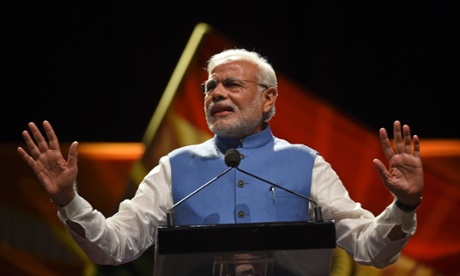
Good night
Well, that was a content rich day. But I think it’s time for me to stop talking.
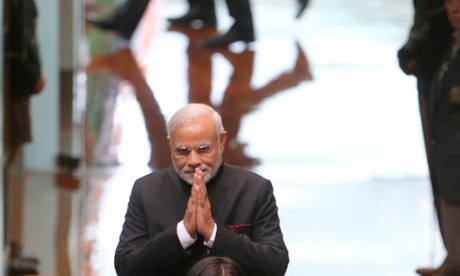
Let’s part ways with a summary.
- The last couple of mornings have been unfortunate for the prime minister. Today, there was a crook Newspoll. On Monday, it was Alan Jones, hectoring about the perils of free trade with China, and lecturing about the great wind farm hoax and the con that is global warming.
- Fortunately, things pick up around mid morning. On Monday, there was a free trade deal with the Chinese. Today, there was progress towards and economic cooperation agreement with India, and a defence agreement.
- In addition to warm words and a timetable – a free trade deal in 12 months – prime minister Modi sprinkled his people power magic in Canberra.
- The PUPs continued their general mulishness. During a debate about defence pay in the senate, it wasn’t clear whether Glenn Lazarus was digging in behind an increasingly recalcitrant Jacqui Lambie – or rebuking her.
- Labor continued to mull its options on the China FTA. It sought particulars on whether or not there would be labour market testing in the deal, and inquired why the deal had an ISDS clause when there’s a growing consensus in trade circles that these mechanisms are problematic. These were questions without specific answers.
- The agriculture minister Barnaby Joyce liked the China FTA, but he wasn’t quite sure whether or not it passed the pub test. It depended on whether it was the 7pm, 8pm, or 9pm pub test. It probably passed the pub test at 7pm .. provided it delivered something.
- Late in the day, the immigration minister Scott Morrison thought he’d not only set the terms for unauthorised boat arrivals, he’d dictate terms of resettlement for folks in Indonesia.
That’s pretty much it. Have a lovely evening.
Thus ends the meta cycle. We are #deskcisive on that front.
@murpharoo @lenoretaylor @SimonThomsen @marcuskelson #deskcisivemoment pic.twitter.com/1VRNpFC9WJ
— Mike Bowers (@mpbowers) November 18, 2014
Terribly convenient – these press conferences outside the Guardian Australia office. We get them periodically. It means Mike Bowers can shoot and file live without standing up.
An office right by the press gallery 'boxes' means @mpbowers needn't leave his desk pic.twitter.com/LBGGeUwxXQ
— Lenore Taylor (@lenoretaylor) November 18, 2014
After a day sprinting after world leaders, this is called winning at life.
The Greens leader Christine Milne is currently outside my door, reacting to this Morrison announcement.
Once again, Australia has failed the global citizenship test. These are people who have been found to be refugees.
Milne says the Abbott government has lobbed this announcement once world leaders have departed the country. She says – where are the Afghan Hazaras and the Iraqi Christians supposed to go?
We decide who comes to Indonesia, and the circumstances in which they come. The old Howardism is becoming more and more ambitious.
Border crackdown: again
A statement has just lobbed from the immigration minister, Scott Morrison. If you registered with the UNHCR in Indonesia on or after 1 July 2014 – you will no longer be eligible for resettlement in Australia. The Morrison statement says the change is part of the government’s ongoing work in the region to strip people smugglers of a product to sell to vulnerable men, women and children.
Morrison:
While nine of ten months of 2014 have passed without a successful people smuggling venture to Australia, we know smugglers continue to encourage asylum seekers to travel illegally to Indonesia for the purpose of seeking resettlement in Australia. These changes should reduce the movement of asylum seekers to Indonesia and encourage them to seek resettlement in or from countries of first asylum.
This seems somewhat presumptuous, to in effect impose arrangements applying in countries other than Australia. Morrison says the Indonesian government has been briefed.
There was Lazarus, speaking just before.
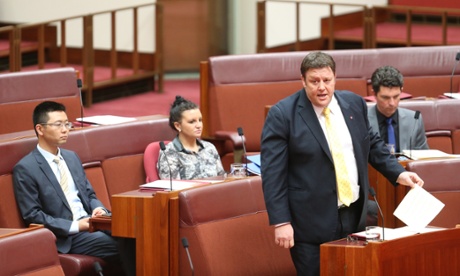
At the close of the debate, Jacqui Lambie sought a 30 second statement. She said she would have liked to speak during the debate, but she’d been denied leave to make a contribution.
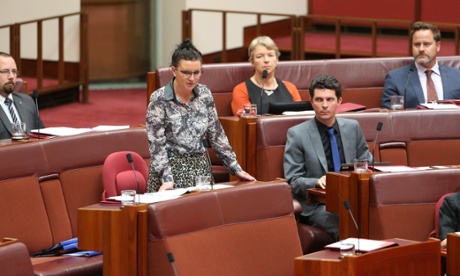
Liberal senator Ian Macdonald says he likes to be the voice of reason in debates. He’s surprised by Senator Back’s breaking news of the politician’s pay freeze.
I hadn’t focussed on it. I hadn’t realised it.
Macdonald says he is concerned about the pay offer, but the good folks of the defence force have to defend the country from Labor’s profligacy. Meaning the ADF folks have to defend the coffers as well as the country. By not getting a generous pay rise.
Now who says there’s trouble in the PUP kennel? The brick with ties, Senator Glenn Lazarus, is rising now to speak to this defence pay motion.
He’s lending Jacqui a hand. Possibly. Lazarus repeats a Lambieism in the debate – why do we give all this aid money to Indonesia when we could be giving some money to our diggers. Indonesia has a perfectly good army. (Let’s not get bogged down in facts here, like we don’t give aid money to fund armies in other countries. It’s not helpful.)
Lazarus:
I think the Abbott government has taken advantage of the ADF becuase it doesn’t have a union or an association to speak for them.
The Palmer United Party is determined to see this insulting pay deal reversed.
It isn’t actually clear whether Lazarus is helping Jacqui or lecturing Jacqui. He says together as a team, the PUP is determined to force a rethink on the pay deal. Lazarus warns this issue could bring down the government. It’s unclear whether this contribution is tacit endorsement of Lambie’s tactic of voting against government legislation, or whether it’s just a general political observation.
Senator Back in the senate’s defence pay debate says he’s been getting emails, from soldiers, presumably, complaining that politicians get generous pay increases despite all the alleged belt tightening. In June 2013, the Remuneration Tribunal increased the base salary of Australian parliamentarians by 2.4% to $195,000.
But Back insists hard times have come for honest politicians.
Our salaries were frozen on the 1st of July.
We have had our salaries frozen.
I have some free advice for Senator Back, which he should feel free to take or leave.
Let it go.
The prime minister will be doing yoga next. You heard it here first.
@narendramodi it was real honour to host your visit. I Iook forward to seeing you at the @MCG tonight!
— Tony Abbott (@TonyAbbottMHR) November 18, 2014
As I mentioned before – very glad our visitors have left the building, even if Narendra Modi is keeping up his diplomatic end in the Twitterverse.
Liberal senator Chris Back, in the defence pay debate in the senate.
I will allow the Labor party to burn slowly over the next few minutes.
The fact that both PM @TonyAbbottMHR & I had reciprocal visits in the same year indicates our commitment to strengthen India-Australia ties.
— Narendra Modi (@narendramodi) November 18, 2014
That serial liar, Mr Abbott ..
That’s Labor’s Stephen Conroy, speaking in a motion in the senate about defence pay. For a moment I thought he was going to get away with this unseemly flourish of unparliamentary language – but no, the senate president is awake.
Conroy withdraws.
Oh dear. The G20 isn’t very popular in Essential land. 62% were more likely to agree that “the G20 is an expensive talk fest, it’s unlikely to change anything.”
Harsh.
Tuesday is poll day. We began with Newspoll. Now we have Essential.
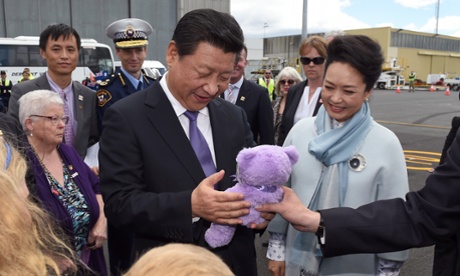
Helpfully, Essential has dived head first into the China FTA. (I refuse to call this thing CHAFTA, and if anyone else does, that purple bear is coming back. You have been warned. Maybe you like the bear. I have an irrational fear of purple bears. Anyway, enough about the bear.)
Here are the findings: we approve although that’s soft; we suspect China will benefit more than Australia; we think the deal benefits government, miners and business most; not much to see for workers – and the rest .. without further ado ..
- 44% approve of Australia signing a free trade agreement with China and 18% disapprove. 39% could not give an opinion.
- Those most likely to approve were Liberal/National voters (58%), aged 55+ (58%) and men (54%). Those most likely to disapprove were Greens (27%) and other voters (35%).
- 35% think that China would benefit most from a free trade agreement, 24% think both countries would benefit equally and 12% think Australia would benefit most.
- Those most likely to think China would benefit most were Greens (53%) and other voters (54%) and aged 55% (43%),
- Respondents thought those most likely to benefit from a free trade agreement with China were the Australian government (52%), mining companies (48%) and Australian business overall (44%).
- Only 25% thought that there would be a lot or some benefit for working people. 47% though there would be little or no benefit for working people.
- A majority (61%) support a free trade agreement that gives greater access to Chinese markets for Australian businesses and respondents were also more likely to support reduced tariffs on imported manufactured goods from China (43%).
- A majority oppose fewer restrictions on Chinese workers coming to Australia (57%) and fewer restrictions on Chinese investment in Australia (52%).
- There were few significant differences between Labor and Liberal/National voters – except that 51% of Liberal/National voters supported reduced tariffs on imported manufactured goods from China.
President Xi & PM Abbott chat on live #Antarctic sat. link with Davis & Zhongshan expedition era pic.twitter.com/Q31t486i17
— Andrew Darby (@looksouth) November 18, 2014
President Xi and the prime minister are currently in Hobart. I beleive there’s an event intending to hook the two leaders up with respective scientific teams in Antarctica.
Question time is now over.
Want to know what Kevin Rudd thinks of the China FTA? Here you go.
You know something ..
Sorta PUP senator Jacqui Lambie has the ‘why aren’t you paying our diggers more’ question. (Surprised? No? Me neither.)
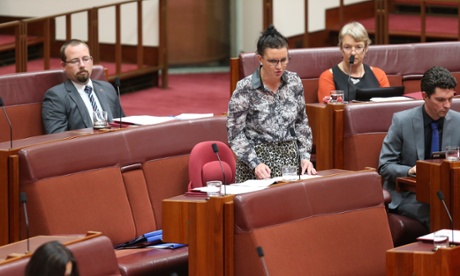
This inquiry is to the attorney-general George Brandis, because the defence minister David Johnston is on G20 duty. Or perhaps he’s on Hollande duty. It’s hard to keep up.
Brandis is resolved to be friendly.
Thank you senator Lambie.
He explains calmly that this is all Labor’s fault. The government can’t afford to pay the diggers because Labor spent all the money.
Lambie is not resolved to be friendly. It’s a disgusting deal, from the Liberal government.
Brandis:
Senator Lambie, I’m sorry, but I can’t accept the premise of your question.
(Surprised? No? Me neither.)
Updated
Ok, the minister for veterans affairs Michael Ronaldson has now joined many others in calling the new free trade CHAFTA.
This terminology sounds completely unbearable.
I return fire with this purple bear.
Mitch Fifield, the minister representing the communications minister Malcolm Turnbull in the red room, is asked why the government said very clearly before the election there would be no cuts to the ABC and SBS – and now there will be a cut to the ABC of around 9% of its budget. Fifield says it was never the government’s intention that the ABC and SBS wouldn’t make a contribution to fiscal repair. (Which begs the obvious question, why tell voters there would be no cuts?)
Do I look like Colonel Klink to you?
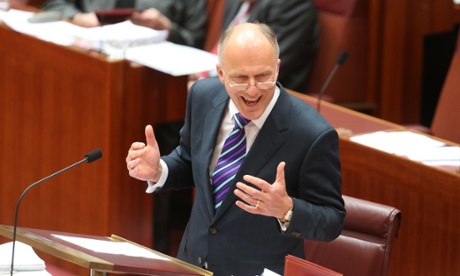
Huh?
So pleased the visitors have left. Downstairs in the red place, Labor’s Sam Dastyari has referred to Abetz as Colonel Klink. The attorney-general George Brandis has, meanwhile, branded the Greens dogs in the manger. Greens just hate prosperity, Brandis says, and hate commerce. Brandis is throwing around generalities in somewhat dangerous fashion. He suggests that ISDS clauses are part of all respectable trade agreements. That’s not quite reflective of contemporary thinking (which is my polite way of saying the impression being created there ain’t so accurate.) But go with the feels, George. Most everyone else does.
I know I’ve been drawing heavily on The Economist today (one of my favourite publications). One more reference. It’s just occurred to me that today at least, I haven’t really explained what an ISDS clause is. This is a neat backgrounder from the magazine on the clauses and why they are increasingly controversial in trade deals. Put simply – an ISDS clause gives overseas investors a mechanism to sue governments if the company’s business interests are adversely affected by national policy. One example: the Asian arm of the tobacco multinational Philip Morris is challenging the Australian government over plain packaging laws – even though Philip Morris lost a case in the Australian courts.
Penny Wong opens the batting for Labor. She’s seeking details on the labour mobility provisions of the China FTA: is there market testing?
The question is to the government senate leader, Eric Abetz.
Abetz says he can confirm that any overseas worker will need to be paid Australian market salary rates. (Which wasn’t the question. The question was about labour market testing, not about conditions of employment.) He adds that existing conditions in existing migration frameworks remain. Abetz says Wong is running a scare campaign. Wong persists. Will there be labour market testing? Abetz retaliates by quoting Simon Crean. Wong retaliates by asking Abetz to answer the question she asked. Abetz says employers will have to demonstrate need.
Wong then asks a supplementary question on the investor state dispute clause. Will it create liabilities via the renewable energy target or the carbon farming initiative? Abetz retaliates by calling Wong
.. immature and very unAustralian.
Abetz says Labor used to negotiate FTAs with ISDS clauses in them. So grow up.
Question time
Hear ye, hear ye.
It being 2pm – and the senate sitting – here cometh the question time.
Shadow trade minister Penny Wong couldn’t give a toss about the pub test. She’s on Sky News now. Wong says she’s concerned the Abbott government has done it again: set an arbitrary timetable for wrapping up a free trade deal with India – twelve months hence – rather than just progressing negotiations in a natural way. She says arbitrary timetables don’t always deliver the best results. Wong is repeating Labor’s two areas of concern on the China FTA – labour market testing and the ISDS clause. She says a Labor government would not have granted China an ISDS clause.
Back to Barnaby for a moment. Just listening through his press conference from just before.
Q: Does the China FTA pass the pub test?
Joyce:
It will go down differently between 5 o’clock, 7 o’clock and 9 o’clock.
But let’s try the 7 o’clock pub test where basically people will say “I will believe it when I see it”.
(We didn’t get to the later pub tests. Probably best we didn’t.)
My joint press statement from Tony Abbott and prime minister Modi – distributed by the prime minister’s office – got lost in the mail.
It’s a great shame that this happens every now and again, stuff getting lost in the mail, because it’s hard to report things accurately if you don’t have facts. Anyhow – I’ve mentioned before that I’ve been in search of some basic particulars regarding the defence MOU Modi clearly briefed the Indian media about before today’s set piece events. This is the relevant material from the joint statement. It’s basically what Team Modi told The Hindu.
Prime minister Modi and prime minister Abbott decided to extend defence cooperation to cover research, development and industry engagement. They agreed to hold regular meetings at the level of the defence minister, conduct regular maritime exercises and convene regular Navy to Navy, Air Force to Air Force and Army to Army staff talks.
Agriculture minister: 'I watch polls. I'm not stupid.'
Agriculture minister Barnaby Joyce thinks there’s more good than bad in the China FTA. Way more good than bad. He’s addressing reporters now.
Joyce:
The sugar industry, I suppose, is one area where there is a form of disappointment, I acknowledge that, and we will continue to work hard to make sure we get a better outcome for the sugar producers – but we can’t let the whole deal fall over because we haven’t got a perfect deal.
Q: Labor has a 10-point lead. What is it you are doing wrong? Is the message not getting through?
A lot of people say I don’t watch polls, of course I do, I’m not a fool. I watch polls but I keep working diligently to try and show the Australian people we are turning things around. I’m not for one moment saying I disregard polls, I don’t, I take it as a cue to work harder.
Politics this lunchtime
Let’s take stock.
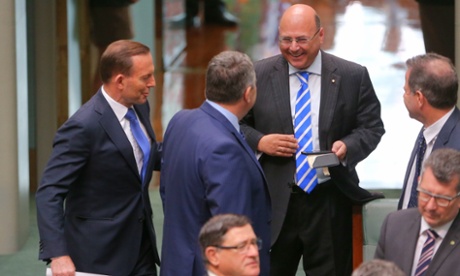
It’s been a relatively straightforward morning.
- Tony Abbott woke up to a bad Newspoll – a ‘Labor ahead by ten points’ Newspoll.
- On the plus side, the free trade framework unveiled with China on Monday was given the thumbs up by most everybody (apart from Labor, which gave a partial thumbs up in lieu of concrete details on people movement and temporary migration.)
- Indian prime minister Modi came, addressed the parliament, signed a bunch of MOUs, hit Twitter and Instagram, spoke about trade and about yoga – and said good on Australia for finally waking up that it was part of Asia rather than part of somewhere else it wasn’t actually a part of.
Onwards, and upwards blogans.
The senate is sitting now to clear a backlog of business. The current topic is education funding. I’ll post a summary shortly so we can take stock of the morning.
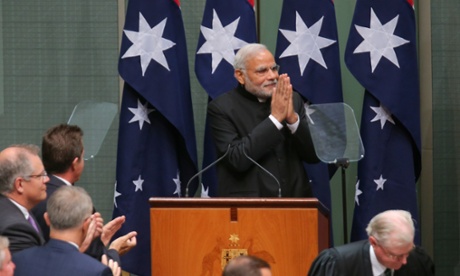
Man of the peeps. A gesture to vocal supporters in the gallery.
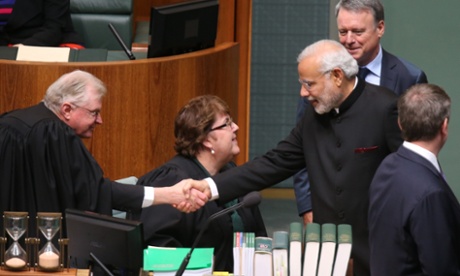
Modi also stopped to shake hands with the clerk of the House of Representatives. Not the usual practice during bursts of pomp and circumstance.
Meanwhile, snapping the kiddies.
PM Abbott & I turned photographers! #Australia #Canberra #IndiaAustralia #Friendship #Photography @… http://t.co/NVXJJ6gVCB
— Narendra Modi (@narendramodi) November 18, 2014
One curiosity of the day. The Indian delegation was obviously eyes on the new defence agreement with Australia – sufficiently eyes on to brief the deal to The Hindu in advance of the day’s festivities (I mentioned this in a post around 8.30am this morning.)
But this, from the press event from Modi, was the only explicit reference to that new MOU today.
I welcome the new framework of security cooperation. Security and defence are important and growing areas of the new India/Australia partnership for advancing regional peace and stability and combating terrorism and transnational crimes.
Some quick thoughts about evolving relationships
It’s been an interesting 48 hours. The Abbott government has set its framework for a free trade deal with China – a pact the prime minister was cool about during opposition.
In Battlelines in 2009, Abbott acknowledged China’s economic power in the region, but he said that development didn’t have to change anything for Australia. The communism was a problem for Abbott. “Although China has had to become less repressive to accommodate more economic freedom, the long term ability of what’s still a communist government to maintain legitimacy and to satisfy popular aspirations is far from clear.”
And if we roll back to October 2011, Abbott said he was happy to pursue a free trade pact with Japan, but he had concerns about China. Abbott favoured an FTA with Japan because Japan was “vastly more of a market economy” and, like Australia, a pluralist liberal democracy. China would be pursued of course, but this was a more problematic agreement because China was not like us. It was not a democracy. There were questions “to what extent China is a market economy”.
That was then, this is now.
But Abbott stubbing his toe against communism perhaps helps explain why he was so quick to jump on president Xi’s very passing reference to democracy in his speech to parliament on Monday.
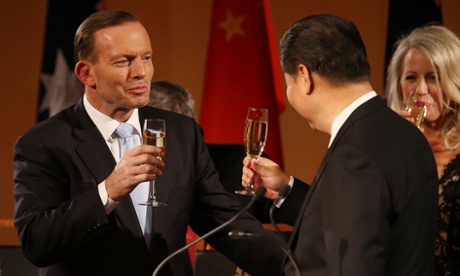
Abbott either didn’t grasp, or didn’t choose to grasp, that “democracy” for China is not western multi-party democracy – but it’s own thing. If it was a projection rather than a stumble (and one of the experts we quoted this morning, Steve Tsang of Nottingham University, suspected it was a projection by the Australian prime minister), it was a revealing one. It would be interesting to know what the Chinese made of it.
Now, to India.
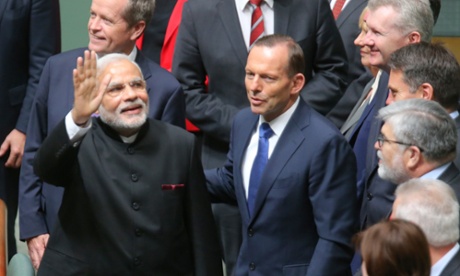
India has always been ok – an important member of the anglosphere, Abbott noted in Battlelines. He also contrasted India and China.
There’s no reason other countries of our region could not also advance economically at much the same pace as China, or even faster. Despite its caste system, India has some key advantages – democracy and the rule of law besides the English language.
So what does this all boil down to?
In the space of two days, Abbott gets to progress two relationships: tie down a trade deal that he used to be openly ambivalent about, and tie down Modi to his domestic agenda of reform and transformation.
Modi wants more market access and more Australian resources, Abbott wants Modi to be the prime minister who delivers, who can steer a deal through India’s complex and impenetrable bureaucracy.
Abbott wants to believe that China is, somehow, on the road to being less communist; and he wants, with Modi, to be the ‘can do’ chaps of the anglosphere.
Now we are through the various set pieces, I want to deal in the next post with Tony Abbott and his relationships with India and China. His evolving attitudes. Just a bit of analysis. Shortly.
Modi points to terrorism, a threat India deals with constantly. Combating terror, the Indian prime minister says, will require global security cooperation but even more, a policy of no distinction between terrorist groups of discrimination between nations.
He rounds out thus:
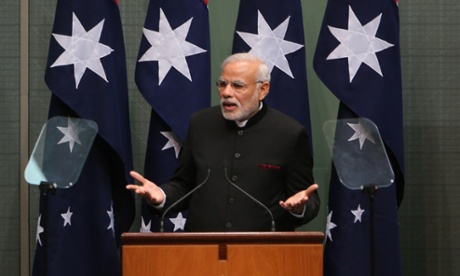
It has taken a prime minister of India 28 years to come to Australia. It should never have been so long. This will change.
Australia will not be on the outer of the region but at the centre of our talks. So we stand together at the moment with enormous opportunity and great responsibility. I see a great future of prosperity, a partnership between India and Australia and a shared commitment.
Updated
Modi moves on to security: practical security and economic security. He argues that closer ties between Canberra and Delhi are positive for regional security. (Again, you can see that big guy in the region hovering just out of sight, can’t you?)
Our region has seen huge progress on the foundation of peace and stability but we can not take this for granted. Preserving it will be the most important task in the region. India and Australia can play their part in it by expanding our security cooperation and depending on international partnerships in the region.
But we do not have to rely on borrowed architecture of the past, nor do we have the luxury to choose who we work with and who we do not, but what we do need is to work together and with others to create an environment and culture. That promotes the currency of coexistence and cooperation in which all nations, small and big, abide by international law and norms.
Even when they have bitter disputes, we should maintain maritime security, we should work together on the seas and collaborate in international forums and we should work for awe universal respect for international law and global norms.
We must also support the process of economic integration in the region. An open global trading system that remains integrated. We must guard against regional trading issues becoming instrument of political competition. however, economic integration by itself would not be a strong basis for peace and stability.
You get a sense from this address of the power of Modi’s change narrative. He’s got that appeal to hope down pat.
Modi is like Obama, before the exhaustion set in.
Modi:
Australia has immense opportunities participate in India’s progress. In turn, India will be the answer to your search for new economic opportunities, and your desires to diversify your global economic engagement. India’s development, demographic and demand provide a unique long term opportunity for Australia and all in the framework of democracy.
There is no other example of this nature in the world.
(That’s a smack at China. You can have a democratic factory to the world if you like Tony, or you can stick with China – what say you?)
Modi delivers a polite backhander among the compliments. He’s pleased to see Australia seeking a bigger role for itself in the region – more meaningful engagement.
There was a time when for many of us, Australia was a distant land on the southern edge of the world.
Today, the world sees Australia to be at the heart of the Asia Pacific and Indian ocean region.
It holds the key to this world’s future and Australia is at a cross roads.
Australia has become more engaged in this part of the world. We welcome it.
The Indian prime minister would also like more Australian uranium so the glaciers don’t melt. India needs nuclear power – a source of low carbon emissions electricity. And gas. And renewables.
Energy that does not cause our glaciers to melt.
Clean coal and gas, renewable energy, a fuel for nuclear power.
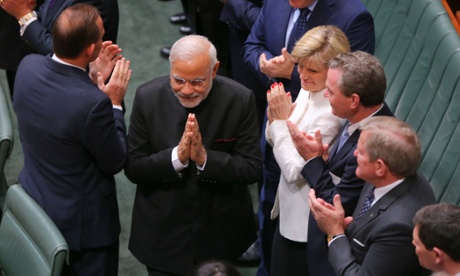
After the inevitable cricket anologies, Modi pays tribute the the nation he is visiting, and to the contribution played by the Indian diaspora.
Australia is ..
A beacon of democracy and rule of law. A nation that leads the search of lost aircraft, one of the most prosperous nations in the world. Among the best in human development index, a nation with some of the best cities in the world, some of the most wonderful minds and advanced technology base and a nation with great sporting skills.
Not just immense beauty, Australia, but also of a great quality of life. Today, its cities are alive with the richness of the world’s diversity and it is home to 450,000 Indians who are as proud to be part of Australia as they are of their Indian heritage.
Updated
A new take on the shirt front
Modi is now at the podium. He opens with a shirtfronting quip.
Modi notes that he’s now the third head of the government that Australian parliamentarians are listening to this week.
Modi:
I do not know how you are doing this. Maybe this is prime minister Abbott’s way of shirtfronting you.
(Maybe.)
Updated
Shorten wound out of cricket to Modi’s domestic agenda for economic and political transformation. He ended with a quote from Ben Chifley. India will show the way to peace.
Of course I’m listening very attentively but some pictures have to be shared just as soon as they hit the desk.
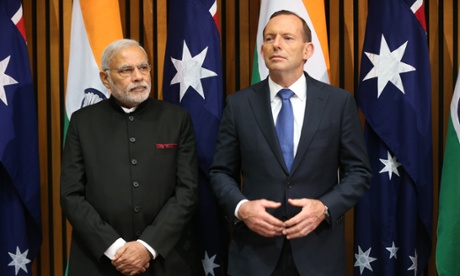
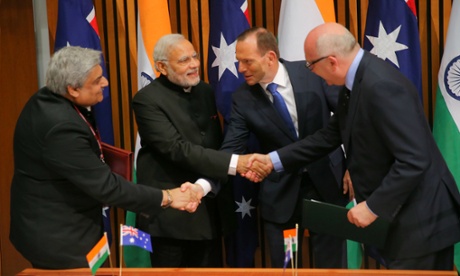
You understand that, right?
The Labor leader Bill Shorten is firmly in cricket territory with his welcome remarks.
One of the firmest and fastest bonds that Indians form with Australians comes from our love of cricket. Prime minister Modi, in Australia we sometimes say that being captain of our test team is the second toughest job in the country behind prime minister.
Some would say we should never compare cricket with politics. After all, one is the cause of great national debates, the intense passion, endless media commentary on controversial decisions and leadership speculation. And the other is just about deciding who governs Australia.
Abbott says comprehensive economic partnership with India by the end of 2015
The Australian prime minister drops a news point into his welcome. In noting how the economic relationship with India has been underdone in the past – he says the two countries have now turned the corner.
It’s shoulders to the wheel, apparently. There are two can do types in this chamber, Abbott says.
By the end of next year we will have a free trade deal with what is potentially the world’s largest market.
And I want to make this declaration here in this parliament, there are two can do prime ministers in this chamber today – and we will make it happen.
Abbott is back now in the Anglosphere – the shared history. India didn’t reject Britain. It reasoned with Britain.
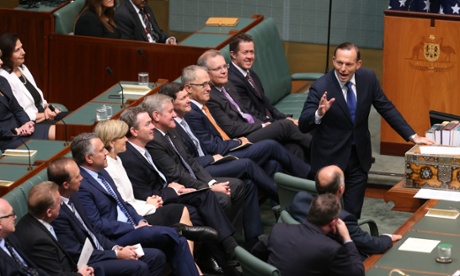
Abbott:
Australians admired the way India won independence, not by rejecting the values learned from Britain but by appealing to them. Not by fighting the colonisers but by working on their conscience.
Democracy again. (You got that – right?)
With China, India is the emerging super power of Asia. The emerging superpower that is already a democracy.
Abbott once again shares his backpacking memories from 1981.
Updated
Modi addresses the Australian parliament
Well, here comes the set piece. Prime minister Modi is getting a very warm welcome as he enters the House of Representatives chamber.
Tony Abbott opens proceedings.
It is long overdue for an Indian prime minister to address this parliament given that the leaders of the US, China, Indonesia, Britain, Canada, Japan and New Zealand have already done so. But I am personally delighted that this omission is at last corrected.
It is fitting that in the home of our democracy we should be addressed by the leader of the world’s largest democracy. Madam Speaker, there is so much that we can learn from a prime minister who must try to reach some 830 million voters.
(That one gets applause. I’m too dignified to reference Newspoll, but I think we know what those folks are thinking down there.)
Early submissions on yoga ministry: Clive Palmer and Peter Garrett.
Coming up in a sec, Modi’s address to the Australian parliament.
Minister for yoga – who would you appoint?
My former colleague and great friend Mark Skulley reminds me via Twitter that Modi recently appointed a minister for yoga. I confess I missed this development, but I salute it to the sun.
Thanks again to The Economist:
Until this week India had somehow got by without a minister for yoga, ayurveda and other traditional medicines. Now it can breathe easier. On November 11th Shripad Naik took charge of a new ministry to promote them. His boss, Narendra Modi, the prime minister, is a yoga enthusiast. He also wants local manufacturers, such as of homeopathic potions, to tap a global market for “alternative medicine” that is said to be worth some $100bn.
This is completely superb and opens the obvious question – who would you appoint Australia’s first minister for yoga?
Go.
Modi references the MOUs signed this morning and addresses security issues, before ending his remarks.
No questions.
Our prime minister could learn to love this.
Modi lobs a yoga reference.
Yoga. Yeeesss.
I know yoga is enormously popular here.
We need to connect our people more.
Prime minister Modi is addressing reporters in English. This is not his usual form. The Indian prime minister says he’s confident aspirations can turn into outcomes in India. He also indicates negotiations concerning a new economic partnership will be split – presumably making a pact easier to achieve.
Modi:
There are huge opportunities for a partnership in every area we can think of – agriculture, resources, energy, finance, infrastructure, education and science and technology.
The economic climate in India has changed. I believe it will be a lot easier to convert opportunities into concrete outcomes. Prime minister Abbott and I discussed what we should do to impart real momentum to our economic partnership. Reconstituting the forum is an important partnership.
We have agreed to split up negotiations under comprehensive economic partnership agreement. I also ask for easier access for Indian business to the Australian market and quicker investment approvals.
If I may say so ..
(you may, prime minister .. )
we’re not resting on our laurels.
Tony Abbott says now is the moment, the economic partnership, the moment, the .. verb.
We want to go further and that’s why the next priority for Australia is a comprehensive economic partnership agreement with India.
If I may say so, this is a moment in time. This is the time to get this done. This is the time to turn the warm friendship between Australia and India, the long history that Australia and India have together into something that will be meaningful, more meaningful for us and significant for the wider world. I think this Australian government has the runs on the board when it comes to free trade. I know prime minister Modi has the runs on the board when it comes to getting the officialdom of India to actually respond to government, to making the Indian bureaucracy work for the people and the nation of India.
This is our moment, Narendra, and I am determined to absolutely make the most of it.
Abbott and Modi address reporters
The two leaders have packed up their MOUs and have stopped by the podium for a chat with reporters. Tony Abbott is pleased with Indian democracy. India has democracy, so that helps I dare say. He also has breaking news: India has smart folks, not just cricketers.
India, as we know, is one of the world’s emerging super powers. India, I often say, is the emerging democratic super power of Asia.
We in Australia tend to associate India with cricket and with sport. That’s important. But we can never forget that India is an intellectual powerhouse, a potential economic powerhouse, IT, science, medicine, research – these are all great strengths of India’s and they can be great strengths for Australia as well if our relationship develops as it should.
Meanwhile, some open mouthed hugging. The best kind, I find.
I feel my friendship with @TonyAbbottMHR will further strengthen India-Australia ties in the years to come. pic.twitter.com/3NJAiBSqtg
— Narendra Modi (@narendramodi) November 17, 2014
Downstairs, we are beginning a sign-off. Tony Abbott and prime minister Modi are now singing a number of agreements with relevant portfolio ministers. There is clapping and gripping and grinning and flashing of flash bulbs. And throat clearing.
Gosh, things must be bad. Peter Costello is actually being nice to Tony Abbott.
The former treasurer makes something of a small specialisation of using a regular column in the News Corp tabloids to tell Abbott regularly enough that he’s the younger foolish brother to Costello’s elder statesman. But this morning he’s been charming about Abbott and treasurer Joe Hockey’s effort at the G20 at the weekend. He saves his disdain for Barack Obama. (Oh, that guy.)
Costello:
When Barack Obama strode on to the platform at the University of Queensland he placed the issue of climate change firmly on the summit agenda. He received the kind of rapturous applause that is given to an international celebrity, which he is. He is an accomplished performer and does oratory well. Since he has lost a majority in both Houses of the US Congress his chances of meaningful domestic legislation back home have diminished. He will use his two remaining years in office to focus on the international stage, where he carries much more influence and respect.
Went to get a quick coffee.
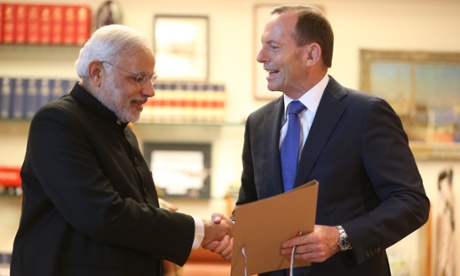
Missed the present. A present!
While I’m doing the rounds of the regional media, democracy doesn’t get a look in in the Xinhua report of president Xi’s address to the Australia parliament yesterday. (There are a lot of reports of the visit – perhaps it’s elsewhere and I haven’t found it yet.)
Xi pledged that China will continue to follow a win-win strategy of opening-up, both uphold justice and promote cooperation, develop an open economy and strengthen and expand all-round mutually beneficial cooperation with other countries.
On Sky News meanwhile, the trade minister Andrew Robb is being asked whether people are right when they say Australians can’t own assets in China (so what’s the point of trade with China because we never get anything.)
People like, say, I don’t know .. Alan Jones.
Robb:
This is wrong.
The Hindu tells us the two leaders will upgrade defence ties as part of the day’s announceables.
India and Australia will commit to an “enhanced strategic partnership” when Prime Minister Narendra Modi meets his Australian counterpart Tony Abbott in Canberra on Tuesday. Sources told The Hindu that the two sides will announce an “action plan” for cooperation in defence and other areas. This will include exercises between armies, navies and air forces, as well as counter-terrorism, maritime security, non-proliferation and cyber security.
Again, some useful background on our guest – this time from The Economist.
This piece departs from the usual ‘here comes the rockstar’ journalism that inevitably follows the Indian prime minister – it looks at the two insiders behind the Modi juggernaut.
Even the mightiest cannot rule alone, and Mr Modi relies on two old allies, both crucial. One, Amit Shah, engineers the electoral victories that give Mr Modi his authority. The other, Arun Jaitley, must take that authority and out of it craft policies and decisions that will launch the economic recovery which Mr Modi has promised and by which he will be judged.
These two men are Mr Modi’s enablers.
I suspect most politics tragics will enjoy this read.
If you need some background on Modi, do have a look at this profile by my colleague Ben Doherty.
Modi is a genuinely fascinating mix of populist and economic reformer. Ben’s piece tracks Modi from the controversies of the Godhra riots to last weekend’s G20 meeting.
Modi was ostracised for his actions, or inactions, during the Godhra riots, sectarian violence that roiled across his state for a month in 2002 in which 1,000 or more people, largely Muslim, died.
As a neophyte chief minister, he was accused of allowing the riots to rage, even of actively fomenting the violence of Hindu vigilantes. Modi has always denied the allegations and none have ever been proven against him.
That he did not, or could not, stop people dying in the brutal communal bloodbath that seized his state is self-evident. Whatever else he may have done is likely lost forever in the conflicting “truths” of the time. That month has coloured all opinion of him since.
Once the outcast, Modi arrived at the G20 on Friday as the political rock star of the summit. As the newly minted prime minister of the largest democracy the world has ever known, the 64-year-old is the man the other leaders are seeking out this week.
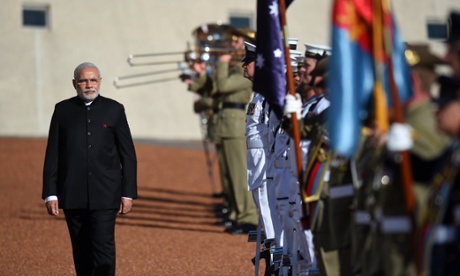
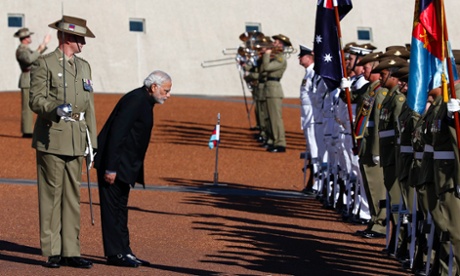
Lots of gripping and grinning down on the forecourt right now. There will be anthems. Ah yes, here they are. Let the music play. Tony Abbott and Narendra Modi are standing together in front of the trombones. And the soldiers.
For folks wanting to plan their blog watching when the boss isn’t watching – let me help with Modi facts.
- Shortly, there will be a ceremonial welcome at parliament house.
- Modi will meet Tony Abbott at around 8.30am, and there will be a media conference (of some sort) at 9.35am.
-
Prime minister Modi’s address to parliament is just after 10am.
On cue, the ACTU president Ged Kearney is on another ABC radio outlet talking about people movement and labour market testing.
Andrew Robb says the trade union movement has been scaremongering on this issue.
Radio National Breakfast host Fran Kelly asks Kearney is that true, is she scaremongering – talking about the risks of Chinese workers taking jobs that should rightly go to Australians?
Kearney:
I don’t see how it is. Are we actually inflating what is going to happen from this agreement?
The Chinese president incidently is on his way to Tasmania, continuing his Australian visit. The newspapers and morning radio current affairs are dominated by the China free trade deal. The interesting question now, apart from the concrete details about various in-principle agreements not yet supplied, is will this trade pact win bipartisan support? The China FTA has the potential to spark the biggest internal bunfight within Labor since the US free trade agreement in 2004. It may not, but it’s certainly possible.
The shadow trade minister Penny Wong has hit the ABC early. She says Labor in-principle supports trade liberalisation, but she notes key details concerning this pact are not yet in the public domain. Labor is concerned about two things: the people movement provisions in this deal, and the investor state dispute resolution mechanism. Wong was asked about the people movement provisions on the ABC. Wong says the government needs to clarify whether this proposed agreement will safeguard Australian jobs. She says the key to this is labour market testing. Wong says the trade minister Andrew Robb needs to clarify this provision. If there’s labour market testing, make that clear. It’s not clear in the framework text circulated yesterday.
Good morning everyone and welcome to Tuesday. Yesterday was China day. Today, Tuesday, it’s all about India. Parliament will host the Indian prime minister, Narendra Modi.
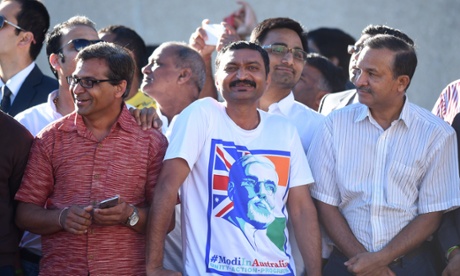
We are underway slightly early this morning because Modi is underway slightly early. He’s already stopped by the War Memorial, and he’s on his way into the building. Possibly he’s powered by the crowd – the Indian prime minister is getting a huge reception from the expat community.
Before we turn to India, let’s first deal with the wash-up of China. Readers with me yesterday know that the Abbott government secured a handshake on a free trade pact with China. The deal has been well recieved by business. The Chinese president Xi Jinping also gave an address to parliament in which he asserted China’s posture in the region: the big guy, but the peaceful, rule-of-law guy. The address by Xi was a bookend to the 2011 address to the Australian parliament by the US president Barack Obama – his famous “pivot” to the Asia-Pacific.
Xi made one reference to democracy in his speech in the context of explaining the official slogan, “the Chinese dream.” Xi has discussed democracy in the past, but he’s made it clear he doesn’t mean multi-party democracy, he means Chinese democracy, which means a one party state.
But Tony Abbott liked what he heard. The prime minister told a state dinner last night that Xi had made a commitment to full democracy in China by 2050 – an “historic statement which I hope will echo right around the world.” Given the working disposition of the Chinese leadership, China watchers were less than convinced about that. Steve Tsang, Nottingham University, said:
Mr Abbott has clearly got carried away in projecting his own understanding of democracy and rule of law to what he heard from President Xi. What President Xi referred to could be seen as ‘democracy with Chinese characteristics’ and ‘rule of law with Chinese characteristics’.
Perhaps Abbott has the correct interpretation. As is said in the classics, only time will tell. In any case, the prime minister has more to deal with than a possibly overly enthusiastic report on Xi’s commitment to multi-party participatory democracy, and his high-level hosting duties today.
There’s another bad Newspoll this morning.
Labor has a ten point lead on the Coalition and Bill Shorten is ahead as preferred prime minister. This poll was taken over the G20 weekend, which was supposed to be a triumph. World summits never are political triumphs of course, but it’s fair to say this one wasn’t great. You wouldn’t care about one bad poll, but the trend is bad for Abbott and for the Coalition. Sydney broadcaster Alan Jones told the prime minister on Monday he wasn’t passing the pub test. I suspect it’s been a while since Alan’s been in a pub, but we can say Abbott is not passing the poll test. Just as well these good folks aren’t inclined to panic.
The Politics Live comments thread is open for your business. I’ll do my best to call by for a visit. You can also chat to us on Twitter @murpharoo and @mpbowers
Updated