Indian ministers are considering whether to launch a frontal assault on one of the best-defended official privileges in the emerging economic power: the use of red lights on government cars.
Known locally as lal bhatti, the lights are theoretically restricted to the top ranks of the list of precedence and only then when officials are on business to help them accomplish their public service.
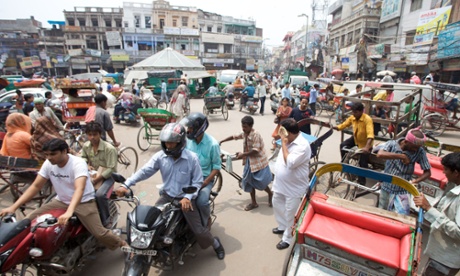
Yet as Indian cities become more and more congested, the lights are increasingly coveted as the only way to clear a path through the jammed cars, trucks, rickshaws, carts and cows.
Now the minister for roads, Nitin Gadkari, has suggested a drastic cut in the number of officials eligible for the lal bhatti. If his proposal is agreed by other ministers and by the prime minister, Narendra Modi, only a few dozen people will get the red lights on their cars, rather than the hundreds who currently have them.
“Only after the key ministers give their views, a formal proposal will be put before the government. It will take some time. But one thing is clear, that the number of such dignitaries would be limited,” the local Times of India newspaper quoted a government source as saying.
If approved, the measure will be a popular one. The sight of official cars forcing ordinary traffic aside enrages ordinary citizens in the capital, already resentful of the constant closure of main roads to ease what are known as “VIP movements”.
Arvind Kejriwal, the anti-corruption campaigner turned politician who is chief minister of Delhi, won power in the city after promising to fight the VIP culture in the Indian capital.
Kejriwal has since made a point of travelling in ordinary vehicles with a limited escort, and has told ministers in the state government to do the same.
Outward signs of status and rank remain greatly valued in India. Parliamentarians, judges and senior bureaucrats receive housing, drivers, cars, maids, gardeners, train tickets and many other perks paid for by the state. Many are exempt from security checks at airports and are unafraid to use their status to intimidate critics. They also receive a form of de facto legal immunity while in office. There are VIPs, VVIPs, and, inevitably, VVVIPs.
“Important people are expected to behave in important ways. That is part of the Indian psyche,” said Manu Joseph, a novelist and commentator.
Minute grades of difference are detailed in government regulations. Ministers get a red light “with a flasher”, while deputy ministers have to make do simply with a plain red light.
Delhi’s mayor was criticised recently for using a red light on her official car when only permitted a yellow one.
However, a growing middle class is less and less happy to accept the exercise of privilege, particularly by those they elect to office, and increasingly willing to challenge politicians.
“There’s been a sea change. People never thought deeply or questioned this before. Now they do,” Joseph said.
Two years ago, the country’s supreme court ordered officials to remove their lal bhatti.
“We think you can remove the red lights … straight away. One thing is there in the mind of people that they dislike the red light. Why not reconsider removing it? That will be a great signal for bringing everybody at par,” the bench of judges said in a judgment.
The court also said the lights were being misused by people as a status symbol and ordered that they should be used only by emergency services, which routinely face delays due to congestion.
Ministers in the previous government, led by the centre-left Congress party, defended the privilege following the court order.
“Our day is packed with public functions and meetings. Beacons and hooters help us move without difficulty through the traffic,” Harun Yusuf, the minister of power at the time, told the Times of India, a newspaper that has launched a campaign against the red lights.
Government officials have told local reporters that, if the new measure restricting the lights is passed, “there has to be strict enforcement and stringent penalty against violators”.
Explanations for India’s continuing obsession with rank and status vary. Some blame the tenacious social hierarchy of caste. Others suggest the influence of the British colonial rulers or even the Mughal rulers before them.