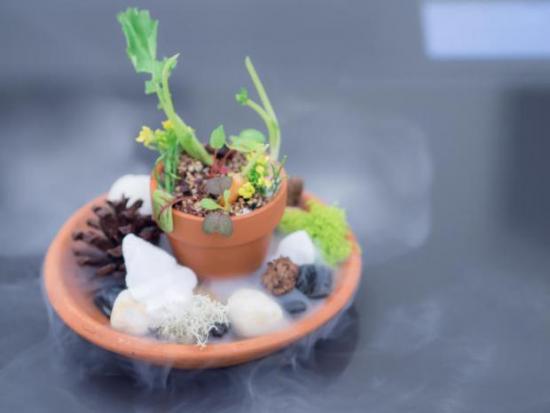
Chef Srijith Gopinathan, who runs the Michelin-starred eponymous restaurant at the Taj Campton Place Hotel in San Francisco, once described as "the best bet to take Indian cuisine to the next level internationally", is not a fan of the phrasing.
"There is nothing as the best bet," he says. "For the longest time, trained Indian chefs did not travel abroad, until 10-12 years ago. Most of it was led by the culinary boom in Spain and New World cuisines, which Indian chefs decided to check out. The Culinary Institute of America and some of the institutes in France saw an increase in the number of Indian chefs. Plus cheffing was not the most respected profession in India 15 years ago. Now it's a big celebratory profession. I was probably part of the earlier new trend when Indian chefs were in the spotlight. I wouldn't agree with that statement, because there are a lot more people who are taking Indian cuisine international."
But the haute question is: does Indian cuisine have a place in the fine dining world, an industry focused on French classicism, Japanese minimalism and emerging Nordic trends? "Fine dining is a very vast term," says chef Srijith. "To some, [it means] a beautiful-looking restaurant. The food should be fine and the balancing act of food is fine dining. Indian food can be put in a fine-dining way -- smaller portions, cleaner-looking, in a progression like six or seven courses. But the main question is: will people accept that? For the longest time, they did not; now they are. This is because people are travelling, the cuisine is getting more exposure and acceptance. It's all about acceptance."
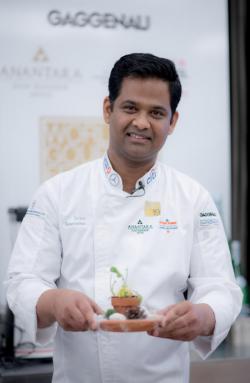
Chef Srijith Gopinathan, who runs an eponymous Michelin-starred restaurant, at the Taj Campton Place Hotel in San Francisco. Anantara Siam Bangkok
He is lauded for coining the term California-Indian cuisine (Cal-Indian), which he explains is a way of thinking. "When I joined Campton Place, it served Californian cuisine, and though I could make it happen, it wasn't the same as making it successful. I knew Western cooking because I was trained by European chefs, but I needed to put it together with what I liked to cook with. This was how the Cal-Indian concept was born."
His culinary philosophy is like that of anywhere in the world: cooking tasty food is the prime fundamental, using the freshest ingredients and being honest with the food. "Everything else is all frills that can give a little bit of light to the situation," as he puts it.
Though the South Indian native has also described his cuisine as "Indian but not too Indian", his first biggest exposure to the culinary world was in San Francisco. "If I made my food overly Indian, it would be hard for the cross section of society to dine at Campton Place. No one wants to come and eat a bowl of curry and rice in a fine-dining restaurant. You can get there anywhere. We wanted to show a bit of creativity in the Indian food scene. So if we made it overly Indian or what my mother made in the kitchen, it made no sense."
It is always difficult having to explain to people that the term "Indian cuisine" doesn't really exist, says chef Srijith. "What exists is the phrase 'cuisines of India'. There are so many of them. It is a very difficult task to explain Indian cuisine. The first bunch of people to get out of India and take their cuisine with them were the Punjabis. Because of that, Indian cuisine outside of India became dal makhani and butter chicken. Later on, when people started travelling and some of the wealthier ones started setting up restaurants for themselves, that is how Indian cuisines evolved abroad."
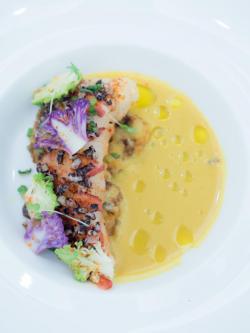
Butter poached lobster.Coastal coconut curry, tamarind, cauliflower variations and summer herbs. Anantara Siam Bangkok
This is perhaps why East Indian cuisine hasn't really been spread in India or abroad, he says -- "because they haven't really started travelling. Even in America, people are accepting regional cuisine only recently, and there are restaurants specialising in South Indian cuisine -- Chettinad or Keralite cuisines". To focus on one Indian cuisine is too hard, chef Srijith emphasises. "I have to give respect to the overall scene, not one region. Maybe at some point I will do a Kerala-concentrated or Tamil-concentrated cuisine restaurant. But that will be more casual, rather than fine dining, something which I will eat at home on a regular basis."
Chef Srijith entered the culinary world by accident, having never wanted to become a chef. The idea, he says, was to become a doctor or an engineer. "Somewhere something went wrong," he laughs. Initially he took it up as a job, and after less than a year in the industry realised it was something he enjoyed.
Campton Place was not always a Michelin-starred restaurant. It was awarded two Michelin stars, in 2016 and 2017, making Srijith the only Indian chef with two Michelin stars at the time. (Gaggan Anand's Gaggan earned two Michelin stars in the first edition of the Thailand Michelin Guide in 2018.)
However, Campton Place lost a star in 2018, and Srijith agrees: "There are particular reasons why we lost a star. No Michelin-starred-restaurant meals are cooked in a kitchen from which other outlets are being fed as well. It is very hard. Maintaining stars is all about consistency, and that is one thing which sometimes you end up unknowingly compromising on when you're cooking for five different outlets from one kitchen. The crew was also taken off focus because their focus is on many things. But we pulled it out and managed to keep a star, which we have kept for a few years. That isn't easy. Getting a star increases the pressure and the work. I wasn't striving for a Michelin star or stars -- I was just doing what I knew well and people liked it."
Does he plan to check out of the hotel and open his own restaurant in the near future? "It is not easy to jump into water and not know how to swim. I need to know it's safe to swim in those waters. Opening a restaurant is not about food -- it's a lot more than that. Right from the first dollar you put into the restaurant to the first dollar you make, there is so much in-between. You could serve the best food that may not work, or you could serve the most mediocre food that will work. There is that sweet spot that you have to hit to get the business running smoothly. I will not wait for it; I will go fetch it. But yeah, me opening my own restaurant is a work in progress."