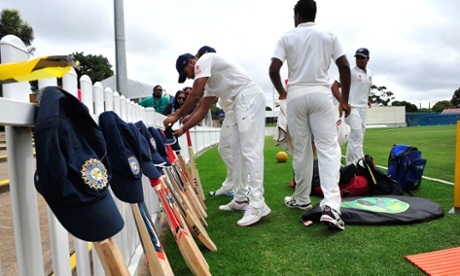
The last time India arrived for Tests in Australia, the hosts were so firmly entrenched in the mire that the thought they might have been knocked off for the first time on home soil by the tourists went against traditional wisdom but was not entirely fanciful.
Australia had just lost a home Test to New Zealand for the first time in two and a half decades, had been chastened by their embarrassing showing against England the summer before and had an injury list that could have made for an episode of M*A*S*H. Nevertheless, Australia won that series 4-0 in not so much of a canter as with their elbows leisurely propped on the bar and their steeds tied up outside the saloon.
Then, as should probably be the case now, India’s deplorable Test form in England in the lead-up forewarned ill tidings. Following a familiar trope, the Indian batting – Tendulkar, Sehwag, Laxman, Dravid and all – turned out to be a fast bowler’s wet dream, skittled at every attempt and on four occasions for fewer than 200. Ben Hilfenhaus and Peter Siddle ran amok, sharing 50 of the 80 Indian wickets to perish.
Now those batting legends are gone and for at least the first Test this summer, so is current captain MS Dhoni. The leadership mantle will be taken up by Virat Kholi, the only one of his side to make a truly lasting impression on that 2011-12 trip - not always in an entirely positive light - with a feisty century in the dead rubber finale at Adelaide.
Now Kohli will lead and also anchor a line-up boasting undeniable talent, but who on foreign soil remain as shaky a proposition as ever. There have been brief glimpses to suggest otherwise: to start their five-Test engagement with England in June, Dhoni’s men drew at Trent Bridge and then plunged the home side to the depths of despair by winning at Lord’s. That was their first overseas Test win in three barren years.
Then they reverted to type, thrashed in the next three Tests in a manner that beggared belief. Of the batsmen, only Murali Vijay scaled the heights expected of him. Kohli, Dravid-understudy Che Pujara and Shikhar Dhawan were all rendered ineffectual by a bowling attack not superior to the Australians they’ll now face in less forgiving climes.
Their bowling attack boasts raw pace in Varun Aaron and swing from Bhuveshwar Kumar and Mohammed Shami. And while Ishant Sharma showed in England he can still produce that occasional spell of magic, the last time he played in Tests in Australia he was the wrong type of bowling machine – the one that plugs into a power socket. Umesh Yadav is the only bowler in the touring party who impressed at all last time around, but it remains to be seen whether he’s given a chance here. The spinning Ravis, Ashwin and Jadeja, will receive little assistance from Australian surfaces.
What both these sides were faced with in the lead-up to this series though was the tragic and unprecedented events of the past fortnight following the death of the loved and admired Phillip Hughes. Now just taking the field presents its own set of challenges for the Australians.
Needless to say that the selection debates, mooted personality clashes and pre-tour verbals that so often flow at this juncture in the Australian summer are not only missing, but in hindsight seem so absurd. Hope remains that this series will breathe back some life and perhaps provide some of the joy that Australian cricket has lost in the past week. We’ve rediscovered the fact that cricket is not life after all, but is a gift in both the playing and watching.
Perhaps this time around the cricket will benefit from some of the bon vivant spirit of Hughes and that both sides might channel his boyish smile a little more often than the menacing snarls of recent times. Still, no encounter between these two sides is without its own dramatic melody.
Beyond the obvious, the Australians face a few hurdles as they head toward the series opener. Captain Michael Clarke – a rock of dependability and dignity in recent times not just for a grieving family and his teammates but an entire nation – now must battle a niggling hamstring seemingly beyond even his reserves of strength. He’s due some luck with both it and his bat.
After a forgettable performance in the Gulf, the rest of Australia’s batting line-up is at least settled in most respects. Openers Chris Rogers and Dave Warner, Steve Smith and a fit Shane Watson appear locks for the summer. How they and No.7 Brad Haddin readjust from the desperately trying time they’ve endured lately might benefit from some patience, understanding and perspective.
Should Clarke’s body hold up, most conjecture will focus on Mitchell Marsh’s spot. His Test-batting temperament was actually one of the few positives Australia’s top six would have taken from the recent engagements with Pakistan though on home soil, Australia might want a more wicket-threatening brand of bowling from their allrounder. James Faulkner hovers close for another opportunity should Marsh’s body or form falter.
Drafted into the squad as cover for Clarke, Shaun Marsh has in recent times gone a little closer to putting up the numbers expected of one carrying the weight of his surname, but his body too remains cause for concern. At present he can barely throw in the field, not ideal in his line of work. Ready to leapfrog him is South Australian Callum Ferguson, who for now sits comfortably above a second tier of hopefuls like Adam Voges, Usman Khawaja and Joe Burns.
The remodeled Test schedule also means that Ryan Harris is a chance to play fewer games than originally expected so he can be nursed through to next year’s winter Ashes. If so, he’d open a spot for one of Josh Hazlewood, Pat Cummins, Mitchell Starc or even dark horse Western Australian paceman Jason Behrendorff, now with 76 wickets at 24.06 in his 19 first-class appearances and at a quite astonishing strike rate of 45. Mended Victorian James Pattinson might soon be on the selection radar, too.
Though spin has often not been in great need for the Australians of the past year, enigmatic Nathan Lyon receives from his nation a shorter-running supply of goodwill than any of this Australian squad and might find himself in the spotlight again if his pace-bowling comrades don’t do all of the heavy lifting. Fawad Ahmed continues to gently press him, but few other contenders have suggested that he should be discarded.
We can probably expect a less brash Australian side this summer – particularly in the field – and you wonder what affect recent events might have had on the thirst of Harris and Mitchell Johnson for the kind of demolition derby at which they’ve excelled in the past year. The law of probability tells us that even an Indian batting line-up as talented at this one won’t cut the mustard, but whether they’re given the kind of relentless examination of all critical and technical faculties as England last summer remains to be seen.
We know that any Darren Lehmann side will compete hard, but this one has been bonded in an unthinkable grief and they could be forgiven if a certain edge was lacking. Like the crowds likely to flock to grounds this summer and show their support, perhaps it will merely be in the playing of the game – regardless of results – that a cricket nation still wiping away tears can begin to heal.