India has successfully launched its first privately developed orbital rocket, marking a milestone for the country’s commercial space industry and its ambitions to expand its presence in the global space market.
The Vikram-1 launch vehicle lifted off from the Satish Dhawan Space Centre on Sriharikota, a barrier island off India’s south-eastern coast, at 12.05pm local time on Saturday, after a last-minute delay pushed back the launch from its scheduled 11.30am liftoff.
About 15 minutes later the rocket successfully placed six payloads – including satellites, scientific instruments, and other cargo carried into space – into a 450km low Earth orbit, completing its maiden orbital mission, dubbed Mission Aagaman, which means “arrival” in Sanskrit.
Developed by Hyderabad-based Skyroot Aerospace, Vikram-1 is the first privately built Indian rocket to place payloads into orbit, making India the third country, after the US and China, to have a private company successfully develop and launch an orbital rocket.
The achievement marks a turning point for India’s commercial space sector. For decades, rocket launches were carried out exclusively by the state-run Indian Space Research Organisation (ISRO), with private companies largely limited to supplying components.
That changed in 2020, when the government opened the space sector to private investment and established the Indian National Space Promotion and Authorisation Centre (IN-SPACe), giving startups access to ISRO’s launch sites, testing facilities and technical expertise.
The government has said it wants to grow India’s space economy from about $8bn to $44bn by 2033, with private companies expected to play a leading role.
IN-SPACe chairman Pawan Kumar Goenka said the flight had surpassed expectations. “The mission objective was to simply clear the tower. It went all the way up to 450km orbit, successfully completed all the tasks and [that’s] something that is way beyond expected in the very first launch,” he said, according to the Press Trust of India.
Vikram-1 carried six technology demonstration payloads from Indian and international organisations. They included Skyroot’s SCOPE satellite, Grahaa Space’s SOLARAS mission, Cosmoserve Space's Embrace experiment, which is testing robotic technology designed to capture space debris, and two payloads from German aerospace company DCubed.
The rocket also carried symbolic payloads, including Cosmic Bloom, a lotus-shaped artwork made from lab-grown diamonds and a microscopic gold rocket honouring Indian scientists Vikram Sarabhai – the father of Indian space exploration, after whom the rocket was named – as well as Sir C V Raman and A P J Abdul Kalam. Also included was a handwritten postcard from India’s prime minister Narendra Modi, bearing the words “Vande Mataram”, a phrase from India’s national song that translates as “I bow to thee, Mother”.
The mission represents a significant step beyond Skyroot’s Vikram-S mission in 2022, which was the first privately developed rocket to reach space from Indian soil.
Vikram-S was a suborbital mission, meaning it briefly crossed the boundary of space before falling back to Earth. Vikram-1, by contrast, was designed to travel fast enough to place satellites and other payloads into orbit, allowing them to continue circling the Earth instead of returning immediately.
Skyroot said its longer-term goal is to offer dedicated launches for small satellite operators, rather than requiring them to share space on larger rockets. The company has described the model as a “cab service to space”, allowing customers to choose when and where they launch instead of waiting for larger missions involving multiple payload providers.
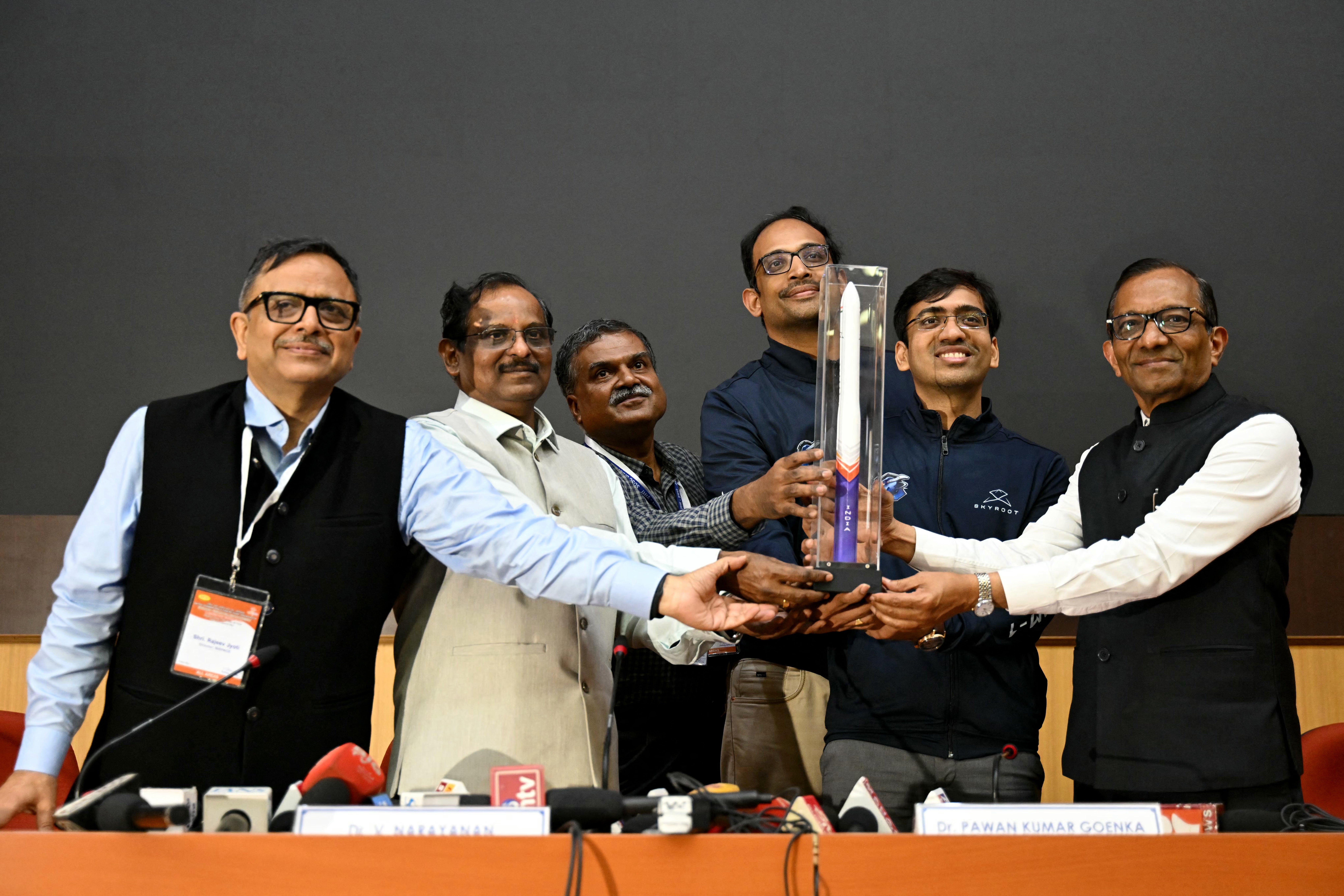
Skyroot co-founder and chief executive Pawan Kumar Chandana compared the service to “booking a cab rather than taking a train”.
“The ‘cab’ market is what we want to put our mark on with the Vikram series,” he told Space.com before Saturday’s launch. “There are very few opportunities for customers to reach customised orbits today.”
Chandana added that Skyroot hoped to manufacture one Vikram-class rocket a month once commercial operations begin.
Instead of competing directly with larger launch vehicles capable of carrying dozens of satellites on a single mission, like SpaceX’s Falcon 9, Vikram-1 has been designed to carry payloads of up to 350kg into low Earth orbit and to place them into customer-specific orbits.
According to Skyroot, the vehicle uses an all-carbon composite structure intended to reduce weight while increasing payload efficiency. It is powered by the company’s indigenously developed Kalam-100 engine, a solid rocket motor manufactured using carbon-composite materials and 3D printing, which they said reduces manufacturing time and improves performance while lowering costs.
Srimathy Kesan, founder and chief executive of SpaceKidz India, told The Week that the mission also demonstrated “advanced indigenous avionics, autonomous flight software, high-precision navigation systems and mission management technologies developed by India's growing private space industry”.
We’ll be watching this ignition on loop all day.
— Skyroot Aerospace (@SkyrootA) July 18, 2026
Kalam-1200 — Vikram-1's first stage, named for Dr. A.P.J. Abdul Kalam — roaring to life and lifting Vikram-1 off the pad, on a flight that reached orbit.#Vikram1 #MissionAagaman pic.twitter.com/ul9wlY8LzH
After the launch, Modi called Skyroot chief executive Chandana and co-founder Naga Bharath Daka to congratulate the team. “You have planted India's aspirations in space and have also given roots to the dreams of the youth,” he said, according to NDTV.
“Your team has proved my faith in the youth of India right. Many doubted our space dreams, but this team has shown that if trusted, Indian youth can do wonders,” he added, after being told the average age of Skyroot's workforce was 28.
During the call, Chandana told the prime minister that “Vande Mataram is now in space”, referring to the handwritten postcard carried aboard Vikram-1. Modi said he had chosen the words because 2026 marks the 150th anniversary of the national song and because it had inspired generations of young Indians.
“You have lived the spirit of Vande Mataram,” he told the team.
Thank you, Hon’ble Prime Minister @narendramodi ji!
— Skyroot Aerospace (@SkyrootA) July 18, 2026
Your good wishes right before the flight, and now your kind words soon after — both have meant the world to Team Skyroot. Vande Mataram is now in space 🚀 🙏
This defining moment for India’s space journey was made possible by… https://t.co/GUFc9K4eFX
Mission Aagaman is the first of three planned developmental missions before Vikram-1 enters commercial service. Skyroot says data collected during the launch will be used to validate the rocket’s propulsion, guidance, navigation and telemetry systems ahead of routine commercial missions.