The runway exists in a different country
You watch the reel. A model moves down a white-lit runway in something that is half-sari, half-structured coat, hand-embroidered at the hem, priced somewhere between a month's rent and a small car. The designer takes a bow. The front row applauds. By the next morning, the look is on seventeen Instagram accounts you follow, each one calling it "the future of Indian fashion."
You close the app and open your wardrobe. Nothing there has changed.
This is the central experience of India Fashion Week for the majority of Indian women: spectatorship. The shows happen in Mumbai and Delhi, occasionally Bengaluru. The buyers who attend are retailers from the same four cities, or exporters whose orders leave the country entirely. The woman in Indore or Bhubaneswar or Thrissur is not the end consumer the runway is designed for. She is the audience for content that was never meant to clothe her.
Supply chains don't reach where you live
Even when a trend is genuinely wearable, a silhouette, a colour story, an embroidery technique, the path from runway to wardrobe runs through a distribution system that stops well short of most Indian cities.
The high-street labels that adapt runway trends fastest, Zara, H&M, Mango, operate in fewer than thirty Indian cities, almost all of them metros or large Tier-1 towns. Indian designer diffusion lines, the more affordable second tiers that labels like Anita Dongre or Ritu Kumar have built, are similarly concentrated. A woman in Raipur or Gorakhpur who wants something that gestures toward what she saw on a runway has two real options: she commissions a local tailor to approximate it, or she orders online and absorbs the return cost if the fit is wrong.
The tailor option is genuinely powerful, and often produces better results than the original. But it requires that the woman already knows what she wants, that she can describe a cut or a collar or a drape to someone working from instinct rather than a pattern. Most trends don't survive that translation. They arrive as a mood, not a blueprint.
The social grammar of dressing outside metros
Supply is only part of the answer. The deeper constraint is social.
Fashion trends travel fastest where there is an audience for them, workplaces with relaxed dress codes, social circuits where novelty is read as confidence rather than eccentricity, peer groups where someone wearing something new gets curiosity instead of comment. These conditions exist more reliably in Mumbai, Delhi, Bengaluru, and Hyderabad than almost anywhere else in India.
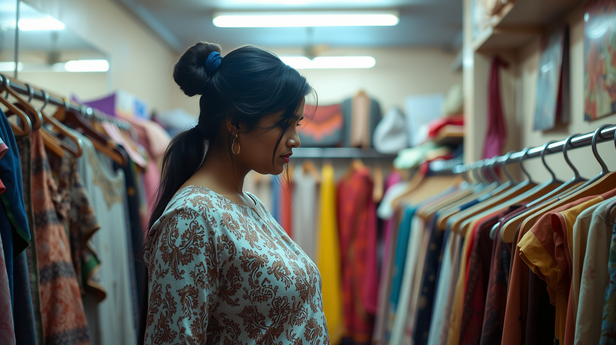
In smaller cities and towns, a woman's wardrobe is still largely governed by occasion, family expectation, and the unspoken question of what her choices say about her family's values. A structured blazer worn with a dhoti-pant might read as aspirational in Bandra. In many parts of small-town India, the same outfit reads as a statement about the woman's character, and not always a generous one. She knows this. She dresses accordingly. The runway trend dies not because she doesn't want it, but because the social cost of wearing it is one she has calculated and declined.
The industry's blind spot is structural
India Fashion Week is not designed to fail most Indian women. It is designed to serve a specific, narrow market, and it does that reasonably well. The problem is that the industry talks about itself as if it represents Indian fashion, when what it actually represents is the fashion consumption of a small, urban, English-speaking demographic that happens to live in the country's four largest cities.
This gap produces a specific kind of frustration. Indian women who follow fashion are not passive or uninformed. They track trends. They have opinions about styling. They know what they like. What they lack is access, physical, economic, and social, to the infrastructure that would let them act on those preferences. The fashion industry reads this as indifference and designs its next season for the same four cities again.
The brands that have broken this pattern are not the ones that brought runway fashion to smaller cities. They are the ones that started from what women in those cities were already wearing and made it better. Fabindia built a national retail presence not by translating trends downward but by treating regional textiles as the starting point. The direct-to-consumer ethnic wear brands that have grown fastest on Meesho and similar platforms are not selling runway looks, they are selling the embroidery and silhouettes that women in Tier-2 and Tier-3 cities already wear, made more accessible and more varied.
The women were never waiting for the runway to notice them. They were already dressed.
The four cities that host and consume India Fashion Week are not wrong to have a fashion culture of their own. But the trends that emerge from those runways will keep missing most Indian wardrobes until the industry stops confusing the cities it can see with the country it claims to dress.