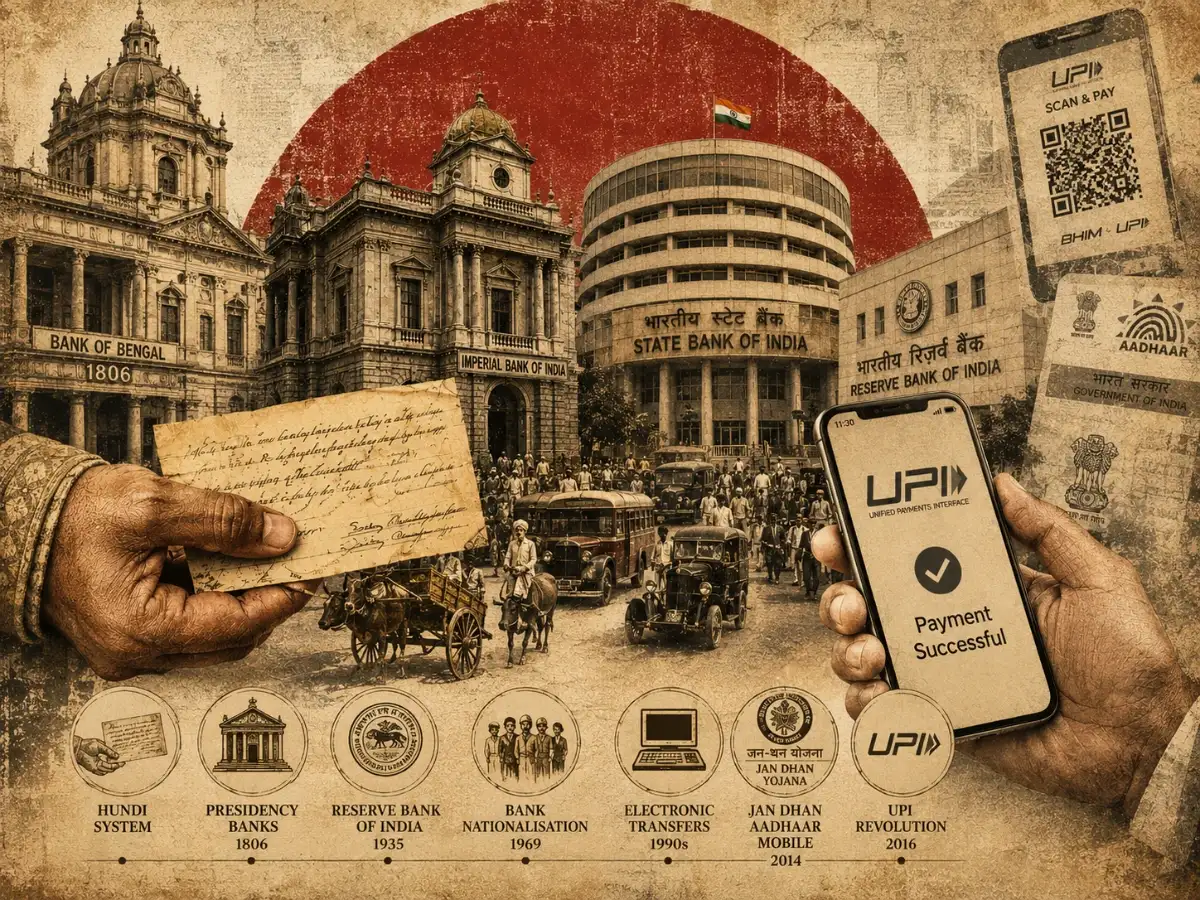
Today, a QR code can move money across hundreds of kilometres with a few taps on a phone. As India enters its 80th year of Independence, that simple transaction is the latest chapter in a centuries-old story of how money has travelled across distance.
Go back several centuries. Somewhere along India’s sprawling trading routes, a merchant needs to send money to a distant town. There is no bank to walk into, no machine to withdraw from, no electronic network waiting to carry the payment. And yet, the money can move. A hundi — passed through a trusted network of merchants and bankers — carries the instruction to pay, allowing value to cross hundreds of kilometres without the coins themselves travelling with it.
Also read: 79 years of an India on the rise as its households dream bigger
The two transactions could hardly look more different. One happens in seconds on a screen; the other depends on paper, people and reputation. But the economic algorithm is remarkably similar: how do you move value across distance without physically moving the money itself?
For centuries, India has kept finding new ways to answer that question. The journey has run from hundis and indigenous bankers to colonial banks, nationalised branches and electronic transfers, and eventually to debit and credit cards, ATMs and UPI [Unified Payments Interface].
Before banks, India already had a financial network
A hundi was not simply an old-fashioned piece of paper. The Reserve Bank of India describes it as a credit instrument that evolved in India and says its use was most widespread in the 12th century, continuing into modern times. Hundis served three purposes: remitting funds from one place to another, borrowing money as credit instruments, and financing trade as bills of exchange.
They came in different forms. A darshani hundi was payable on presentation, while a muddati hundi was payable after a stipulated period or on a specified date. A jokhami hundi tied payment to the safe arrival of goods. The system worked because the instrument was backed by networks of merchants and indigenous bankers who understood one another's credit and reputation.