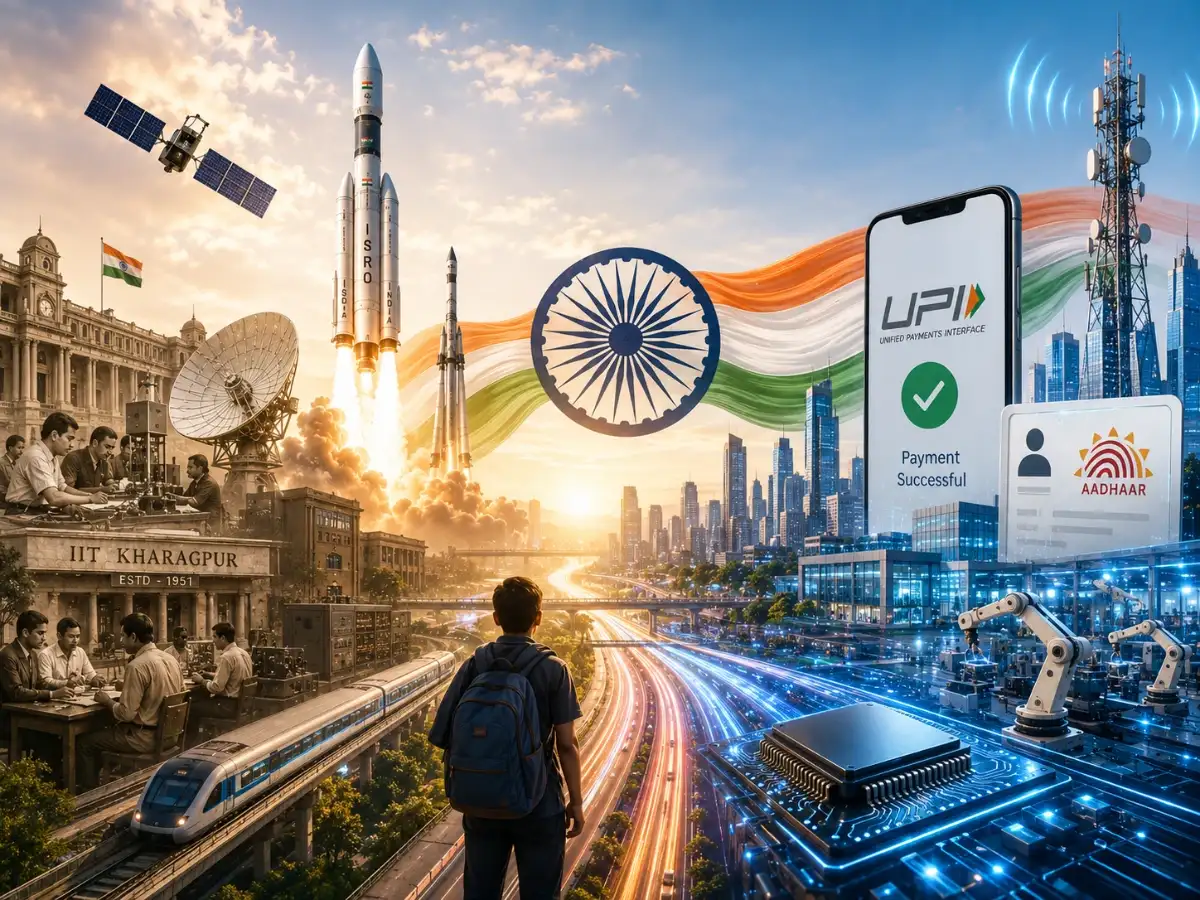
Over the 79 years of India’s technological journey since Independence, the country has transformed from an importer of ideas into a global technology powerhouse. As India celebrates its 80th Independence Day, the next chapter of that journey could be its most ambitious yet.
In 1905, the Swadeshi movement laid the foundations of economic self-reliance by urging Indians to reject foreign cloth and build indigenous industry.
Also Read: Independence Day 2026: A 1968 gold ban that turned every Indian household into an underground vault
Nearly eight decades after Independence, that pursuit of self-reliance has taken forms the country's founding leaders could barely have imagined.
India now has more than 1.09 billion internet subscribers and 1.06 billion broadband subscribers, according to the Telecom Regulatory Authority of India (TRAI). Its technology industry is expected to cross $315 billion in revenue in FY26, according to NASSCOM.
The vocabulary has changed — from steel plants to semiconductor fabs, from software code to GPUs. But the ambition has remained remarkably consistent.
From building capability to scaling it
In the years after Independence, India was trying to build a modern economy from scratch.
The First Five-Year Plan, launched in 1951, focused on agriculture, irrigation and reconstruction, even as the young republic built the scientific institutions that would underpin its industrial ambitions. IIT Kharagpur began its academic programme that year. The Atomic Energy Commission had been established in 1948, followed by the Department of Atomic Energy in 1954 and DRDO in 1958.
These institutions were not designed to produce technology companies; they were designed to create scientific and technical capability.
That capability gradually translated into achievements in space, telecom and computing. ISRO was established in 1969, Aryabhata was launched in 1975 and C-DOT was created in 1984 to develop indigenous telecom technologies.
India’s push for computing self-reliance followed a similar path. After the US denied India access to an advanced supercomputer, the government established C-DAC in 1988, which went on to develop the PARAM series of supercomputers.