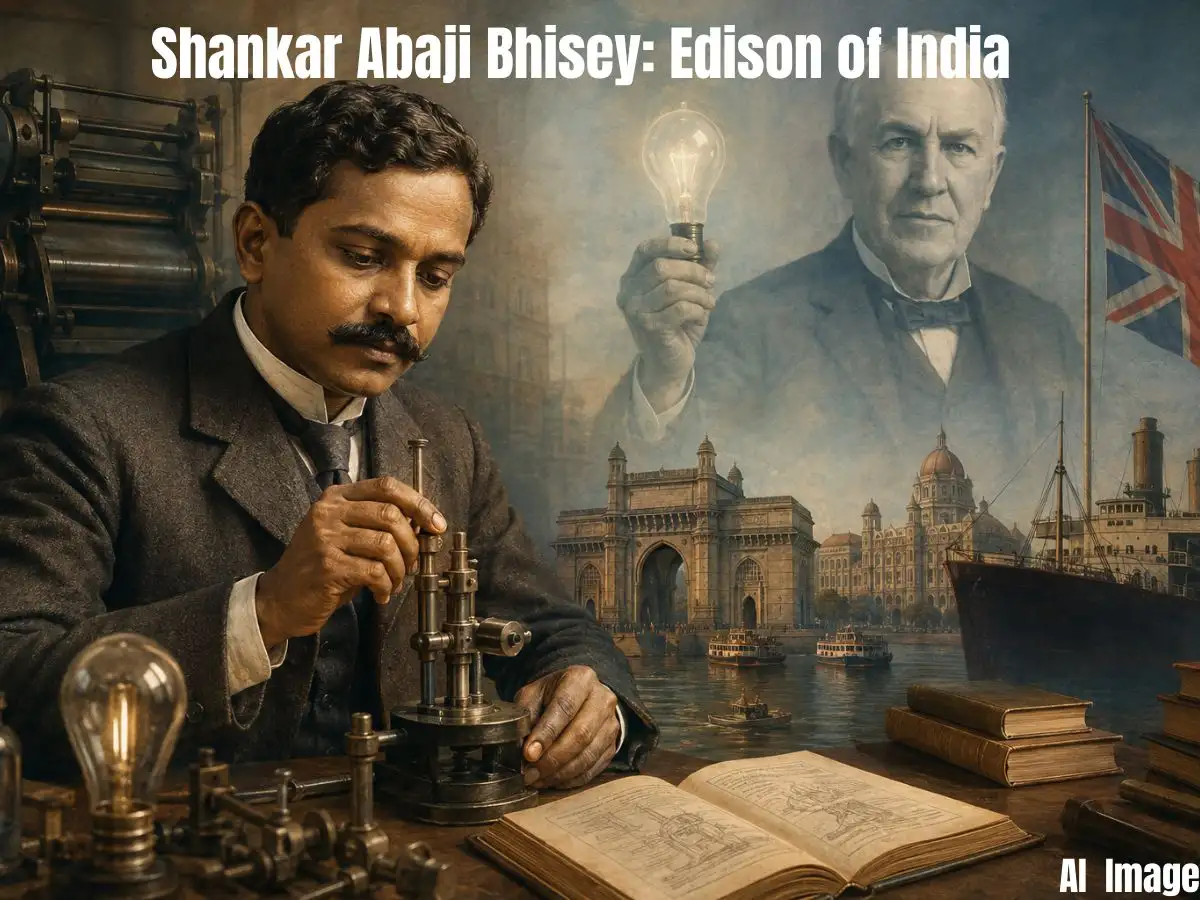
As India prepares to celebrate Independence Day on August 15, the story of Shankar Abaji Bhisey offers a glimpse into a lesser-known chapter of the country’s scientific history. Born in Bombay in 1867, Bhisey became known for his inventive mind and scientific experiments at a time when Indians had very limited access to formal scientific education and research facilities.
Often described as the “Edison of India”, Bhisey developed an interest in science while still young and taught himself through books and scientific magazines. His journey eventually took him outside India, where he worked on inventions and obtained patents.
Shankar Abaji Bhisey: The boy from Bombay who learned science from magazines
Bhisey grew up in Bombay, now Mumbai, at a time when India had very few institutions capable of supporting scientific research and invention.
He did not have the conventional path available to a modern engineer or scientist. Instead, he turned to books and scientific publications.
Among his favourite sources was Scientific American, a magazine that introduced him to mechanical ideas and new developments from around the world.
Years later, Bhisey recalled how important the magazine had been to his education. For him, its pages became a substitute for the formal technical training that was difficult to access in colonial India.
His interest soon moved from reading about machines to trying to build them.
From small gadgets to international attention
Bhisey established a scientific club in Bombay and began experimenting with different ideas while still a young man. His inventions included a tamper-proof bottle, an electrical device for bicycles and a station indicator intended for Bombay's suburban railway system.
His big opportunity arrived in the late 1890s after he learned about a competition organised by a British inventors' journal. Participants were asked to design a machine capable of weighing groceries. Bhisey reportedly came up with his design during an early-morning burst of inspiration and entered the competition. He won.
The achievement brought him attention in Bombay and demonstrated that the self-trained inventor could compete with established British contestants.
Bhisey moves to London
The recognition encouraged Bombay's administrators to support Bhisey's plans to take his work to Britain. He travelled to London determined to find investors and turn his inventions into commercially successful products. His ambition was clear: he did not want to return to Bombay without either succeeding or exhausting his money trying.
London also brought Bhisey into contact with some of the most influential Indian nationalists working in Britain.
He arrived with a letter of introduction from Dinsha Wacha, a prominent Congress leader and businessman from Bombay. Wacha introduced him to Dadabhai Naoroji, one of the most important Indian nationalist figures of the period.
Naoroji was impressed by Bhisey's growing collection of patents and agreed to help him establish a business syndicate. That association would become an important part of Bhisey's career.
The inventor and the Indian nationalist movement
Bhisey's time in London was not limited to laboratories and workshops. Through Naoroji, he became connected with anti-colonial circles at the centre of the British Empire. He also came into contact with Henry Hyndman, a British socialist and outspoken critic of colonial rule.
While continuing his inventive work, Bhisey participated in meetings and demonstrations linked to India's nationalist cause.
His career therefore developed along two tracks. He was attempting to establish himself as an inventor in Britain while also staying connected to the political movement seeking greater rights for Indians.
His biggest invention was the Bhisotype
Among Bhisey's many ideas, the invention that generated the greatest expectations was the Bhisotype. It was a typecasting machine designed to produce metal type used in printing books and newspapers. Bhisey believed his machine could make the process quicker and cheaper than existing methods. The invention attracted considerable interest.
Bhisey and his supporters began looking for investment to develop the machine commercially. Hyndman promised to raise a substantial amount of money for the project, while Naoroji helped connect the inventor with potential backers.
But the commercial breakthrough Bhisey expected never arrived. A major printing company, the Linotype Company, reportedly offered to buy the Bhisotype. Bhisey turned down the offer, choosing instead to continue improving his machine while waiting for the promised investment. The funding never materialised on the scale he needed.
By 1907, Hyndman was unable to raise the money he had promised. Naoroji's financial support also eventually ran out. In December 1908, Bhisey stopped work on the project and returned to Bombay. The failure was a major setback for an inventor who had spent years trying to make the Bhisotype a commercial success.
A chance meeting with Gopal Krishna Gokhale
Bhisey's journey home produced another important turn in his life. On the voyage from Britain to Bombay, he met Gopal Krishna Gokhale, one of the leading figures of the Indian National Congress. Bhisey showed Gokhale his typecasting machine and managed to impress him with the invention.
After returning to India, Gokhale helped introduce Bhisey to Ratanji Tata, leading to the creation of another commercial syndicate backed by the Tata family. The arrangement did not ultimately make the Bhisotype a commercial success. But it helped open another chapter in Bhisey's career and eventually contributed to his move to the United States.
From London to New York
Bhisey later settled in New York, where his career took an unexpected direction. The Bhisotype, despite the attention it had received, never became the commercial triumph he had imagined. Instead, Bhisey made money from an iodine-based solution that he developed.
His later years also saw him explore subjects far removed from conventional mechanical invention. He developed a “spirit typewriter”, an invention linked to his growing interest in the occult and attempts to communicate with spirits.
That phase of his life was very different from the young inventor who had once travelled from Bombay to London with plans to transform the printing industry.
Why the ‘Edison of India’ is remembered
Bhisey's career ended without the spectacular commercial success that he had once hoped for. The Bhisotype did not revolutionise printing. Some of his other inventions remained experimental, while his later interest in the occult added another unusual dimension to his story.
But judging Bhisey only by the success or failure of individual inventions would miss what made his journey remarkable.
He was a self-trained Indian inventor who emerged at a time when opportunities for scientific education and research in colonial India were limited. He learnt from magazines, experimented independently, secured patents and took his ideas to international markets.
He also remained connected to India's nationalist movement. In London, he worked alongside figures such as Naoroji and Hyndman. Later, in New York, he supported Indian nationalists and promoted ideas associated with Mahatma Gandhi.
The forgotten inventor worth remembering
India's Independence Day is usually associated with the freedom struggle and the events of August 15, 1947. But the country's history also includes Indians who were challenging the limitations of colonial rule in other ways. Bhisey's laboratory was his route.
He crossed continents in search of investors, developed machines when formal scientific support was scarce and attempted to compete in industries dominated by established Western companies.
His story did not end with a famous commercial breakthrough. Instead, it became a complicated tale of promising inventions, financial failures, political connections and an unusual final chapter. That may be why the “Edison of India” is not as well known today as many of his contemporaries.
Yet Bhisey's life captures something important about India's early scientific ambitions: curiosity did not always begin inside a university or laboratory. Sometimes, it began with a young man in Bombay reading a science magazine and wondering whether he could build the machines he saw described on its pages.