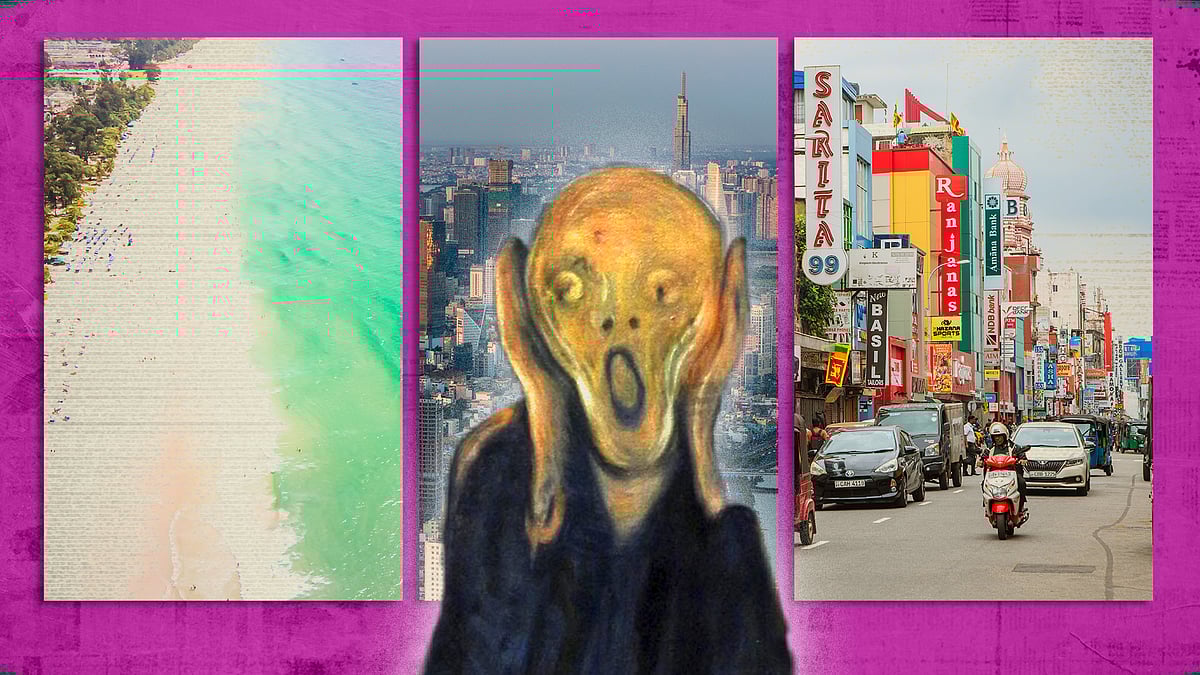
A few years ago, when you said “Thailand” to an Indian man, his face would undergo a minor muscular transformation. A smirk would appear on face that can be interpreted as half-guilt for the sins he’s committed or half-anticipation for the sins he desires to commit.
For a long time in this Indian imagination, Thailand was not a country but an inside joke. It lived in the same moral zone as activities associated with cheap debauchery. But then this particular imagination was from the people who have never been there but had a preconceived notion about the nation.
But in recent years, something changed. Flights got cheaper. Visas on arrival made it incredibly easy for Indians to travel. Even the mental barrier of travelling outside India became smoother. Indians began landing in Bangkok, Phuket and Pattaya, expecting moral chaos but finding civic order.
There are many phases to this shock. You land at the airport, you open Grab – their version of Uber. Within the same fare as your Delhi cab, you might get a spotless Toyota Fortuner, our ultimate symbol of power. The driver doesn’t honk. He doesn’t curse. He simply drives in his lane.
As the popular meme template goes: unbothered, moisturized, happy in my lane, focused, flourishing.
The next shock is the footpath. It is wide, continuous and, as the name suggests, it’s a path meant for foot. Not a service lane for two-wheelers, not a parking strip for scooters, not a bazaar extension. You walk without scanning for open drains or missing manhole covers that wait like traps. Back home, one wrong step on that rare thing called a footpath and you’re in the underground, literally. A missing slab, an open drain, and for a brief moment, you’re Dostoevsky’s narrator, shouting your own Notes from Underground. Here, the pavement keeps a simple promise. It lets you walk.
You reach your hotel and find it clean, quiet and cheaper than its Indian equivalent. In India, cleanliness is a premium feature where you pay extra to be spared from stains. Here hygiene isn’t luxury, it’s the minimum basic, like air or gravity.
You pull off the curtains and look from the window of the hotel that traffic is moving so smoothly as if everyone is just back from the meditation center. Southeast Asian cities hum like those who have quietly solved their problems without needing to brag about them. And somewhere in the middle of all this, you begin to feel a strange shock that also has an air of melancholy. We assumed everyone in the neighbourhood was rotting at the same pace. Our decay felt like regional solidarity, a shared belonging among the not-quite-first-world nations. It felt fine. It felt relaxing. Until we realised they’d been progressing while we were perfecting the art of the great Indian delusion.
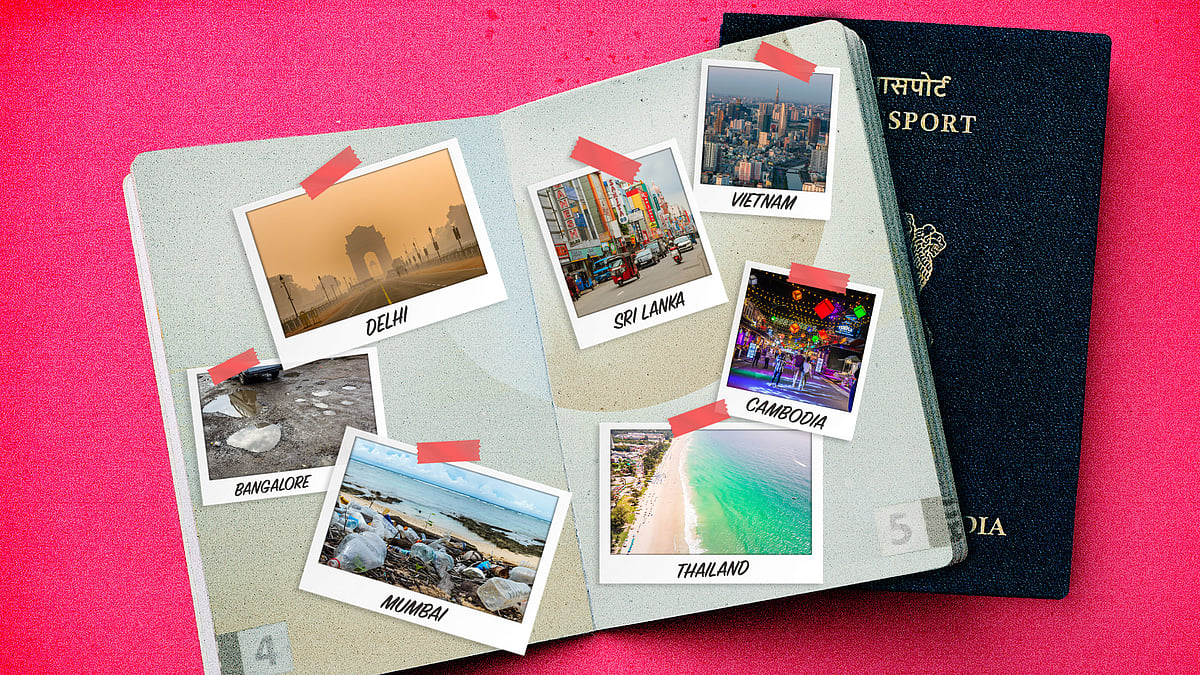
This is how, in recent years, one can see that Instagram and YouTube today are flooded with videos of Indian travellers shocked by the infrastructure and beauty of nearby Southeast Asian countries like Thailand, Cambodia and Vietnam. In fact many are even surprised that even Sri Lanka, which is another hot destination in the tourism world, is so clean with smooth roads and traffic discipline. And this bewilderment by the progress of the nations around us made them top travel destinations for Indians.
East Asian countries are, in general, clean. Japan, China, Korea are very clean. Streets, sidewalks, plazas, parks… clean, clean, clean.
— S.L. Kanthan (@Kanthan2030) July 19, 2023
Even relatively poorer countries like Thailand and Vietnam have cleaner roads and buildings than India or even the big American cities.… pic.twitter.com/mpMJbJzhwn
It’s also interesting to note the history of tourism in India. For a long time, travel was tied to religion. The earliest form of tourism was the pilgrimage, which was the form of the journey that had to have a moral purpose, a divine destination, so that leisure could feel guilt-free. The very idea of leisure entered our vocabulary much later, especially for the generation that grew up on a quote Nehru never said: “Aaram haram hai.”
I remember that in my college days when Dil Chahta Hai released, the image of three friends going to Goa became an aspiration. Even the title song has complete leisure without the need to dance or perform or even act loudly. Goa became a shorthand for freedom, a taste of internationalism for India in the early years of leisure travel without purpose. It was the kind of trip you once imagined with friends as a symbol of youth, and later with your parents as proof that you had finally made it.
But in recent years, especially after Covid, something shifted. Indians went abroad and discovered an entirely different world. For decades, we romanticised chaos and unhygienic nature of the nation and called it colour, spirit, spirituality. But once you’ve seen order, the chaos looks less poetic and more like disgusting negligence. This negligence and mediocrity was always there and there is nothing new about it. The truth is, India never really changed. What changed was the world around it. We finally saw that vikas, the great promise, was happening elsewhere.
This is the reason why, a few months back, “Boycott Goa” started trending on Twitter, a grievance against what they termed as ‘taxi mafia’ and the poor quality of roads. Many started posting that they will go to South East Asian countries and not come back to Goa.
Indians went abroad and discovered an entirely different world. For decades, we romanticised chaos and unhygienic nature of the nation and called it colour, spirit, spirituality. But once you’ve seen order, the chaos looks less poetic and more like disgusting negligence.
The frustration reached such a pitch that even Goa’s tourism minister, Rohan Khaunte, had to respond. At a press conference, he said, “People come to Goa for what it is. More importantly, Goa’s beauty and creativity and other things… cannot be compared with Thailand. We don’t want to experience a Thailand in Goa.”
Fair enough. I love Goa, and I can see why it’s unfair to compare it with Thailand or Vietnam. They are countries, after all, while Goa is just a state in the Indian republic. But even with all my affection for its people and its vibe, I must admit that when booking a holiday, the thought does cross my mind: why Goa, when you can get far better value for money in South East Asia? That same thought is now pushing thousands of Indians abroad, skipping domestic destinations altogether.
Then there’s now a whole economy of vloggers roaming through these countries, filming every cafe, train, market, and street. Many seem genuinely puzzled why the bus station walls here don’t have that great Indian abstract art, painted by someone who just spat “bolo zubaan kesari” and moved on.
Without intending to, these vloggers are documenting what functional societies look like. Their travel content has become a mirror that reflects how much disorder we have learned to call culture.
For instance, I was once walking through the lanes of Jaisalmer and accidentally stepped into fresh cow dung on the road. I was disgusted, but a shopkeeper nearby shouted, “Ab aapka aaj ka din subh jaayega. Gobar mein pair girna bahut shubh hota hai.” (Your day will go well now. Stepping on cow dung is considered very auspicious.)
But there’s also a catch in this new dream travel economy.
The government there takes its job seriously, but so do the people. They don’t wait for the state to behave like a parent. Cleanliness, for them, is not an act of obedience but a reflex of dignity. They sweep, sort, and dispose not because someone is watching, but because they were raised to believe that filth is an insult to the self.
In India, this reflex never arrived. Littering is not seen as a moral failure but as an act of minor privilege. Civic sense, like most virtues here, has always been arranged along caste lines. When you grow up believing that someone else exists to clean after you, you slowly lose the idea of being an equal citizen. You become an upper node in a hierarchy, not a unit in a society. You throw, they pick. You pollute, they purify. The chain of filth remains sacred.
At Phuket airport, I saw an Indian family, well-dressed and clearly upper middle class, pushing a large trolley. Two bottles of cola slipped off and rolled across the floor, spilling dark fizz in small circles. They paused, looked at the mess for a moment, then walked away as if nothing had happened. Two Thai staff members nearby looked at each other, not with anger, but with the tired resignation of people who must have been thinking “ah, here we go again”.
This is not an isolated incident. Reddit threads and Reels are filled with such stories. Many Indians have been leaving their mark on other nations with their peculiar version of civic sense. There are videos of affluent families stealing from small shopkeepers in Vietnam and Bali, or tossing litter on pristine beaches.
Indians, on their first real encounter with functional societies, are stunned by how beautiful and orderly those nations are. Ironically, those same nations are now discovering their own shock, watching how effortlessly some Indians can disturb that order. In time, this shared astonishment will only deepen.
When you return home from these places, everything you once thought was ordinary begins to look exaggerated. The chaos of the roads, the public indifference to how cities are maintained, the government’s careless approach toward even basic urban planning; it all starts to grate. The broken roads that earlier felt like part of the adventure, like a cheap 5D ride in a mall where the chairs shake and jump, now just feel exhausting.
For Indians one of the very first real encounters with politics begins with a pothole. You take your nice, clean car out, the MRF tyre sinks inside a crater, and you yell the country’s favourite phrase: “idhar to har cheez mein corruption hai.”
This dissatisfaction has accelerated in recent years when they realised a better condition is possible. After tasting order abroad, the chaos at home feels almost like betrayal. It’s no longer funny, only familiar. And perhaps it’s true that when the flight lands back home, Indians won’t jump with joy, they’ll jump because the first pothole of the motherland waits right outside the airport, ready to welcome them back.
Small teams can do great things. All it takes is a subscription. Click here to join the tribe.
Newslaundry is a reader-supported, ad-free, independent news outlet based out of New Delhi. Support their journalism, here.