George Osborne has hailed the benefits of a buoyant British economy for the Treasury’s bottom line, after official figures showed that a sharp rise in income taxes helped to cut the deficit in public finances by £7.5bn in the first half of the financial year.
In a fillip for the chancellor, who is under severe pressure over his plans for tax credit cuts, the Office for National Statistics said on Wednesday that public sector net borrowing in September was £9.4bn, down from £11bn in the same month last year.
Revised data for July and August also showed a more positive picture than had previously emerged.
Osborne, who is putting the final touches to his autumn statement and spending review for 25 November, said the figures were evidence that his “hard choices are paying off”.
He added: “At a time when inflation-adjusted pay is rising strongly, this welcome news shows the benefits of a higher-wage economy, with both businesses and working people contributing to balancing the books.”
But some analysts warned that the improvement might still be too little too late for the chancellor to meet the Office for Budget Responsibility’s forecast of a £69.5bn deficit over the year as a whole.
“We are moving in the right direction, but not fast enough,” said Alan Clarke of Scotiabank. “There are still six months to make up for lost time, but I suspect that the target for the year will not be met.”
Over the first six months of the fiscal year, which starts in April, a 7.9% increase in corporation tax receipts and a 4.4% rise in income tax helped to cut public sector net borrowing by £7.5bn compared with the same period in 2014-15, to £46.3bn.
The prolonged squeeze on wage growth since the recession has repeatedly led to disappointing tax receipts. But with the latest official figures showing pay increasing at an annual rate of 3%, income-related taxes are recovering strongly.
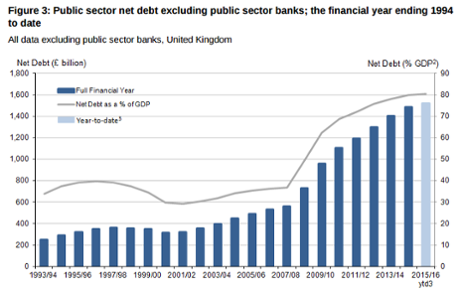
With the government still running deficits in the public finances each month, the UK’s total debt pile is still increasing, according to the ONS. In total, the UK now owes just over £1.5tn – 80% of a year’s GDP.
The chancellor’s fiscal charter, which was passed in the House of Commons last week, commits the government to eliminating the deficit altogether in “normal” economic times.
Howard Archer, of consultancy IHS Global Insight, said the Treasury would be hoping the economy continued to grow strongly, to help boost tax receipts.
“With the economy seemingly seeing a slowdown in growth in the third quarter, there is the risk that tax receipts could disappoint going forward,” he said. “The chancellor will obviously be hoping that the economy can kick on and is not hampered by global growth being held back by a marked slowdown in China and emerging markets.”
The OBR will present its latest forecasts for growth and the public finances alongside the autumn statement, in which the chancellor will also spell out how he plans to achieve his pledge to eliminate the budget deficit.
Ross Walker, a UK economist at RBS, said: “The OBR’s economic forecasts are prudent, but lower-than-expected oil prices and struggling equity markets are likely to put a further dent in revenues.”
With the spending review looming, the British Chambers of Commerce, which represents small firms, urged the chancellor to press on with cutting the deficit – but to spare pro-business spending such as on infrastructure and export support.
David Kern, the chief economist of the BCC, said: “It is important for the chancellor to persevere with cutting the deficit, mainly by focusing on reducing current public spending. The government must also look to boost economic growth through investment and exports, as our recent survey has shown that export orders fell in both the manufacturing and services sectors in the last quarter.”