One of the responses to the budget has been for some senators to question the lack of support for stay-at-home mothers. They argue that not only should proposed cuts to family tax benefit B in last year’s budget be reversed, but that a policy of income splitting is introduced that would allow single-income-earners to reduce their tax.
Such a scheme, however, would inevitably benefit those on higher incomes, and would work directly against efforts to improve the workforce participation of women.
This month’s budget included tables that compared the amount of tax paid with benefits received by households. One aspect the tables show is that budget measures will mean dual-income families are better off compared with single-income families.
The tables feature 12 types of family, but include only two where the household income and family size are comparable.
It presents two households with $80,000 annual income and three dependent children. One household has one income earner; the other has one parent earning 70% of the income ($56,000) and the other 30% ($24,000).
After paying tax and receiving government benefits the single-income household has a disposable income of $85,497, compared with $93,559 for the 70:30 household:
The main reason for the difference is the amount of tax paid. While the 70:30 household receives $589 more in government benefits, it pays $7,473 less in tax.
This can be explained by the amount of individual income tax, where the first $18,200 earned is tax-free. There is also a “low income tax offset” which raises the tax-free threshold to $20,542. And if you have two earners, both receive the tax-free threshold.
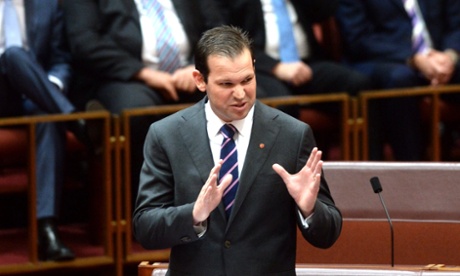
The release of the budget tables favouring dual-income families has led to National party senator Matt Canavan to argue for income splitting. Income splitting involves the main income earner splitting some income off and giving it to their partner for tax purposes.
For example, if you allowed full income splitting, a person earning $100,000 would file a tax return in which both they and their partner earned $50,000.
As this not only puts them in a lower bracket but also has both taking advantage of the tax-free threshold, their tax bill would be significantly lower.
A household on $100,000 with one earner pays (excluding the Medicare levy) $24,947 in tax for an average tax rate of 24.5%. But splitting that income in half sees the household pay just $15,097 in tax for an average tax rate of 15.1%.
Canavan has been on the income splitting caravan for a while now.
He raised it in his maiden speech to the Senate last year, and again in September last year.
Despite the former prime minister John Howard suggesting an income-splitting policy while in opposition, he did not introduce it in government. Instead he created a de facto scheme targeted at one-income families with family tax benefit B. Originally it had no means testing and attempted to replicate the benefit of the tax-free threshold for the stay-at-home parent.
Family tax B is now limited to households where the main income is less than $150,000. Last year the Abbott government proposed lowering this to $100,000 and removing it for families once a child turns six.
Canavan argues that “Australia’s tax system discriminated against single-income-earner families to a much larger extent than average”.
He cites a 2012 OECD paper which shows that for households on 133% of the average wage, Australia has the 8th largest disparity between tax paid by a single-income-earner and dual-income-earners taking home the same amount:
Canavan proposes replicating a scheme recently introduced in Canada. There the main earner can assign up to $50,000 of their wages to a partner. Canavan suggests allowing any amount of splitting income up to the tax-free threshold.
So what is the problem?
Well, for a start it costs a hell of a lot. Canavan suggests it would cost $1.5bn a year. To give some context, the government’s massive child-care support package is projected to cost $1.3bn in its first year.
And the policy benefits a fairly small percentage of the community. The Canadian parliamentary budget office estimated that the scheme would benefit only 15% of Canadian households. It also noted that “middle- and middle-high-income households benefit most” because they are more likely to have one high income earner.
This has long been a criticism of income splitting. In 2002, when asked about income splitting, the family and community services minister, Amanda Vanstone, said, “The problem is that it, generally speaking, benefits the rich more than people on lower income levels. It certainly offers no benefit whatsoever to people who are not in a position to be paying tax.”
One Canadian tax law professor estimated that only 12% of the total benefits of the Canadian scheme would go to the bottom 50% of households. And that 87% of the benefits would be for men as they are more likely to be the highest income earner.
And these benefits also assume no government spending is reduced to offset the cost. But any cuts to spending would likely hurt lower- and middle-income households more than the higher-income households who are getting the major benefit of income splitting.
The other issue is that income splitting reduces the incentive for the non-income earner to go back to work.
Currently if you work, regardless of what your partner earns, you don’t pay tax on your first $20,542 – which is a great incentive to work at least part time. With income splitting, such as that proposed by Canavan, they would pay19% tax from the first dollar they earn.
Now, of course, currently higher earnings does reduce your family tax benefit A (and other welfare) payments if your household income goes over certain thresholds.
But the previous ALP and current Liberal governments have attempted to reduce this disincentive. The government’s entire purpose for the childcare package is to reduce the penalty of going back to work because of the costs of childcare.
And we are certainly in a time where married women are likely to be in work. But this was not always the case. Thirty-five years ago there was a massive difference in women’s labour force participation between married and single women:
Now the difference is marginal, and in some age groups married women are more likely to be in the labour force:
Income splitting would seek to undo this trend at a time when lifting labour force participation is crucial given the ageing population.
It is a very costly way to benefit families with one income, and rather than targeting lower- and middle-income-earners who may need the assistance, it favours the wealthy. The cost of the scheme would also necessitate either cutting government funding, raising other taxes or, more likely, lowering the tax-free threshold. Splitting income would invariably hurt lower-income households more than it would benefit them.
Given that the thrust of this government’s labour force policy has been to encourage greater participation, proposals for income splitting are likely to be ignored by the prime minister and treasurer.
It would be a very odd move for a government to spend nearly $1.5bn to encourage workforce participation, and then spend the same amount again to use the income tax system to discourage people from going back to work and earning an income.