The director Michael Wilson has assembled a very worthy revival of Arthur Miller’s very worthy 1964 play, Incident at Vichy, for the Signature, which is a pleasure and a problem.
Incident at Vichy is an occasionally poignant play, though it may not be one of Miller’s best. The pessimistic philosophy is somehow too assured. The arguments presented are impossible to disagree with and less nuanced as the play would have us think.
The play was sparked by a real-life event that Miller heard about third-hand. In a small town in unoccupied France in the midst of the second world war, a group of men, mostly Jews, were rounded up for an identity check. In an act that was never invited or explained, a Gentile who had just been released from questioning gave his pass to the last remaining Jew in the room, sparing that man from the camps.
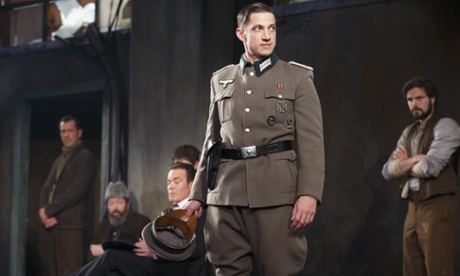
Incident at Vichy opens in similar circumstances. A group of men have been gathered in a disused building that has been transformed into a makeshift police station. The painter Lebeau (Jonny Orsini) paces nervously, trying to figure out why they have all been brought here. The fact that the man who arrested him got out of a car and measured his nose gives him some idea.
A few more men are brought in, including a Viennese aristocrat, Von Berg (Richard Thomas), arrested by mistake, and Leduc (Darren Pettie), a psychiatrist and former soldier who is also seemingly Mr Miller’s mouthpiece.
Miller’s concern is evil, why we fall prey to it, why we seem powerless to resist it. Leduc tries to persuade the men to overpower the guard stationed at the door, but most of the men decline, because they don’t believe in the nightmares that have only been rumored, because they still believe an exception might be made for them. The ones who do agree are too weak to make much of a difference.
The Germans are not an entirely unvaried bunch. The major in charge (James Carpinello) clearly feels a moral disgust at the proceedings, but he is unwilling to endanger his own safety. In an argument with Leduc, perhaps the most interesting in the play, the major asks if the others were kept and only Leduc released would Leduc refuse to leave? Leduc won’t answer, but the major uses his gun to force a response.
“No,” Leduc says.
It is Miller’s contention that the horrors perpetrated by the Nazis happened because some streak of sadism or self-interest lurks in all of us.
“Jew is only the name we give to that stranger. Each man has his Jew; it is the other. And the Jews have their Jews,” Leduc insists.
This argument, like nearly every other one Leduc makes, is difficult to disagree with, which is something of a problem. This is a discussion play in which the discussion is ultimately quite one-sided, which gives the play, which is meant to be searching, a kind of complacency.
Having just seen Ivo van Hove’s extraordinary deconstruction of A View from the Bridge, it’s worth wondering what a director less respectful than Wilson might have done with this material, how ways might have been found to explore and challenge it. Instead this version is dignified and dutiful, as certain as it can be of the degradations it depicts.