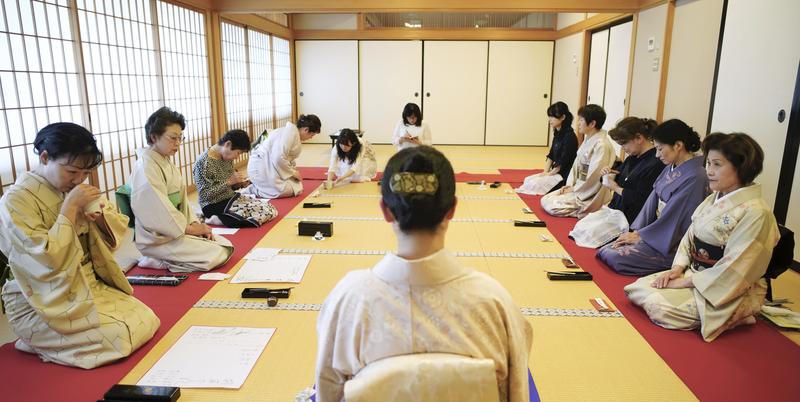
NARA -- On a recent day at Yakushiji temple in Nara, women in kimono sat on a red rug with their backs straight. In turn, each held an incense burner in their left palm, while loosely covering the burner's opening with their right hand.
They then brought their noses to the burner to experience the wafting fragrance of an aromatic wood before passing the burner to the person sitting next to them. I found the fragrance faint yet sweet.
Heating aromatic woods in incense burners to appreciate and distinguish their wafting fragrances is a high-culture hobby established during medieval times, along with the tea ceremony and flower arrangement. The hobby was refined into an art form and named kodo, which can be translated into English as "the way of fragrance" or "the incense ceremony."
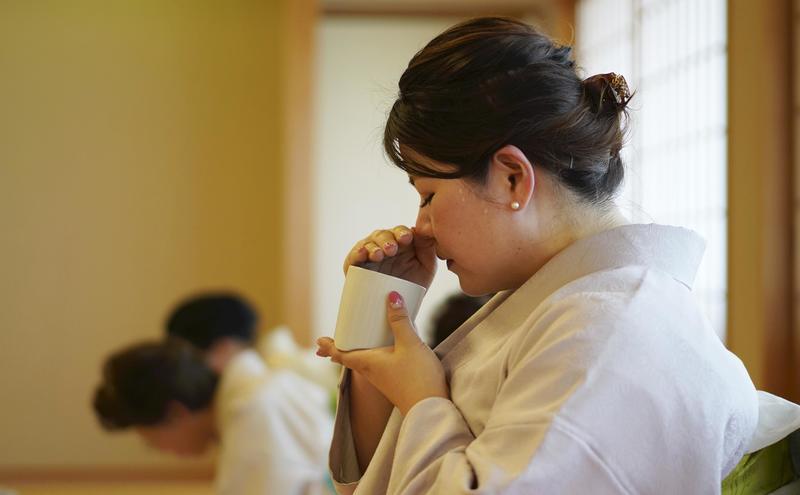
The art is still enjoyed today as an elegant game.
The kodo event at Yakushiji was organized by the Oko-no-Kai foundation headquartered at the temple.
The foundation has served as a center of the art and holds various events such as an annual large-scale event with about 400 participants on the final day of the New Year's Buddhist service at the temple.
Monthly kodo classes are also given at the temple by the Oie-ryu school, and the Shino-ryu school, the two largest kodo institutions.
A recent class given by Oie-ryu drew 12 participants. In kodo, taking in the fragrances is called "kiku" (listening). That means to "ask and listen to yourself while using your five senses," explained Gyoyo Horii, 67, a licensed instructor for the school.
"I feel relaxed and forget about my hectic days while appreciating fragrances in a quiet place," said a smiling Kaori Shiroiwa, 52, of Hirano Ward, Osaka.
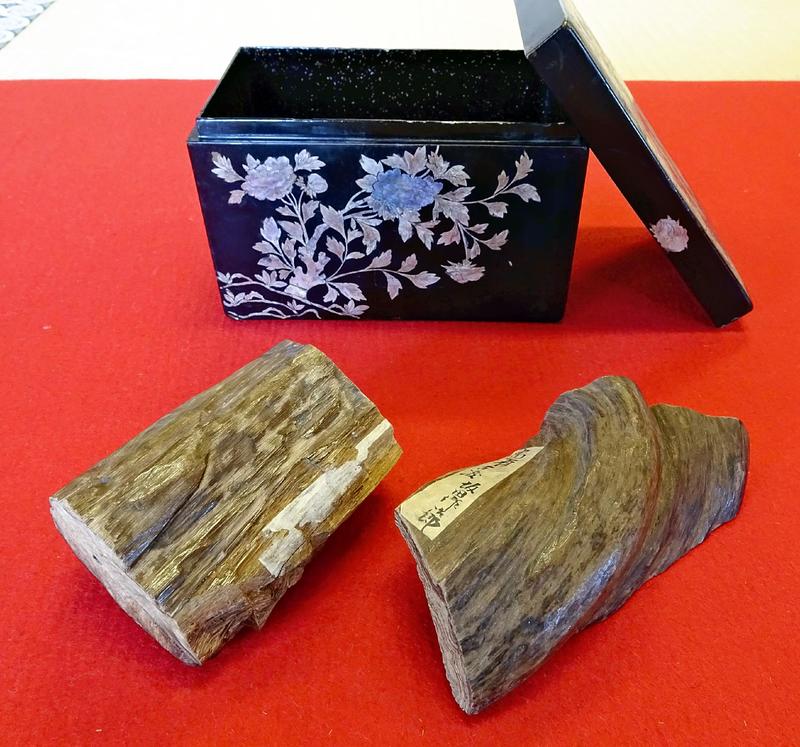
The history of incense in Japan dates back to ancient times. Nihon Shoki, an official chronicle of Japan, records that a piece of incense wood drifted ashore on Awajishima island in 595.
Incense was frequently used at Buddhist services at temples during the Nara period (710-784).
"Fragrances, flowers and votive lights are fundamental offerings to Buddha," said Hoin Yamada, 77, a high-ranking priest at Yakushiji who serves as the board chairman of Oko-no-Kai. "When you experience fragrances, you feel calm and clear-headed. That condition is said to bring you closer to truth."
During the Heian period (794-late 12th century), the nobility started using incense indoors at home and having its fragrances transfer to their clothing.
Appreciating fragrances was established as an artistic genre in the latter half of the Muromachi period (early 14th century to late 16th century). Sanjonishi Sanetaka, a member of the nobility, is said to have sorted imported incense wood and started his original way of enjoying its fragrances. His style became Oie-ryu.
Shino-ryu is said to have been started when the shogun Ashikaga Yoshimasa ordered his close aide Shino Soshin to study incense.
Current-day kodo was completed during the Edo period (1603-1867), and started being enjoyed by commoners as well.
Games to guess fragrances
Although the kodo schools are different in their styles, one thing is common -- playing a type of competitive game called kumi-ko as a main activity.
At each kumi-ko event, several participants enjoy a few fragrances and try to distinguish the differences.
The host announces the names of two or more kinds of incense wood and heats them, one incense in one burner. In the first round, participants in turn sniff the scent from each incense burner and memorize its characteristics.
In the second round, the burners are circulated among participants in random order without announcing their names. At the end, the participants rely on their memories to recognize which burners emitted which scents and state the order.
Incense woods are produced only in Southeast Asia and its neighboring nations. Today, their imports are restricted.
The most famous one is probably the 1.5-meter-long, 11-kilogram piece called Ranjatai, which has been treasured at the Shoso-in repository in Nara.
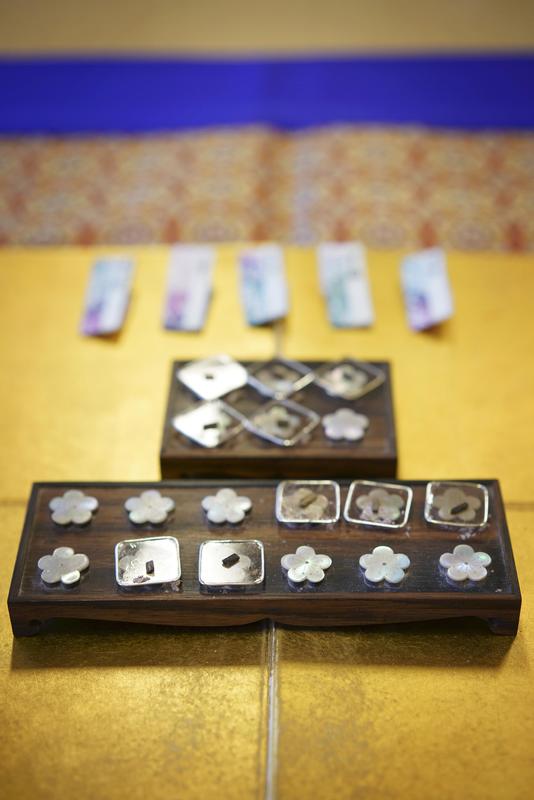
In fact, only about 3-millimeter-long chips of incense wood are used at kodo events.
Each chip is placed on a small mica plate, called ginyo, to be heated on a burning charcoal ball in a burner to enjoy its wafting fragrance.
To distinguish various fragrances, the traditional guideline called Rikkoku Gomi is helpful. Incense wood is classified into six kinds, including Kyara and Rakoku. Those woods smell different depending on age and state of preservation. Such differences are further classified into five tastes -- sweet, bitter, spicy, sour and salty.
The differences, however, are very subtle. I myself attended a recent game and my answer was wrong. I found it very difficult to recognize the characteristics of different scents.
"You can sense fragrances well by turning your nose away from the burner a little," Horii said. "The more you experience, the more you can learn various characteristics of fragrances."
Yakushiji started hosting kodo events in the 1940s as an entertainment gathering held during Buddhist services. The foundation was established in 1974 at the temple.
Today, Oko-no-Kai offers lessons in Tokyo, Nagoya and Fukuoka, as well as at the temple on a regular basis. It also hosts classes at various locations. Recently, children and men have been among those starting to learn kodo.
"Kodo involves all five senses," Yamada said. "It has a competitive element and is very interesting. It also features the four seasons of Japan. For example, some of the incense is named after seasonal elements. I hope many people get to know its elegant world."
At first I was afraid kodo would be a little difficult to take up. Yet in fact, advanced learners kindly offered me instructions.
I enjoyed the event's exquisite atmosphere and want to learn more about kodo.
-- Yakushiji temple is close to Nishinokyo Station on the Kintetsu Railway's Kashihara Line. Kodo lessons are offered at the Mahoroba Hall on the temple premises each month. Kodo events open to visitors are held on Jan. 15 every year as well as selected dates. Call the temple at (0742) 33-6001 (in Japanese only) for more information.
Read more from The Japan News at https://japannews.yomiuri.co.jp/