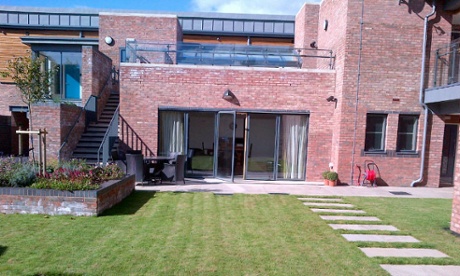
Curved walls with no sharp edges, bedrooms built a little below ground level to diffuse outside noise, and a structure that allows for gradual transition from light to dark – these are among the bespoke features of Bessemer Close, a collection of specialised homes soon to be built for people with autism.
The six bungalows tailored to the unique needs of people with high-level autism are being built by Cherwell district council in Bicester. They are part of a new wave of innovation in specialised housing provision for vulnerable people, reflecting an emerging focus in recent years on improving the lives of residents in ways that aren’t possible in mainstream housing.
In Bideford-upon-Avon, a specialised home for up to nine adults with learning disabilities is already up and running. Murray House has nine individual apartments with a large and bright communal space, designed to foster an atmosphere of interdependence that reduces the need for outside support and combats feelings of isolation.
“There are still far too many people living in institutional settings, and this particular project has proven how good design can give choice where none existed, and enhance the lives of people with support needs who benefit from bespoke living space,” says Glyn Davies, special projects manager for Creative Support, which developed Murray House after winning a bid from Warwickshire county council.
Both Bessemer Close and Murray House were awarded significant funding – £240,000 and £256,500, respectively – in July 2013 by the Department of Health from its £101m care and support specialised housing fund (Cassh) which has been allocated to specialised housing projects in England for groups such as older people and people with mental health conditions.
The idea is to encourage construction of a wide range of housing options to help people live independently for as long as possible. The first block of money is funding more than 3,000 homes for vulnerable and older people. According to Davies, it allows organisations such as Creative Support to take on more innovative projects, for which funding is normally difficult to find.
Bidding has now opened for the second phase of the Cassh fund, which will make a further £120m available for such projects. In 2013, just 13.8% of the total budget went to housing for people with learning disabilities, mental health problems or physical or sensory disabilities, with the bulk of funding spent on homes for older people. This time round, priority will be given to those that focus on support for adults with mental health conditions, although no specific target has been set.
Kevin McGeough, head of corporate strategy at the Homes and Communities Agency (HCA), which delivers the fund, said he will welcome a variety of bids, but could not say how much funding would go to projects for people with mental health conditions. “This time we want a wider range of provision, but we can’t force people to bid or invent projects. We need to see quality schemes that will work in the long term and can’t allocate funding purely based on the user group.”
The HCA hopes to combat the issue of vulnerable people being forced to move hundreds of miles away from their families because local provision for their needs doesn’t exist. Assessment criteria for the funding focuses on local strategic priorities, as well as value for money, viability and suitability for the intended user.
Demand for specialised housing is increasing, with an estimated shortfall of up to 45,000 homes a year, even with the continuation of Cassh funding. And McGeough suggests the situation could be even worse, because demand has not yet been quantified.
Given that the first phase of Cassh funding was oversubscribed by 400%, McGeough acknowledges that there is not enough money to cope with growing demand. “This is just a starting point in terms of need,” he says. “It is a significant step in the right direction but we can’t solve all of the problems with it.”
The HCA has seen massive cuts to resources, with its affordable homes programme budget slashed from £4.5bn in 2011-15 to £3.3bn in 2015-18, but McGeough says significant portions of this budget are allocated to specialised housing.
However, the HCA is unable to confirm how many people the Cassh fund will help. Not setting a target for the latest funding round, stresses McGeough, is to avoid setting specific targets that might discourage bidders from focusing on value for money. Local authorities have until the end of May to bid for funding.
Sign up for your free weekly Guardian Public Leaders newsletter with news and analysis sent direct to you every Thursday. Follow us on Twitter via@Guardianpublic