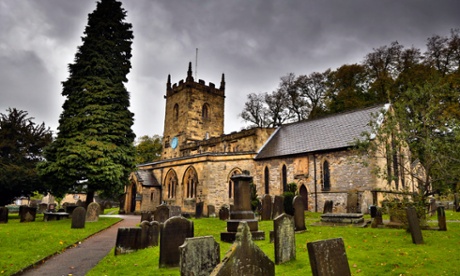
I left Eyam on a clear spring morning through the churchyard of St Lawrence’s. Confetti littered the entrance, cheerful detritus from Saturday’s wedding to set against the ominous tombs. Despite the early hour, holiday crowds were already gathering.
Eyam is famous as the plague village where, in 1666, St Lawrence’s rector William Mompesson led his parishioners in sealing off the village to protect neighbouring communities and then watched half of them die, including his own wife, Catherine.
Climbing the hill past one of the plague stones that marked the village’s exclusion zone, I saw signs for Mompesson’s Well, where food was left for the stricken inhabitants in return for money soaked in vinegar to prevent the spread of infection.
Two buzzards circled over a stand of beeches on the steep climb up to Ladywash Mine. Here, just below Eyam Moor, I heard my first lark of the year and turned to look down on the village while I drank in its song.
Modern quarrying has diminished the view into Middleton Dale, but from this perspective Eyam seems the perfect place to put a village, with its sweet water supply and built on mudstone on the flat between the deep limestone dale and the gritstone heights of Eyam Moor. It has a felicitous energy, which makes Eyam’s fate in the 17th century seem doubly cruel.
How much choice the rector and the people of Eyam had in their isolation is debatable; the well-connected Mompesson made sure his children were safely in Yorkshire before quarantine began.
Mompesson did have the sense to persuade his parishioners to bury their dead in unconsecrated ground; a few of the burial sites, like the Riley Graves east of the village, now maintained by the National Trust, are still to be seen.
Perhaps Eyam’s story best illustrates the resourcefulness of an ancient community that has often defied misfortune. When lead mining failed, there was fluorspar; when that finally ended in the 1960s, there were tourists. They are truly the great survivors.