The plaudits for George O’Grady have been flooding in for days. Not surprisingly, the 65-year-old will discover far more people willing to praise his job as the chief executive of the European Tour now that his departure has been announced.
Which is fair enough. O’Grady is a decent guy who has done, on the whole, a fine job since he took office in 2005. Struggles at the bottom end of the tour are offset by basic economic circumstances and the securing of fresh riches for the top players, primarily during the current, Final Series spell. History should look kindly upon his role and long-standing commitment to European golf.
To an extent, O’Grady has been on to a loser for some time. Comparisons are constant with the PGA Tour in the United States, despite how spurious those are. Tim Finchem, the PGA Tour’s commissioner, may be apparently untouchable in a critical sense but his continuation of a theme which sees bans for playing members kept secret – on the basis of protecting the brand – remains a ludicrous case. There are also humdrum events in the United States, and plenty of them, despite claims to the contrary.
Yet praise of O’Grady should not overshadow what needs to happen next. Namely, that the Tour should look outside golf in a bid to tap into fresh commercial markets. If a continuation of the same was the plan all along, O’Grady’s departure would be a waste of time.
For too long, golf’s approach to sponsors has been back to front. Namely, that is, the pursuit of money in exchange for token exposure rather than working overtime to promote the game as one which can best serve international brands.
Golf needs to sell itself harder than ever, simply on account of competition. The business is not unique so as people from other sectors could not possibly understand how to move things up a level. That freshness, in fact, should be actively pursued.
There is every chance that it will. David Williams, the European Tour’s chairman, has taken the best part of a year to evaluate every component of the business; including talking to players, sponsors and those in the player-management sphere. Not only does Williams have global business experience, he has a track record of stripping back the engines of companies and rebuilding as required.
The decision of Volvo to end its deal to fund the World Match Play Championship after the most recent playing of the event was just the latest indicator that firms see better value elsewhere. Others such as HSBC, Rolex and BMW should actually be consulted on how the European Tour can move forward given their ongoing and marquee sponsorships. HSBC, in particular, has taken an impressive leading role in growing the WGC event in China, which concluded on Sunday.
Firms from across the globe do not invest in Premier League advertising such as shirt sponsorship because of a lifetime alliance with football. They do it because the product offers television exposure and consistency that golf has to catch up on or, at the very least, challenge. That applies to the individual management and sponsorship of players as much as tournaments themselves.
There have been signs that golf is showing an increased level of self-awareness. The Royal & Ancient has recently commissioned a rebrand, which will be rolled out at the Open Championship next July. For all his critics the departing chief executive, Peter Dawson, instigated a series of forward-thinking initiatives which it is hoped will be continued by his successor.
Golf looks to be entering a fresh administrative age. Which does not at all mean what has come before need be rubbished. It should, though, provide a meaningful opportunity for those making decisive calls to plan for the longer term.
Ninyette makes his own cut
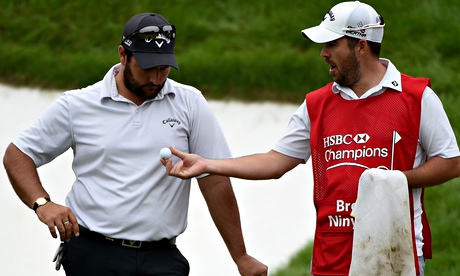
Brody Ninyette will remember the WGC-HSBC Champions event for all the wrong reasons. The Australian blamed a gastric complaint for rounds of 86 and 90, which ensured a 36-hole aggregate of 32 over par.
The problem from here was that WGC events have no cut. Had Ninyette continued it would have caused only further embarrassment to the organisers, not to mention wasted time for those playing alongside him.
The solution? Ninyette was disqualified, handily enough, for apparently signing for the wrong score at the end of round two. Longer term, qualification entitlement for the year’s last WGC tournament may require some attention.
Lawrie and Trump win-double
Friday marks a busy day. Paul Lawrie, the 1999 Open Champion, will address the media in his native Aberdeenshire in what is expected to be an announcement regarding a matchplay addition to the European Tour schedule for 2015.
More intriguing, though, is the return of Donald Trump to Scotland. The American tycoon, who recently purchased the Turnberry resort, will speak at the nearby Glasgow Prestwick airport alongside the facility’s chief executive, Iain Cochrane.
Prestwick’s future has been a bone of contention in Scotland for some time. It is, however, a highly useful asset in practical terms to Trump as he seeks to return Turnberry to former glories and intensify tourist interest. Mystery surrounds the specific nature of Friday’s release but Trump shows little sign of scaling down his Scottish golfing aspirations – which sets him apart from the vast majority.