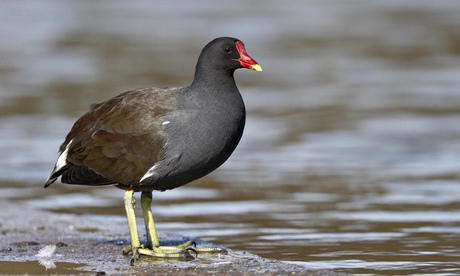
Even past midnight, when I routinely hear their sharp bruuk notes cut clean through the bedroom window, I’m reminded how much moorhens are part of the subliminal mood of our village. As I take my walk across the marsh they are omnipresent fixtures.
There are three basic formats to these encounters. The briefest suggests a blend of rodent and reptile as a charcoal blur snakes into cover.
The most prolonged view is a theatrical affair. Caught unawares midstream, a bird will rally its round wings just enough to raise their owner above the surface of the beck. Yet it seems a moorhen’s body and those two-sizes-too-big feet are not always of one mind.
While the wings beat awkwardly, the toes drag in the water sending up their own chaotic wake of spray. An air of perfect panic is completed by the clattering anxiety in its voice.
A third kind of sighting is the most common. A squat, thin-headed shape pootles across the dyke like a clockwork toy, and the forward jerk of that red beak is timed precisely with the unseen scull of the toes and the backward flick of the white tail, so that one might easily assume all three actions were part of one crudely riveted mechanism.
What all three forms of exit have in common is a moorhen’s self-effacement, which is not surprising given the bird’s popularity with the neighbours.
Pike will snatch them from below, especially when they’re just balls of soot. Foxes can snittle them off a dyke edge and then dash away with a plump powder-puff square in their jaws. Once, when I went to examine a family of marsh harrier chicks, their nest was ringed round by a macabre circle of moorhens’ green legs.
For all the vulnerabilities, there is also something impressive about a bird that can make ends meet in a Mongolian marsh or the turloughs of Co Clare.
You may see moorhens look awkward on the lawns of Hyde Park, but they can also dabble the depths of the Nile or an Amazonian swamp where no human follows.