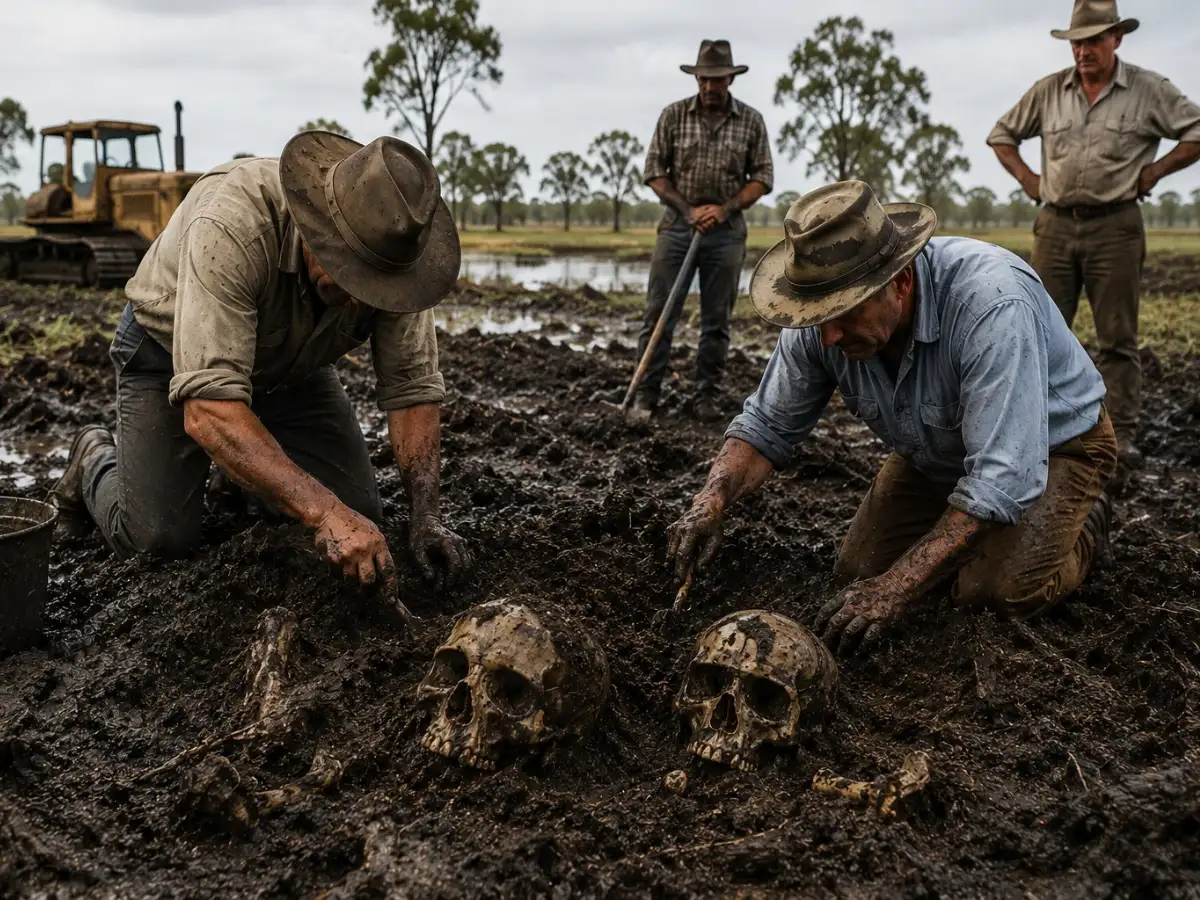
A lucky find made in rural Australia was what sparked one of the most enduring arguments over fossilized bones in the country. Human fossils with exceptionally strong skulls found at the Kow Swamp wetlands in Northern Victoria, adjacent to the research area in Queensland, where public interest was piqued subsequently, left scientists puzzled with a tricky query: are these early settlers merely modern man with extraordinary features, or did they retain elements of a more ancient human lineage?
These fossils appeared particularly remarkable at first. Fossils with skulls shaped rather broadly and thick, coupled with pronounced eyebrow ridges and wide faces, reminded early paleoanthropologists of characteristics that were once typical of archaic humans like Homo erectus. As per findings available through PubMed databases, the Kow Swamp fossils were pivotal in debates around the subject of “archaic features” within the field of Australian paleoanthropology.
Why did the skulls cause such a stir?
What generated interest in the Kow Swamp skeletons is the unique appearance of the remains. They were described by some experts as being robust, and there were even suggestions made early on by researchers who thought that the preserved features were the primitive traits of ancient inhabitants of Southeast Asia, hinting at the theory of the existence of archaic humans in Australia at one time.
However, as it turned out, the matter was much more complicated than that. As indicated by the same PubMed article, later studies showed that an abnormal skull structure alone cannot prove the origin of the people whose skeleton had been found. Researchers raised the idea that the unique appearance could be the result of intentional cranial deformation – a practice where the skull of an infant is reshaped using various methods. Thus, "primitiveness" could very well indicate human activity.
It becomes important because a skeleton may seem primitive while not being from another type of human. Broad skulls, heavy brow ridges, and other distinctive features of ancient peoples can occur due to natural causes or cultural practices.
The bones below the skull told a different story
One of the most compelling reasons for rejecting the archaic explanation stemmed from the study of skeletal remains outside of the skull. The analysis of femoral specimens in Kow Swamp showed that the leg bones were closely related to Homo sapiens and not Homo erectus.
As mentioned by results presented through PubMed, there was no primitive characteristic in the postcranial remains that could suggest the presence of an archaic community in Australia. This was important since any claim that these skeletons were part of a more ancient human lineage required evidence of such characteristics throughout the skeleton structure, not only in unusual skull morphology.
In other words, the femoral analysis suggested that the remains belonged to anatomically modern humans. This evidence steered the argument in a much less controversial direction. Instead of claiming the existence of an archaic community in Australia, scientists began arguing that the fossils were part of early modern human variation.
A debate that lasted for decades
The Kow Swamp fossils would continue to be controversial for many more years, because they found themselves at the center of a much broader dispute concerning the ancestry of the first Australians.
Specifically, according to another review published by PubMed, while some scientists maintained that the robust Australian fossils retained an “archaic suite” of characteristics associated with their Southeast Asian relatives, others held that the fossils could easily be considered a part of the story of the modern humans' migration from Africa.
It was hard to resolve the conflict between the two groups, because they were right about certain facts. Indeed, the skulls looked peculiar, but mere peculiarity could not serve as evidence of different ancestry.
It is interesting to note that the reviews that followed later kept emphasizing the importance of caution. According to the authors, scientists should consider other factors, such as regional variation or adaptation to a particular environment or culture, before classifying fossils as archaic.
Genetics helped settle the argument
A DNA study later added yet another crucial element to the narrative. The ancient DNA study of remains from Australia, which included the bones from Lake Mungo, showed no genetic information suggesting the persistence of archaic hominins in Australia.
As was noted by scientific publications made available on PMC, the genetic information was pointing to an anatomically modern type of people, rather than the descendants of Homo erectus-related peoples. Even though some of the skeletons had a robust build, their DNA could not indicate any connection to an archaic group of hominins.
The population genetics also supported the notion. According to PMC scientific publications, Aboriginal Australians and Papuans have a common heritage from the early settlement of Sahul, a supercontinent consisting of modern-day Australia and New Guinea.
The studies failed to detect any archaic maternal or paternal haplogroups in either of these populations.
Why the discovery still matters today
What made the Kow Swamp fossils valuable was not that they showed the presence of non-modern humans in Australia, but that they showed how quickly ancient bones could be misunderstood by scientists.
In forcing scientists to consider all of the aspects of biology and culture when comparing fossils, the Kow Swamp skull showed scientists that something which at first appeared to support archaic humans could actually end up being used as a cautionary tale.
As time has passed and more research has been done, it appears increasingly likely that the early Australians were part of the same modern human lineage as everyone else, even though their bones might have been sturdier than normal.