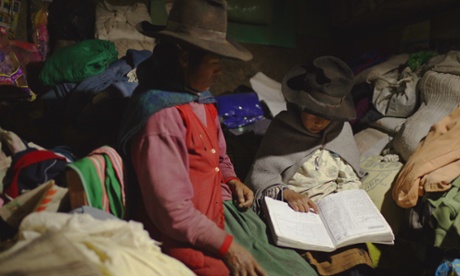
There can be few places on Earth less like the desolate high plains of Chile’s Atacama desert than the tiny Rajasthani village of Tilonia, where summer temperatures reach the mid 40s Celsius.
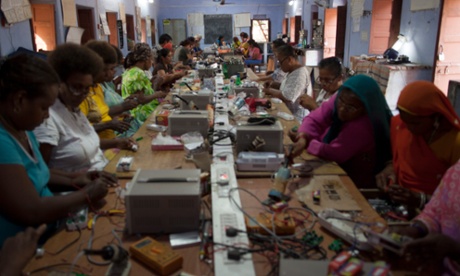
Yet, each September, a handful of illiterate women in their 30s, 40s and 50s leave remote rural villages across South and Central America to make the pilgrimage to Tilonia, enduring flights up to 19 hours long and crossing continents, time zones and the equator to emerge into the shock of a vastly different climate and culture.
For Sanjit “Bunker” Roy, who founded the Barefoot College in Tilonia – inspired by Gandhi’s mission to help marginalised people become self-reliant – this epic journey is a vital part of the process of training some of the poorest women around the globe to build solar panels and bring electrification back to their home villages.
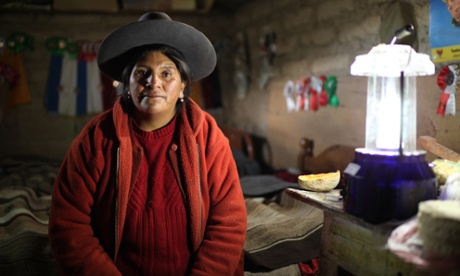
“Some people say: ‘why don’t you bring trainers to these countries [instead of making them come to India]?’” he says. “It’s not the same. You have to bring these grandmothers out of their habitat, their family, community, country and put them in a challenging situation like they have for six months here, mixing with other cultures, communicating with other cultures.”
They emerge from the trial by fire equipped not only with valuable skills, but the confidence to become leaders of their communities when they go back. Since 1989, when the Barefoot College started its solar training programme, it has brought electrification to 1,000 villages, reaching 450,000 people.
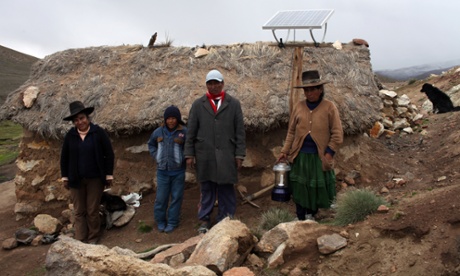
Basic solar kits of the type the Barefoot College trainees build and then bring back to their villages – enough to power four lights, and charge a mobile phone and a portable solar lantern – are widely regarded as key to realising the UN’s goal to bring clean energy to the more than 1.1 billion people who do not have access to electricity, particularly as the costs of solar power have come down sharply over the past seven years.
What has been less well recognised is the importance of equipping local communities with the skills to install and maintain those systems, says Adam Hashian, chief executive of the Boston-based technology firm LucisLumen. He points out that the challenge of finding skilled people to keep the solar systems operating over the 20 years they are meant to last, particularly in remote communities, could be a “major hurdle” to the roll-out of solar power in developing countries.
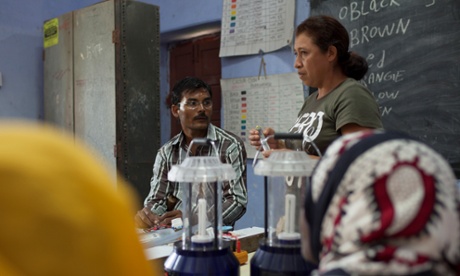
Sarah Best, a senior researcher at London’s International Institute for Environment and Development, a policy research organisation, points to the Niger delta, where projects to build solar-powered water pumps to bring clean drinking water to remote villages were technically successful but failed in time because of the communities’ inability to sustain the projects.
Francesco Starace, Chief Executive Officer of Enel Group, agreed to support the Barefoot College when he was Enel Green Power CEO, thus allowing the first group of women from Latin America to be trained in Tilonia in 2012. He believed the Barefoot approach could be key in helping solve the global energy access deficit: “In the past this problem has never been solved properly. We gave people a generator or some kind of technological contraption, but they didn’t take responsibility. This must be something that’s owned by the people. They should know that they are the ones doing this – which is true for Barefoot College women, since they learn how to build and manage these solar systems, they are the real solar engineers of their communities, the panels are theirs, they are in charge.”
But why choose illiterate and semi-literate women to be the solar pioneers rather than men, who will be more likely to have some education and be easier to teach?
Roy says women are the best candidates because the skills they learn remain in their villages. “Men are restless and ambitious. They just want a certificate and, once they have that, they leave for a job in the city. Grandmas are respected in society. People will listen to them seriously. They are rooted in their communities and will never go away.”
But it does make for a slow and painstaking difficult learning process. Though there are basic materials in their own languages, most or the women cannot read them, and the tutors are often illiterate themselves.
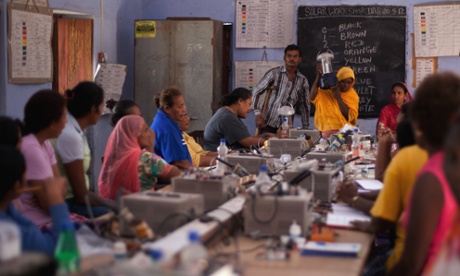
The women’s stories inspired a 2013 documentary about them called Bring the Sun Home, by Chiara Andrich and Giovanni Pellegrini. In the film, Jenny from Candarave in Peru, one of 39 “solar mamas” who have travelled to Tilonia from Latin America, remembers the shock of her first days there. “I didn’t understand a thing. I was spaced out. I had no clue what they were talking about. Our teachers kept repeating things but I couldn’t remember any of it. It was another language and I also worried about my little girls.”
But she says that the process of learning, though difficult, left her with the same feeling of happiness and excitement she’d felt after giving birth.
Another trainee, Luisa Teran, from Caspana in Chile, says her sister sent her supportive text messages every day saying: “Study. We are well. You need to focus on what you are learning.” She says she realised “This is your opportunity to learn that nobody else is going to give you.”
Maria Cristina Papetti, head of Sustainability Projects and Practice Sharing at Enel, says the women, who have come from 41 communities in nine Latin American countries, are well supported through the first difficult two to three months. They always go in pairs so they are not alone, phone calls are arranged home once a week, and someone from a local NGO back home will travel to Tilonia in the third month to spend time with them.
By the end of their time, there is a transformation in the women that runs deeper than their new engineering skills, Papetti says.
“It is a kind of miracle, this process of learning by doing, the exchanging of their experiences with other women from around the world. They go back empowered, strong, full of energy and passion.”
There is a critical month between when the women return to their communities and the arrival of the solar equipment from India. During this time each community will set up a solar committee, which will set a monthly tariff paid by the families that receive solar equipment – typically each community gets around 300 kits. That money will pay the salaries of the solar engineers and some will also go into a fund for replacement parts. A workshop is also set up, where the engineers can work on and store the equipment.
Importantly, Papetti says, this process gives the women the chance to assert their new leadership roles. “The communities can understand and see the change that has occurred to these women.”
Papetti says more than 3,500 solar kits have been distributed in Latin America though its agreement with Barefoot College so far, benefiting 19,000 people. But there is a limited number of people each year who can attend the college, which earned its name because of its rudimentary facilities, including earth floors.
Enel is partnering with Barefoot College about setting up solar training offshoots in a Latin American city, to expand the reach of the college to many more potential recruits, thanks to the support of these 29 already trained solar engineers.
That of course would mean that many women would no longer travel to India. But it is clear that, even if Barefoot College does expand beyond India, there will be no swerving from its Gandhian principles and the approach of taking illiterate women out of remote villages and empowering them with new skills.
Roy points out that women make up two thirds of the world’s 875 million illiterate adults. “She might not know how to read or write. She might never have left her village, but in six months we can make a grandmother into a solar engineer…. Hats off to the grandmothers of the world.”
Content on this page is paid for and produced to a brief agreed with Enel, sponsor of the energy access hub on the Guardian Global Development Professionals Network.