While it’s true that we’re suckers for bulging eyes and sleek long limbs, the Rainforest Alliance didn’t choose its little green mascot only for its good looks. With their semi-permeable skin, unprotected eggs and reliance on external temperatures to regulate their own, frogs are highly sensitive to changes in the environment, making them what scientists call an “indicator group”. In other words, when habitats shrink and ecosystems degrade, frogs are among the first creatures to die off — a sure sign that we need to get cracking to ensure their survival, because other species are certain to follow if we don’t.
No one knows that better than author-photographer Robin Moore. In 2010, Dr Moore, who is also the conservation director of Amphibian Survival Alliance, spearheaded a massive search across the globe for frogs, salamanders and caecilians not seen in decades. Over the course of six months, 33 teams in 21 countries slashed through thick jungle, waded up rivers and hiked remote mountain passes, hoping to find one of their designated “lost frog” species. But the intrepid scientists on these expeditions weren’t just out for adventure: with half of all the worlds amphibians endangered, and 250 species that haven’t been seen since 2000, Moore and fellow researchers were intent on learning what they could about the biggest loss to biodiversity since humans appeared on the earth.
Here are some of Moore’s stunning photos along with his observations.
Ecuador
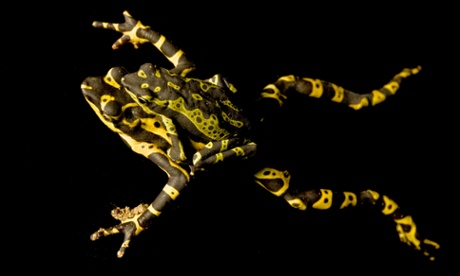
“Local scientists Luis Coloma and Santiago Ron took us to see a new species of frog they discovered in a small stream near Cuenca. When we arrived, we were stunned to find that recent road construction had destroyed much of the creatures’ habitat. Soon I spotted a corpse in the stream’s shallows: a brilliantly colored black-and-yellow harlequin frog. A male, oblivious to her passing, clung to her back, attempting to mate. We took the male to a lab in Quito, but he died weeks later, the last of his kind. A species was lost almost as soon as it was discovered.”
California
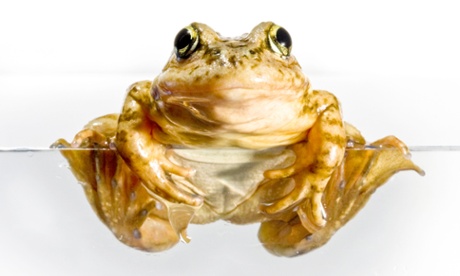
“I visited scientist Vance Vredenburg and his team in the Sierra Nevada Mountains to learn about their work with the mountain yellow-legged frog. Nearly ubiquitous in the high-elevation lakes there at one time, these frogs spend harsh winters under ice by lowering their metabolism so much that they can go without food for nine months straight; tadpoles can spend two or three winters under ice before leaving the pools as froglets. Despite their incredible hardiness, and the apparent pristine state of their lakes, the mountain yellow-legged frogs are dying off rapidly from a disease caused by the amphibian chytrid fungus—which is also decimating frog populations in Costa Rica, Australia and Ecuador. Vredenburg is studying the disease in the mountain yellow-legged frogs in the hope of finding ways to prevent future extinctions at the hands of the fungus and help species that are rediscovered to recover from it.”
Colombia
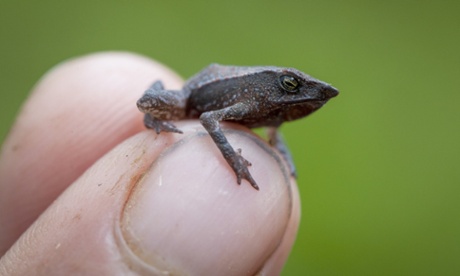
“We went in search of the Mesopotamia beaked toad, last seen in 1914, when Wes Sechrest, CEO and chief scientist for Global Wildlife Conservation, appeared from upstream with a red-brown toad the size of a thumbnail. It is beautiful, with nodes of blue strewn down its flank like miniature jewels. Local expert Alonso Quevedo, president of Colombia-based conservation group Fundación ProAves, took the small creature between his thumb and forefinger and held it close to his eyes as though scrutinizing a rare gem. “This is a different beaked toad. It is likely a new species.” After I off-handedly remarked on the frog’s resemblance to The Simpsons villian Monty Burns, the name stuck, and the Monty Burns toad went on to win Time magazine’s #1 new species of 2010. In our search for a lost frog, we discovered a new one.”
Haiti
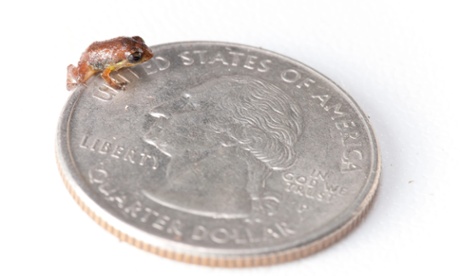
“It was nighttime, and we were camping in a clearing in the cloud forests of Mafisse de la Hotte, in southwest Haiti. To our surprise, our tents turned out to be frog magnets: I plucked one off, and saw that it was the macaya breast-spot frog, last seen twenty years ago! Just a bit larger than a grain of rice, it was perhaps the smallest frog I have ever seen—it’s certainly one of the smallest in the world. I pulled out the white background that I carry with me on expeditions and a coin for scale, and snapped this shot. This minute frog, found on just two mountains in southwest Haiti, is critically endangered because of habitat loss. On the bright side, we ended this expedition having rediscovered six species—including the little macaya breast-spot frog—that haven’t been seen in two decades.”
Israel
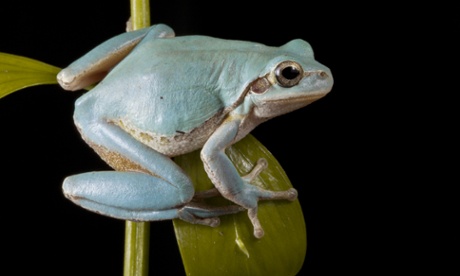
“I spent the day with scientist and amphibian expert Dr. Sarig Gafny, searching for the painted hula frog, a species that disappeared in 1955 and resurfaced in the Hula Nature Reserve in 2011. Alas, no luck. Sensing my great disappointment, Gafny offered this consolation: “Want to see a blue tree frog?” I told him I didn’t realize there were blue tree frogs in Israel. “There aren’t,” he replied. “Well, there aren’t supposed to be.” Gafny, one of Israel’s leading amphibian experts, had never seen a blue tree frog either; when he heard about this one, he assumed it was a new species. But after running DNA tests, he confirmed that it was a lemon-yellow tree frog, common in Israel. Only it was blue.”
Costa Rica
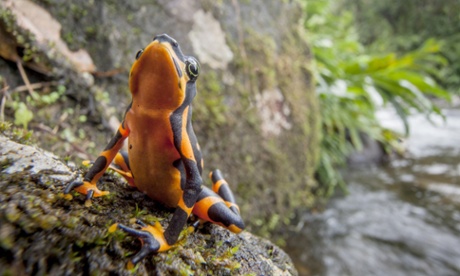
“The creature in front of me was something that had grown in my imagination to mythical status. The variable harlequin frog of Costa Rica and Panama was thought to have gone extinct in the 1990s, but a remnant population surfaced in Costa Rica in 2003—and now I was looking right at one. The culmination of millions of years of evolution, the variable harlequin frog is a survivor of one of the worst animal mass-mortalities in recent history. (They are now believed to be completely extinct in Panama.) As I studied her granular skin, her lime-green eyes met mine. I felt humbled and re-inspired to continue our research.”
For more of Robin Moore’s photos and stories from his journey go to his website In Search of Lost Frogs.
Content on this page is brought to you by the Rainforest Alliance, supporter of the Vital Signs platform.