MANATI, Puerto Rico _ Some had arrived with wounds from the twisted metal and debris that still littered streets. Others came sick from the contaminated water and mosquitoes that followed the hurricane. And a few, displaced from the local hospice, were spending their final days in the company of family.
All around them, doctors and nurses conferred in hushed tones amid the neat rows of cots lining the sports stadium turned temporary medical shelter. Generators hummed in the background, powering the ventilators and feeding tubes of patients who had fled nearby hospitals after Hurricane Maria knocked out power across the island.
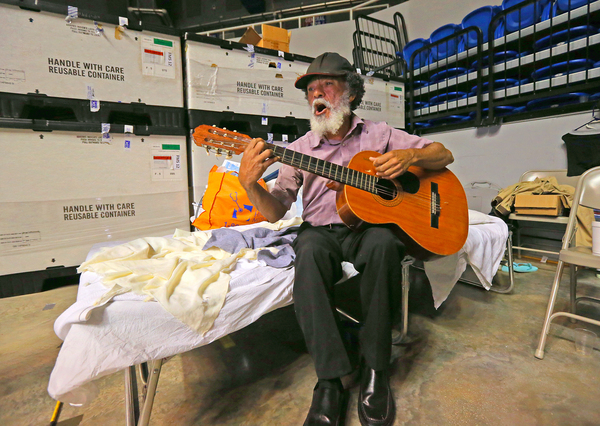
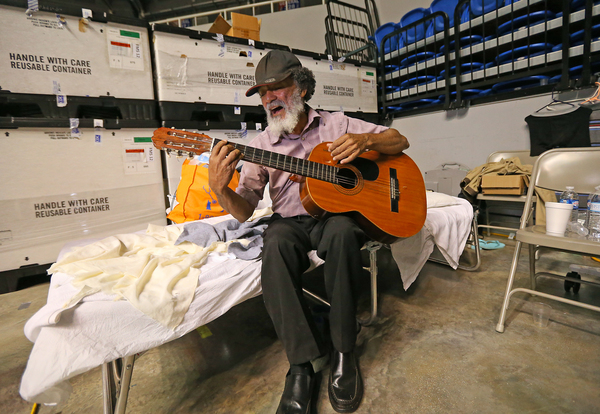
Then in one corner, under a row of bleachers, an old man picked up his guitar and began to play _ for his wife on her deathbed and for the doctors and nurses who had come from the mainland to take care of her and so many others.
"Gracias," he sang, "today I want to thank all of these women and men that God has sent here to help Puerto Rico in this devastation."
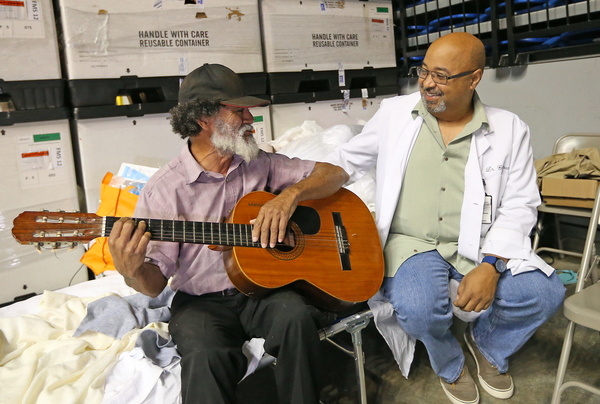
As he strummed, a small crowd gathered. Some of the medical staff didn't understand the words in Spanish, but Santos Candelaria explained that he had composed this song just for them. One doctor, Puerto Rican-born Alfredo Guzman who had traveled from Alabama, sat down on the cot next to Candelaria. When the old man played another piece _ "Preciosa," a standard about love and nostalgia for the island _ the doctor joined in.
"Now I understand," they sang, "that whatever happens, I will be Puerto Rican."
Another old man walked over and stood quietly at the foot of the hospital bed where Candelaria's wife, Evelyn Rivera Vargas, lay, breathing through a ventilator and unresponsive to the music around her.
Jose Velez, 79, also began singing softly, his voice barely audible above the generators.
"It makes you alive," he said later, after the music had ended and he had returned to his own ailing wife's bedside. Velez had lost his home in the hurricane and taken his wife to the temporary hospital because they needed electricity to power her medical equipment. She suffered from Alzheimer's and Parkinson's disease and diabetes. "She's got a lot of things," Velez said.
Since it first opened on Oct. 3 in the Acropolis de Manati stadium, the medical shelter in Manati had taken in some 4,000 patients. About two-thirds just needed medication refills or had minor injuries, but couldn't go to the local clinic because it hadn't reopened yet. The rest came from nearby hospitals, hospices and nursing homes _ or directly to the shelter in ambulances _ and filled the roughly 100 beds on the stadium floor. They would stay at the shelter until they healed or until local facilities were up and running.
"We're here at the request of the Puerto Rican local government," said E.J. Brennan, a spokesman for the New York-based NY-2 Disaster Medical Assistance Team, one of the groups running the shelter. "They define the need and we fill it wherever we can. We know that they're going to recover, but we'll be here as long as they need us."
Doctors and nurses from the Veterans Affairs medical system and volunteers from a number of New York hospitals had also answered the call. Together, they kept the temporary hospital running 24/7, even when the generators crashed _ which had happened a few times. They had one emergency generator that powered the ventilators during blackouts, but everything else, including the computer systems to track patients, went dark.
For Candelaria and his wife, the medical shelter had been their last hope.
The 71-year-old musician had stayed by Rivera Vargas' bedside at a nearby hospice when the hurricane hit. But the next day, the generator broke there and Candelaria had to rush his wife to a shelter. Then that shelter's generator ran out of diesel, and Candelaria had to take his wife to two different hospitals in search of a reliable generator to power her ventilator. They had finally arrived at the sports stadium on Oct. 22. "We've been traveling a lot in ambulances," Candelaria said.
So now, Candelaria serenades his wife and the hospital staff every morning with traditional songs _ his voice sweet and strong. It had been Candelaria's singing that had first made Rivera Vargas fall in love with him 45 years ago when they met at a concert where he performed. They had raised a daughter together and shared a happy life, Candelaria said. But 12 years ago, Rivera Vargas was diagnosed with Alzheimer's disease and Candelaria had been caring for her ever since.
"She was a beautiful, wonderful woman, but the age and the sickness really can change a person," he said. "It's not easy to see a person that you've known for so many years deteriorate by the minute."
It wasn't clear whether Rivera Vargas knew her husband was by her side or whether she could hear him singing. But that didn't matter to Candelaria. He had been singing to her every morning and sleeping on a cot next to her bed every night since they'd arrived.
"I sleep close to her," he said. "We've been doing that for the last 45 years."