In 1946, the novelist Rebecca West travelled to Nuremberg to report on the closing sessions of the war trials for the Daily Telegraph. At 54, and routinely billed as "the world's no 1 woman writer", she was consolidating her taste for moral inquiry. In only a year's time, her book on the rasping Lord Haw-Haw would try to untangle, in the words of her own title, The Meaning of Treason. But in August 1946, she was concerned with evil of a blunter kind. Before the panel of judges, drawn from across the Allied nations, stood a clutch of top-ranking Nazis including Goering, Hess and Speer. West's descriptions of this gaggle of defeated men would be among the best things she ever wrote.
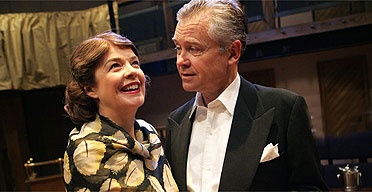
Those few weeks in Nuremberg, during which West grappled with the social and political landscape of the unfolding postwar world, form the basis of Tosca's Kiss, a new play that opens this week. The playwright Kenneth Jupp has neatly stitched together West's published account of the trial with his own speculation as to what she might have said and thought in the privacy of the grand official residence where she was staying for the duration. (Less celebrated female members of the press corps were packed into makeshift dormitories in a hotel across town.) Jupp's ascribing to West thoughts that she may not actually have had is slightly risky. For instance, he slides over the fact that the scrappy socialist of the 1920s had become much more conservative in middle age - West was, after all, writing for the Telegraph. Instead, he prefers to imagine her with all her early capacity for outrage intact. All the same, the play reminds us that there was more to Rebecca West's life than a series of anecdotes about her untidy early love affairs.
In her Telegraph pieces West mapped the tense/bored atmosphere of the Nuremberg court, in which everyone strained a little too hard to find the correct face or laughed too loudly at the judges' jokes. Her quick eye picked out Goering's strangely abundant hair and the mimsy manners of the youth leader Baldur von Schirach, who resembled a "mousy governess".
Another man, too, caught her attention. Hjalmar Schacht, at nearly 70, was by far the eldest. Conspicuously contorting his body so that he sat virtually at right angles to his coaccused, it was clear that he considered himself a cut above the drones and thugs with whom he was temporarily obliged to share space. Schacht was not a general, nor a mouthpiece, nor even a loyal foot soldier; he was a money man, an international banker whose job as minister of war economy in the late-1930s had him raising vast funds for Germany's rearmament.
In the end Schacht was acquitted, one of only three defendants to walk free. His defence was a sophisticated version of "I was only doing my job". Since that job involved raising millions of marks rather than herding people into gas chambers, the judges accepted his plea. West, in her Telegraph article, argued with amused logic that this was only right and proper, since "rearmament itself had never been pronounced a crime; and it is impossible to conceive an article of international law that would have made him a criminal for his doings and not given grounds for a comparison with Lord Keynes". All the same, that didn't mean she had to like Hitler's banker. When, on the final day, the defendants were given an orange for their lunch, the two other acquitted men passed their fruit to those who had been condemned to hang. Schacht, West noticed, kept his orange.
The Nuremberg trials came at a critical time in West's life. Although well into middle age, West found it difficult to shake off the tag that she had gained 30 years earlier of "HG Wells' mistress". The relationship had been anguished and angry, with Wells refusing to leave his wife Jane, yet displaying extraordinary pettishness when West tried to claim the same romantic freedoms herself. The birth of their son in 1912 had turned the affair into a small, delicious scandal and ensured, once Anthony West was old enough to brag about his parentage, that their names would be yoked together for ever.
All the same, since her final parting from Wells in 1923, West had failed to find happiness. Fleeting affairs, including a fling with Max Beaverbrook, had unwound eventually into an unrapturous marriage to a banker called Henry Andrews in 1930. At some point in the mid-30s Andrews had stopped sleeping with West, which means that by the time she arrived at Nuremberg she had been wandering in the sexual wilderness for over a decade.
Then two things happened that are probably not unrelated. Just as West set out on the convoluted journey to Germany (direct flights were reserved for the military), Wells died. While they had not been in regular contact for some time, it looks as if as late as 1935 Wells had been suggesting to the unhappily celibate West that she might consider starting up their relationship again. Now there was no chance of that happening, West seems to have felt able to claim some sexual happiness for herself. For several heady weeks during that fresh, golden German autumn, she enjoyed an affair with the American judge, Frank Biddle, a distinguished former Democrat attorney general. There was never any question that the two middle-aged lovers would ditch their spouses. None the less, this seems to have been the last time (she died in 1983 at the age of 90) West, the woman whose free sexuality had so scandalised early 20th-century society, let a man make love to her.
In Tosca's Kiss, Jupp uses the refusal of Puccini's Tosca to grant the evil police chief Scarpia any sexual favours, even though it would save several muchloved lives, as the motif around which his main characters circle. In Jupp's script, West is anguished by the way in which Biddle is prepared to allow Schacht to slip free so that he may continue his task of building up Germany as a bulwark against Russian expansion from the east. For Biddle, Schacht at liberty is a necessary evil, the price to be paid for "just trying to get us through the next decade". Jupp's West applauds Tosca's futile gesture, believing "there is nothing more inspiring in this world than to watch someone behave according to their beliefs - regardless of the consequences". Biddle comes back sharply: "But that's an opera."
To make his story work, Jupp has had to play with the facts. His Schacht is no sooner out of jail than he is flourishing once again, even signing up for Biddle's own country club in the US. In fact, Schacht was swiftly rearrested by the Germans, sentenced to eight years, and didn't get out until 1948. Wells' death, too, is shifted by a week so that the news may come while West is already in Nuremberg and ripe for the consoling arms of Biddle.
In other places, however, Jupp pulls back. Rather than ascribe to her words that have no historical basis, Jupp creates the figure of Tom Morton, a young American prosecutor, who voices the arguments that Jupp perhaps hopes were made by West. For Morton, who was there at the liberation of Dachau, the connivance of Biddle and the American establishment at the release of Schacht is an intolerable compromise with the forces of darkness.
Although West's Nuremberg articles caused a stir when they appeared in the Telegraph, they weren't published in book form until 1955. It was, instead, her 1947 study of several British traitors, including William Joyce, aka Lord Haw-Haw, John Amery and the scientist Dr Alan Nunn, which confirmed her public reputation as someone who had thought long and hard about the evil men do (women never figure strongly in West's non-fiction landscape although her novels were another matter). Yet all the signs suggest that it was in Nuremberg, rather than the Old Bailey, in recovering Germany rather than still down-at-heel Britain, that Rebecca West first came face to face with the problem of principle in a world that seemed to be playing by a new set of rules
· Tosca's Kiss is at the Orange Tree, Richmond, Surrey, until June 3. Box office: 020-8940 3633.