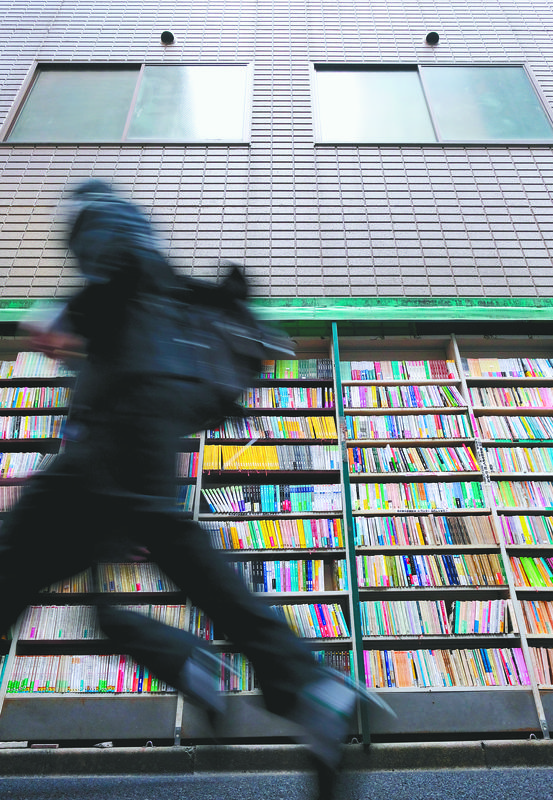
Located along Suzuran-dori avenue in Tokyo's Jinbocho district, which is sometimes referred to as "book town," is a store that specializes in publications relating to China.
Uchiyama Books Co. is owned by Shin Uchiyama, 45, whose great-uncle was the well-known book proprietor Kanzo Uchiyama.
"I've heard Kanzo was always smiling and easygoing," Shin said.
The history of Uchiyama Books dates back to when Kanzo traveled to Shanghai aged 28. In 1917, his wife Miki began selling books related to Christianity from a small stall in front of their house. The shop was initially intended to give Miki something to do while Kanzo was busy traveling all over China as an employee of Santendo Co. (now Santen Pharmaceutical Co.), a company well known for its Daigaku Eye Drops.
The store began dealing with general publications at the request of Japanese bankers and traders living in China, but its selection of books also attracted Chinese intellectuals who had studied in Japan, such as literary great Lu Xun and scholar Guo Moruo. Notable Japanese figures such as Sakuzo Yoshino and Junichiro Tanizaki also visited the bookstore.
While the Manchurian Incident of 1931 began a bleak period of Japan-China relations, Kanzo's shop was a salon of cultural exchange, crowded with visitors freely chatting over cups of tea.
Kanzo's younger brother Kakitsu, the current proprietor's grandfather, was an art teacher who traveled to Shanghai, where he held a block-print workshop at the request of Lu Xun. This experience led Kakitsu to open Tokyo Uchiyama Books in Setagaya Ward, Tokyo, in 1935 as a bookstore to introduce Chinese culture. Two years later, it was relocated to the Kanda-Jinbocho area.
World War II ended in 1945, when Kanzo turned 60. His bookstore in Shanghai closed and he was forced to return to Japan two years later.
Kanzo finished writing his biography "Kakoroku" on Dec. 30, 1950. In China, people retrace their footsteps when they turn 60, believing they have a responsibility to pass down their life experiences to those around them and future generations.
Kanzo was determined to take up his pen and write about his life, noting in his biography, "No one other than myself has had my history, so I want to share it."
Kanzo was not able to return to Japan with diaries and notes that he had kept while living in China so had to rely on his memories when writing his biography, in which he describes his fascination with the vitality and passion of Chinese people.
Gourmet town
As well as being famous for books, Jinbocho is also known for its gourmet offerings. The area is especially popular among curry enthusiasts for the many curry restaurants dotted across the district, including Sumatra Curry Kyoueido, which opened in the Taisho era (1912-1926).
I recommend getting a free map of the area's used bookstores at the information center located along Suzuran-dori. Staff at the center offer not only book-related tips but also recommendations for popular gourmet spots, among other information.
With its cabin-like interior filled with natural wood, Sabouru, which opened in 1955, has many famous fans. People form a long line every day in front of the restaurant for its hearty spaghetti Napolitan and fresh strawberry juice.
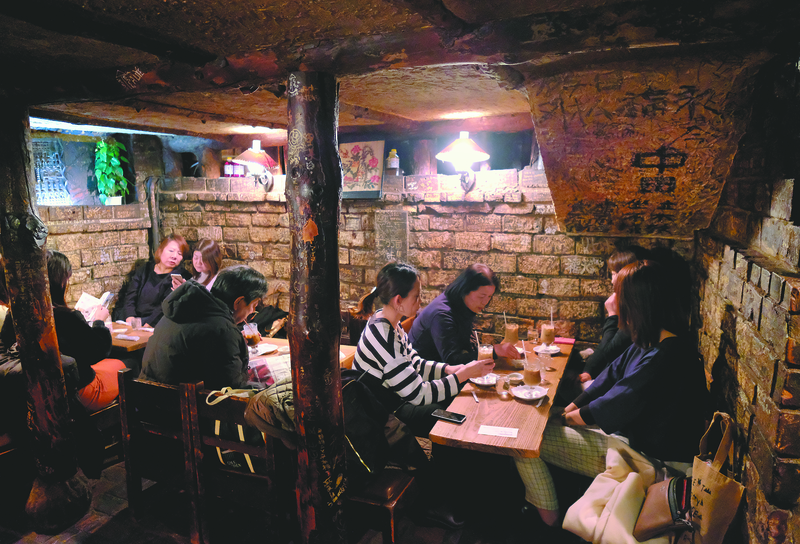
Another recommendation is Ladrio, which is said to be the first cafe to serve Viennese coffee in Japan. The original brick wall from the shop's 1949 opening gives the cafe a retro feel.
You may notice that Jinbocho has many long-established Chinese restaurants, including Yosuko Saikan, which opened in 1906. At the end of the Meiji era (1868-1912), about 50,000 Chinese students were said to have lived in the Jinbocho area.
Lu Xun studied at Kobun Gakuin private school, established by judoka Jigoro Kano. The area around the school was crowded with Japanese language schools and meeting halls for exchange students. Reasonably priced restaurants and barbers targeting cash-strapped students opened one after another, giving Suzuran-dori an atmosphere similar to that of a Chinatown.
Former Chinese Premier Zhou Enlai came to Japan in 1917 to study Japanese at a school in the area. Whenever he had a craving for the taste of home, he ordered meatball soup at Kanyo-ro, a restaurant run by a native of China's Jiangzhe region. The restaurant, which still serves the dish, is a popular attraction for fans of China's first prime minister.
To find out more about Japan's attractions, visit http://the-japan-news.com/news/d&d
Read more from The Japan News at https://japannews.yomiuri.co.jp/