In Homer’s Odyssey, Nausicaa is a tall, gutsy teenage princess who finds a naked and helpless Odysseus washed up on her shore, gives him her brothers’ clothing, and instructs him on how to appeal to her mother, Queen Arete, for help to get home to Ithaca. She is crucial to his eventual return home after 20 years’ absence.
But she doesn’t appear in Christopher Nolan’s film at all – and her absence is part of a broader debate about how his version reduces or simplifies the role of women in the epic poem. In the Guardian, classicist Emily Hauser mourned the absence of the “delightfully brash princess”, along with nuance and complexity.
“There are more female characters than in most Nolan movies, thanks to the source material,” wrote classics professor Emily Wilson, whose translation of The Odyssey is a critically acclaimed bestseller, this week. “But none of them has much to say, in contrast to the characterisations in the poem.”
This applies to several key characters, from the enchantress Circe, who turned Odysseus’ men into pigs, to Odysseus’ wife Penelope. But what about the absent Nausicaa? Who was she? And why was she important?
Nausicaa, Odysseus’ teenage saviour
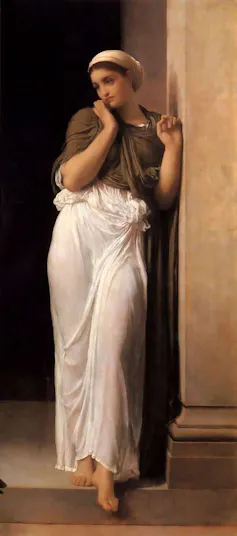
Nausicaa lives on the island of Scheria, where she and her fellow Phaeacians, an isolated and peaceful people, rarely encounter strangers. The goddess Athena visits the teenager in a dream and encourages her to wash her dirty laundry. She tells her the best young men of Scheria want to court her, and that Nausicaa and her bridesmaids will need clean dresses.
When she awakes, Nausicaa asks her father, King Alcinous, to loan her a mule-wagon so she and her female slaves can take the laundry to the seaside to wash. She offers to wash her father’s and five brothers’ outfits too, claiming she wants them to have clean clothes to work in and go dancing.
Nausicaa drives the wagon herself and joins in the manual labour of washing the laundry in a river that flows into the sea. She is near the spot where Odysseus has been washed ashore on a raft after leaving the island of Calypso, the lovelorn nymph, who sheltered him for seven years before being forced to let him go.
While the laundry dries in the sun, the girls play catch with a ball. Homer says Nausicaa is so tall, she stands out from the others, like the virgin goddess Artemis surrounded by nymphs. Their play wakes Odysseus, who jumps up from the bushes, naked and covered in grime. The slave girls run away, but Nausicaa stands her ground.
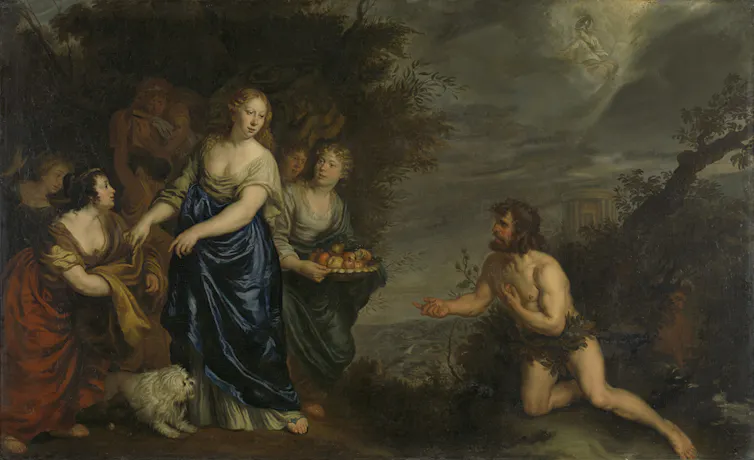
Odysseus praises her beauty and assures her whoever marries her will be the luckiest man by far: there is nothing better than a husband and wife whose minds live in harmony, who live in one house and make their enemies jealous. He is projecting his own desire to return home to his wife Penelope, but guesses accurately what will make this teenage princess trust him.
Thoroughly impressed, Nausicaa promises to give him clothing, food and drink, and a good wash.
After Odysseus bathes himself (at a distance, he’s shy), Athena does something special: she makes him look hot! She “made his hair grow curling tendrils like a hyacinth” and pours beauty on him just like pouring gold over silver. She makes him “look bigger and sturdier”.
Nausicaa is “shocked” and admits to her slaves: “I hope I get a man like this as husband, a man that lives here and would like to stay.” Flirting, she compliments Odysseus’ good looks.
Her next task is to save his life. She instructs him to enter her father’s palace without her, find the Great Hall, pass her father King Alcinous and go straight to her mother Queen Arete, who will be spinning wool by the hearth, and clasp her knees.
The wool-spinning alone is a sign of Arete’s status. She performs the most essential task of the household’s self-sufficiency and sustainability – making thread to weave on a loom into textiles – in the most public part of the palace.
Arete, the previous king’s daughter, has the people’s respect. What’s more, she wove the clothing Nausicaa has just loaned Odysseus. Homer says Arete recognises the clothes and is the first person to speak to Odysseus directly: “Where are you from? And who gave you those clothes?”
But she already knows: Nausicaa has given Odysseus her stamp of approval by sending him to her mother wearing them.
Arete and Alcinous receive Odysseus as their guest. It is to the Phaeacians that Odysseus narrates his adventures – such as the encounters with the Cyclops and Circe – and not, as in Nolan’s screenplay, in a lotus-induced state to Calypso. And it is the Phaeacians who escort Odysseus back to Ithaca and his family.
Penelope is shrewder in the poem
Most significantly, Odysseus’ meeting with Nausicaa is a dry run of his reunion with Penelope. He succeeds in persuading Nausicaa to trust him, helped by his good looks.
But his wife will prove shrewder. After Odysseus has killed all 108 suitors on Ithaca, he finally meets his wife as himself, not in disguise. Athena makes him look hot again, as she did on Scheria – curly hyacinth hair, beauty like gilded silver.
Penelope is not won over by this appearance. She tests his identity in another way, tricking him into revealing his knowledge of their immovable marriage bed and its construction around a tree – something replaced in Nolan’s film with a pendant of Athena that Odysseus carries around with him.
In Homer, the knowledge of the bed is more special, since it exemplifies the husband and wife whose minds live in harmony: the very thing Odysseus guessed Nausicaa wanted for herself someday.
“I love that not only is this about a very clever and ingenious man, it’s also about a very clever and ingenious woman, who’s his match in every way,” Madeleine Miller (author of a novel on Circe) told the New York Times about Penelope’s role in the Odyssey, in the lead-up to the film.
(In Nolan’s version, whose script Wilson claims she would have been “ashamed to have written”, Penelope is “barely more interesting” than the doll he has Odysseus carry to represent her.)
Miller said in Homer’s Odyssey, Circe comes to an understanding with Odysseus and invites him to stay as long as he needs. She offers “a place of peace and a haven”, where she helps him “recover from trauma”. Nolan omits the fact that Odysseus sleeps with Circe – and stays with her (and his men) for two years.
It’s a shame Nausicaa was left out of Nolan’s Odyssey: she is a good example of how Homer’s Odyssey is “a woman’s poem”, as many scholars have recognised.
But Nolan is faithful in one way to how Calypso and Circe appear in Homer: there is every indication they will continue on with their lives once Odysseus leaves their company. Had he included Nausicca, too, she would be another woman who is not just part of Odysseus’ adventures, but have independent narratives of their own – which happen to include Odysseus in it.
This article was originally published on The Conversation. Read the original article.