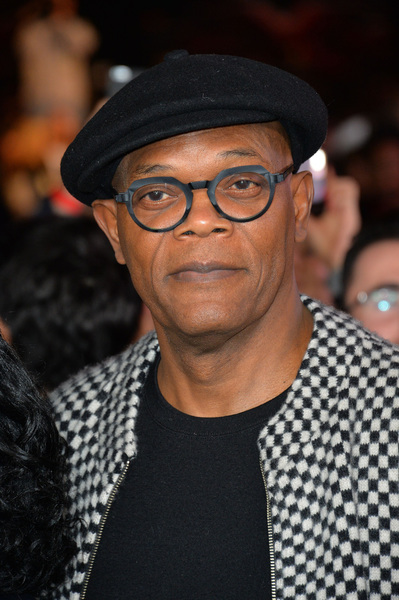
LOS ANGELES _ The evening before he planned to cast his Oscar ballot, Samuel L. Jackson had no doubt as to who had his lead actor vote.
"I don't think anyone did a better job than Denzel," Jackson said of "Fences" star and friend Denzel Washington, who vies for the Academy Award on Feb. 26. "That's a difficult role to play. I've seen him do it onstage _ and he's great."
On a weeknight in Hollywood, Jackson sat backstage at the ArcLight Cinemas before a Q&A following a screening of Raoul Peck's "I Am Not Your Negro," in which Jackson brings the words of the late author James Baldwin to life.
The film is nominated in the feature documentary category, and as Jackson's voice and Baldwin's stirring words wafted through the Cinerama Dome, which was filled nearly to capacity, the actor surveyed the Academy Awards field between puffs from a vape pen.
He digs "Moonlight," director Barry Jenkins' tale of an isolated black teenager growing up gay in Miami, which is nominated for eight Oscars, including best picture, director, screenplay and supporting actor for Mahershala Ali.
"I like the kids," he added, praising the trio of actors _ Alex Hibbert, Ashton Sanders and Trevante Rhodes _ who play protagonist Chiron through three acts. "Mahershala is great, but I like everybody who played that kid."
Jackson, who's been a member of the academy since earning his first Oscar nomination for "Pulp Fiction" in 1995, sees all the nominated movies, although he didn't quite make it through all of this year's nominees.
"The movie everybody's so hyped on, I only made it through 20 minutes. I mean, I like Fred Astaire and Ginger Rogers," he quipped with a sly smile, never once uttering the words "La La" or "Land."
At 68, Jackson is one of Hollywood's top box-office earners and arguably its most versatile blockbuster star. But when Haitian filmmaker Peck approached him to narrate Baldwin's unfinished manuscript "Remember This House," about the legacies of the author's slain friends and activists Martin Luther King Jr., Malcolm X and Medgar Evers, Jackson agreed after one phone call.
He recorded his "I Am Not Your Negro" narration while on location in Bulgaria, where he was filming the action movie "The Hitman's Bodyguard" with Ryan Reynolds.
Jackson had read Baldwin as a student at Morehouse College, where he sparked to the Civil Rights Movement and, later, to acting. Baldwin, a gay African American who fled mid-century American prejudice for an expat life in France, had by then been publishing incisive condemnations of America's racial malaise from abroad.
"He was a shock to the system," said Jackson. "I hadn't read anything like it that confronted the ideals of what America had presented."
Raised in segregated Chattanooga, Tenn. _ "what I now refer to as American apartheid," he says _ the young Jackson found in Baldwin a voice for the feelings he hadn't been able to express.
"To know that there was another way to fight aside from sitting in, or being confrontational with the powers that be of the dominant society, through literature, was really exciting for me," said Jackson, whose commanding readings make Baldwin's words boom, surge and ache.
In the stillness of the ArcLight green room, Jackson mulled the precision with which Baldwin targeted the roots of white American bigotry.
"He plunged into the psyche of the dominant culture in such a way that you see what they're trying to set up. So when you hear a phrase like, 'Make America Great Again,' you know what that means," Jackson said. "And you know what the psychological makeup of that 'again' is.
"To know that we haven't traveled that far from that same general psychosis is amazing. As much as we think we've grown, we haven't grown at all."
Sporting a knit cap with the words "Stay Up _ POTUS 44 delivered," Jackson assessed President Donald Trump's embattled new administration.
"It feels a little like the volatility in the air of the '60s," he said. "I can feel the turmoil. There's a lot of fear in the air too."
Which is why, in a year in which the Oscar race and politics have dovetailed so acutely, a movie like "I Am Not Your Negro" resonates with power and immediacy.
"As illuminating as '13th' is, and as 'walk down memory lane' as ('OJ: Made in America') is," Jackson said of "Negro's" documentary rivals, "this is way more relevant to what we're facing on a day-to-day basis in terms of people trying to change our lives and put us back into place."
Through a 45-year career in Hollywood, Jackson has witnessed major shifts in the representation of black life in mass media that Baldwin criticized.
Now, he said, television is richer in opportunities for minority performers, pointing to ABC's "black-ish," WGN's "Underground" and OWN's "Queen Sugar."
But not everything has changed. Watching Viola Davis lead the supporting actress field for her commanding turn in "Fences" this season reminded Jackson of his own "Pulp Fiction" experience, when he was campaigned for supporting actor while John Travolta was pushed as lead.
He had his qualms at the time, given that the two have similar roles and screen time, "but it didn't matter because it was Harvey (Weinstein)," he shrugged. (Both he and Travolta earned nominations in their respective categories.)
"Viola is great," Jackson said. "But she's not a supporting actor. You don't get to make that choice. That's bull ... to me."
He is, however, supportive of this year's inclusive best picture titles and pitched in to buy tickets for underprivileged youth to see "Hidden Figures," the true tale of three unsung African American heroines who battled racism and sexism while helping launch the U.S. space program in the 1960s.
And he's mindful of what an Oscar win can, and can't, do to boost an actor or actress' profile.
"I don't think an Oscar moves the comma on your check like it used to," he said, "because it's all about (butts) in seats.
"I remember doing a movie with an Academy Award-winner," he said, politely not naming names. "I specifically had a clause in my contract that said I had to make a million more dollars than him because he doesn't put (butts) in seats _ I do. It's knowing who you are and what you're doing."