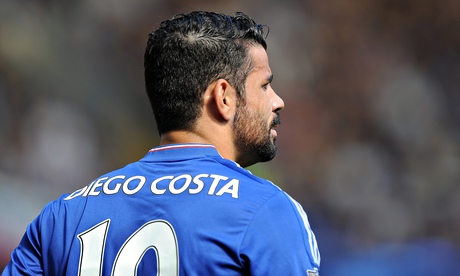
It’s not unheard of for a player to inspire an outburst of unanimity among football watchers – Lionel Messi is quite handy on the ball, Saido Berahino needs to let his football do the talking – but the collective harrumphing over Diego Costa’s performance for Chelsea at the weekend was contradicted only by his manager’s protestation that the Brazil-born Spain international should be named man of the match.
For Arsène Wenger, whose Arsenal team lost 2-0, Costa’s display was simply “unacceptable.” José Mourinho is supposed to be the master of misdirection but with his post-match comments Wenger ensured that he would not have to endure another media inquest into his failure to beat his Portuguese rival in a competitive fixture – a run that now extends to 13 matches.
A defeated manager blaming the terrible refereeing/cheating opposition/planets’ alignment may not seem the most earth-shattering news but there’s something about Costa that football’s commentariat cannot get enough of.
Costa’s roughhouse aerial challenge on Laurent Koscielny was followed by a spot of pushing and shoving and then an altercation with Koscielny’s defensive partner, Gabriel Paulista, that resulted in the Brazilian centre-back’s dismissal.
Gabriel was not involved in the original clash between Costa and Koscielny – for which neither was penalised. It was he who came over to take issue with the Chelsea forward, he who continued the argument even after receiving a yellow card and he who flicked out the sly boot that earned him a straight red, which, according to some, cost his side the game. David Beckham was hanged in effigy for less but relatively little opprobrium attached itself to the Arsenal man. Who cares about Gabriel when there is such a perfect pantomime villain to hand?
Costa’s effect when he arrived in England last season was instant and catalytic. A Chelsea side that had so painfully lacked a dominant striker surged to their first Premier League title in five years, with Costa scoring 20 league goals, despite being hampered by a dodgy hamstring. He also immediately made a name for himself as a defender’s nightmare, always niggling, chivvying and denying his opponent any peace; a man, they said, who could start a fight in an empty room. The clinching element was his on-pitch demeanour: a mean, moody brute, part Popeye’s glowering nemesis Bluto, part sneering Jesus from The Big Lebowski.
Mourinho complained that his team should have been awarded two penalties on Saturday for fouls on Costa and while he may have been stretching a point – a manager exaggerating in a post-match interview? Whatever next? – Chelsea have felt their striker is given less than his fair share of decisions because of his reputation. In this view a pattern was set in his very first Premier League game, when he was tripped in the area by Burnley’s goalkeeper Tom Heaton but the referee chose to book the forward for diving.
Team-mates say that off the field Costa is funny, charming and thoughtful. Unfortunately for him, pretty much none of that communicates itself to the wider public, not least because he has yet to give an interview in English.
Didier Drogba, Costa’s illustrious predecessor as leader of the Chelsea line, was also vilified for his approach to the game, particularly in his early years in England. Time and again he would elicit the euphemistic observation that “he goes to ground easily for a big man.” (Incidentally, Drogba’s only yellow card for diving in a Chelsea shirt – on 11 September 2004 in a 0-0 draw at Villa Park – was rescinded by the referee, Rob Styles, with the implication that Ulises de la Cruz’s challenge had merited a penalty.)
Over the years, though, the narrative around the Ivorian underwent a shift in which his qualities as footballer and leader, on display in the Champions League victory in Munich in 2012, received more prominence. Likewise, Slaven Bilic, once denounced for ruining Laurent Blanc’s World Cup in 1998, is now lauded as the hip sophisticate transforming West Ham’s fortunes.
In part, the reaction to Costa reflects deep-seated cultural biases about what is acceptable on a football field, including what is “acceptable” foul play. When Chelsea toured South America in the 1920s, their players found themselves roundly booed in their match against a Buenos Aires XI for their tactic of shoulder charging. What the English saw as manly physicality, the Argentinians viewed as violent and boorish.
Meanwhile, the English view of South America as the home of sneaky, cowardly cheats – who were also infuriatingly talented – was already well established. Alf Ramsey’s dismissal of Argentina’s 1966 World Cup side as “animals”, the outrage at Maradona’s first goal against England in the 1986 tournament and the contempt for Rivaldo’s playacting in 2002 illustrate a conception of the South American game’s cynical vices that endures, despite the cosmopolitan nature of today’s Premier League.
The style of the former Bolton striker Kevin Davies, who retired this year after a distinguished career that included an England cap, was routinely described as “bustling”. In more concrete terms, he topped the Premier League charts for most fouls committed for three years running – like Costa, he was also one of the most fouled.
Like Costa, he never gave his markers a moment’s peace but was generally praised for his energy and commitment. His indiscretions tended to be seen as indicative of a full-blooded physical battle – of the kind witnessed on muddy English football fields since time immemorial – even when they included the same flailing arms that Costa caught Koscielny with on Saturday. Better a kick in the shins than a snidey wind-up: that’s the English way.
Some in the English game do appreciate South American attributes, however. Lamenting the dearth of strikers produced in Europe, one Premier League manager recently observed: “If you look across Europe and the world of football, then South America is the only continent to develop strikers today.”
Wenger, for it was he, continued: “Maybe in our history, street football has gone. In street football when you are 10 years old, you play with 15-year-olds, so you have to be shrewd, you have to show that you are good, you have to fight, win impossible balls.”
Crafty, talented, a street fighter … Wenger, who switched the fast but ineffective Theo Walcott with the robust but equally ineffective Olivier Giroud up front at Stamford Bridge, could easily have been talking wistfully about Chelsea’s No19.