TUNJA, Colombia _ Steven Motavita was 13 when he bought a mountain bicycle to compete in local road races. It was cheap, with a heavy aluminum frame and fat tires unsuited for competition, but it was all he could afford with the money he made harvesting potatoes with two uncles who had shared his great cycling ambitions.
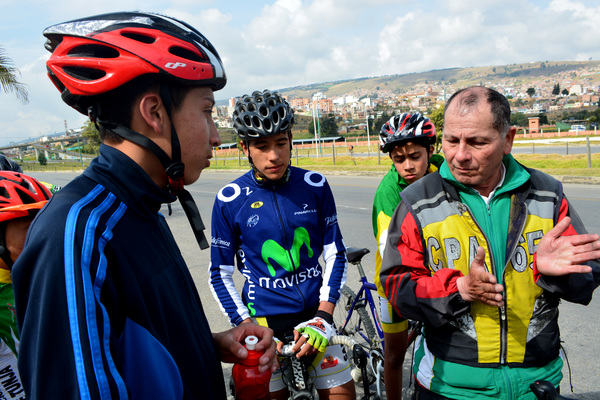
Riding along steep highways in the Colombian countryside, he soon met another young cyclist and learned about the Santiago de Tunja cycling club, a ragtag group of aspiring riders who gather most Saturdays under the shadow of a towering concrete soccer stadium in this colonial city.
Motavita joined the team that week and won his first race a month later, bringing home a tiny plastic trophy that he keeps on a wooden nightstand.
"My dad was so proud," Motavita said, beaming. "And look, it's so small."
But it wasn't long before the coaches stopped signing him up for races. He wasn't performing.
"My teammates all had better, lighter bikes," he said. "The coach would tell me, 'You'll get crushed out there.'"
In a nation consumed by soccer, and where a civil war raged for more than 50 years, there have been scarce resources to fund national sports leagues, let alone professional cyclists.
A race-worthy bicycle can cost several thousand dollars, out of reach for many in a country where the average monthly salary is roughly $700. Nearly 40 percent of people still live below the poverty line in rural areas.
Yet a surprising number of Colombian road racers have ascended into the highest levels of an elite, insular and mostly European sport. Many are dubbed escarabajos, or beetles, for their prowess riding quickly up steep mountains.
By some measures, the first wave of glory began in 1984, when Luis Alberto "Lucho" Herrera, flanked by screaming fans, became the first Colombian to win a stage of the Tour de France.
But the successes dulled within the decade as violence and drug trafficking racked the country. Now, with a temporary peace accord enacted in 2016 after five years of negotiations, Colombians are back. They are once again a disproportionate presence in professional cycling, stacking up victories over the last five years in top races across Europe. In the Tour de France this year, seven of the 198 riders were from Colombia, compared with three from the U.S.
Many of these racers hail from rural, mountainous regions, including the state of Boyaca, where altitudes top 10,000 feet. Here in its capital, Tunja, a city of roughly 200,000 two hours north of Bogota, children grow up pedaling on mountain roads to school in a wet and windy climate, conditions that build endurance from an early age.
They dream of following in the path of the current cycling icons.
Those include Rigoberto Uran, who was 14 when paramilitary troops assassinated his father, and who went on to win a silver medal in the 2012 Summer Olympics and finish second in this year's Tour de France. There are also rising stars such as Miguel Angel Lopez, who won his first World Tour race last year, and Egan Bernal, who signed on with the coveted Team Sky.
But in Tunja no hometown hero is more adored than Nairo Quintana, or "Nairoman," revered for his sustained attacks on sharp ascents and widely predicted to someday win the Tour de France, where he has twice placed second.
Before all the international victories, Quintana was a member of the Santiago de Tunja cycling club.
Lino and Fabio Casas run the team. The coaches, referred to as professors in Colombia, ask only that students arrive on time, with their own bicycles and gear, and "con ganas," or with desire, to learn and succeed. There is no charge. The brothers and former professional cyclists fund the school with whatever donations they can scramble together.
"More than good cyclists, we are trying to grow good people," Fabio Casas said. "We hope the discipline of the sport will stay with them for whatever they go on to do next."
But left off the race rosters, Motavita saw little point of staying in the club. So he quit about six months after he joined.
He'd return to the club if he could afford a better bicycle.
His family could not help. His older brother, Duvan, then 18, had been fighting a rare bone cancer and was hospitalized in Bogota, where his left leg was amputated. His parents, divorced years earlier, struggled to afford the constant trips there on top of everyday expenses.
Motavita had to move in with his grandmother for a time.
Over the next two years, he continued to train alone on his clunker. But he lost a lot of motivation _ for cycling, for school, for everything.
"It was hard on our whole family," Motavita said.