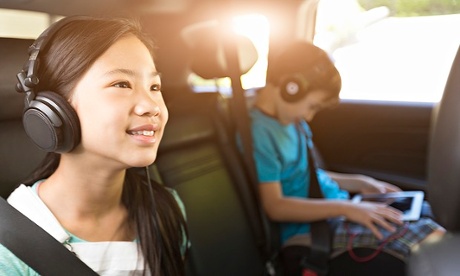
They are five words that parents dread when behind the wheel as they are a sure sign of growing boredom and impending bickering from the backseat. But these days parents have far more to call upon than a simple game of I-spy to keep the children entertained when they ask: “Are we nearly there yet?”
Portable DVD players, handheld games consoles and tablet computers offer ways for children to while away the hours spent strapped in a car seat, and feel as if they have never left home at all.
Indeed recent surveys reveal that parents are increasingly turning to these modern distractions rather than relying upon spotting number plates, or a game of 20 questions while making a long car journey. Less than 14% of British parents now use traditional games to keep their children entertained, according to research by the AA.
Car entertainment on stream
Now more and more car manufacturers are making it easier for families to make lengthy journeys by road with a growing array of solutions. Some models now come with screens embedded into the back of the frontseats to provide passengers with something to take their mind off the passing traffic and countryside. However, over the next year or so vehicles will become increasingly connected to the world around them through wireless 3G, 4G and WiFi networks.
While this technology will be useful for providing drivers with more information about oncoming traffic and the surrounding amenities, it will also open up a new world of entertainment options for those not having to concentrate on the road.
Car stereos will be able to access music streaming sites such as Spotify, and internet radio will allow users to pause, rewind and fast forward through music or the latest audiobook for the children.
Intel has investigated allowing different areas of the car to listen to different types of audio simultaneously, meaning that children can enjoy the latest pop hits while their parents catch up on the news in the front.
Apple’s CarPlay and Google’s Android Auto will also revolutionise the in-car entertainment market by allowing their smartphones to pair seamlessly with vehicles, with their apps displayed on dashboard-mounted displays.
A holographic future?
Microsoft Research and Ford have also been looking at integrating augmented reality devices into the back windows of cars that can provide passengers with a history tour of passing landmarks or even allow them to go on a virtual treasure hunt of passing objects, such as phone boxes.
In Australia, researchers at the Royal Melbourne Institute of Technology’s Games and Experimental Entertainment Laboratory (GEElab) have been developing an in-car entertainment system that combines gesture-sensing controls with holographic displays that will give children puzzles to solve. Children will be presented with objects that they may be able to see while sitting in the backseat and then asked to answer questions about them.
This may help to address concerns from parents that their children are becoming increasingly disconnected from the real world with the increasing amount of time they spend staring at a screen.
GEElab researchers based in Germany have been commissioned to build a prototype of the device for car company Audi, but it could be more than five years before it appears in cars.
If it is a success, it may not mean so much an end to I-spy, but more of a reimagining of it for the digital age.
Always consult a financial adviser before taking advice. Opinions expressed here do not necessarily reflect the views of Sainsbury’s Bank.
Sainsbury’s Bank provides a range of services, including banking products, car insurance, home insurance, life insurance, pet insurance, travel insurance, travel money and savings.
We combine the shopping experience and banking by offering customers great products at fair prices, while consistently rewarding them with extra Nectar card points for choosing Sainsbury’s for their finance and shopping needs. Nectar points can be used towards travel, treats, family days out and shopping.