Every summer, Bengaluru goes back to doing what it knows too well — figuring out how to make its water last. The Bengaluru Water Supply and Sewerage Board (BWSSB) puts out its action plan, neighbourhoods brace for tighter days, and tankers begin to fill the gaps.
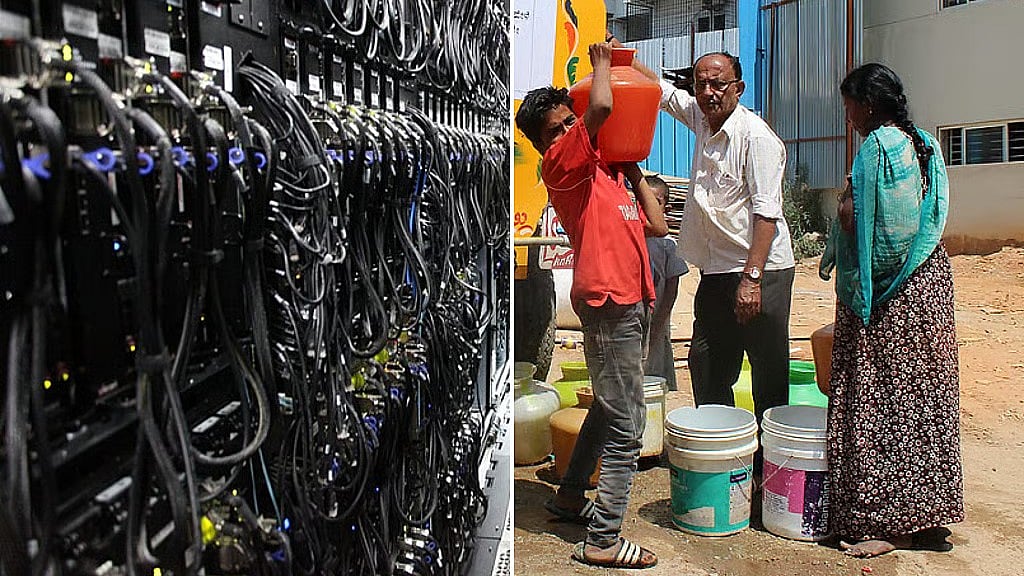
But this time, the city is juggling an additional demand, one that doesn’t slow down when the taps do — its data centres, and the water they greedily consume.
That issue now sits at the centre of Karnataka’s push to rewrite its data centre policy. In the Assembly this March, Information Technology (IT) Minister Priyank Kharge warned that data centres were "heavy water and energy guzzlers" and said the state needed a greener approach. He said 1 mega watt (MW) of data centre capacity requires one acre of land and Rs 70 crore in investment. Each mega watt demands 25 million litres of water a year.
"If you ask five questions on ChatGPT, 500 ml of water is needed," Priyank told legislators. "We have to re-look the existing policy and come up with a sustainable one."
Before the state can draft a sustainable policy, it must answer a question it has not systematically measured: how much water does this industry actually draw?
TNM asked the government how much water the data centres are consuming. And the responses of the water board, the pollution control board, and the IT department revealed why the Minister’s warning has become more urgent than he may have intended.
Data centres are large facilities that house the servers, storage systems, and networking equipment that power everything from cloud computing to artificial intelligence. They run continuously, generate enormous heat, and require constant cooling, which is why water sits at the centre of their environmental footprint. Karnataka has 32 private data centres, of which 31 are in Bengaluru.
The numbers
At the water board (BWSSB), officials confirmed the board has not tracked the water supplied to data centres as a separate category. The chairman Ram Prasath Manohar said the board had only recently been instructed to begin gathering this information.
“BWSSB doesn't have data because they don't monitor where water is going for commercial purposes,” said Khushbu Birawat, a water and environment consultant.
At the Karnataka State Pollution Control Board (KSPCB), which oversees environmental clearances and compliance, multiple officials could not quantify a data centre's water needs. The board has no consolidated accounting of cooling water permissions or consumption norms for the sector.
The IT department, after repeated follow-ups, offered an estimate of roughly 4,000 kilolitres per day across all 32 facilities in the state. But the data was only an industry-wide approximation assembled through informal conversations with operators.
Independent researchers put the consumption figure considerably higher than the government's estimate.
Shashank Palur, a hydrologist at WELL Labs, calculated that Bengaluru's data centres consume approximately 20 million litres per day. The methodology is grounded in publicly available data: one megawatt of data centre capacity requires approximately 26 million litres of water per year. According to the IT department, 18 of Karnataka’s 32 centres alone account for 292.27 MW.
Globally, the sector is under growing scrutiny. In the United States of America, Google, Amazon, and Meta have faced community opposition and regulatory pressure over the volumes of water their facilities draw from local sources, with some towns in drought-prone states pushing back against new approvals entirely. India is at an earlier stage of that reckoning, but the underlying science is the same.
Where the water comes from
Most of Bengaluru’s data centres sit in the city’s eastern and south-eastern tech corridors, clustered in Whitefield and Electronic City. The newer facilities push into the peri-urban stretches around Devanahalli. Together, they form a continuous belt of high-capacity infrastructure running through the city’s worst water-stressed areas during summer.
According to data shared by the IT department, recent investment commitments from nine major operators – including NTT, Nxtra, STT, CtrlS, Data Samudra, Sify, Tata Communications, Reliance Communications and NxtGen – add up to Rs 24,253 crore. The department estimates that around 2,694 direct and indirect jobs have been created across these proposals.
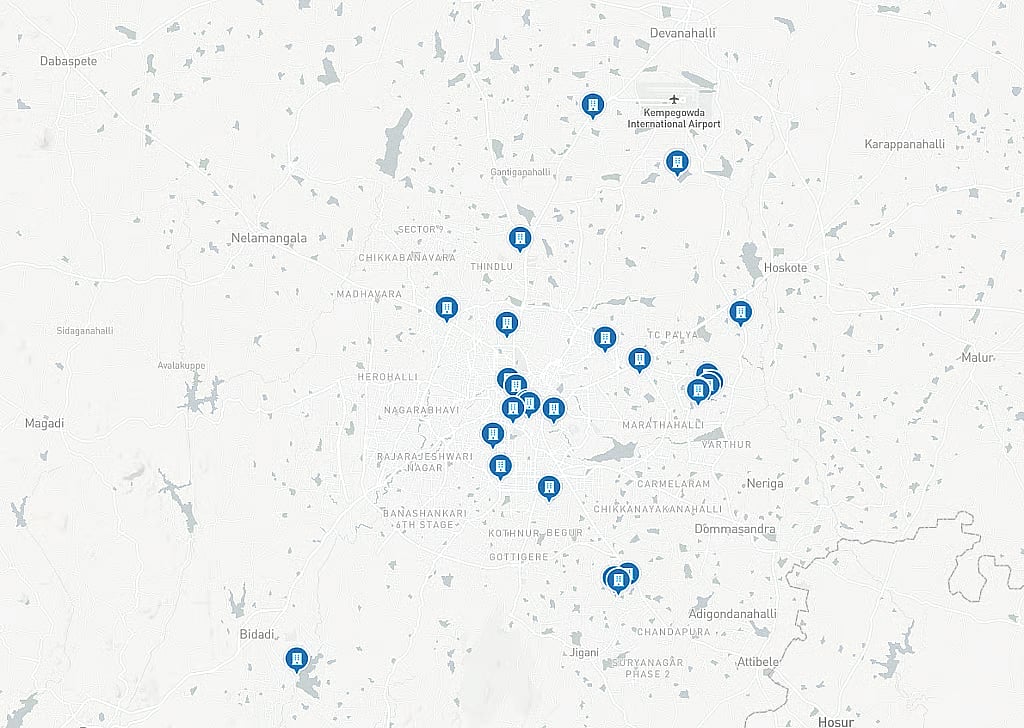
In fact, the harder question is not the volume of water, but the source.
When developers apply for project approvals to the BWSSB, the Karnataka Industrial Areas Development Board, or local bodies, they must declare their intended water source — or private arrangements including borewells. Once clearance is granted, no agency verifies whether the declared source matches actual practice.
Our interactions with the agencies offered no clear indication on whether groundwater is among the sources being approved. But, as hydrologist Shashank pointed out, "Right now, data centres mostly consume groundwater. A lot of these centres are coming up in peri-urban areas where there are still agricultural communities relying on non-potable water."
This is concerning, because Bengaluru's groundwater is already under serious stress. The Central Ground Water Board has found that Bengaluru extracts almost 10 times the water it recharges each year. Devanahalli, which has no perennial surface water source and hosts multiple data centres, consumes 169% of permissible extraction limits of water.
"What we withdraw comes from borewells around 1,000 feet deep," Shashank said. "But recharge happens on the surface, maybe up to 200 feet. Almost 90% of Bengaluru is concretised. For rainwater to percolate the ground, you need open spaces. We don't have more than 5% of blue and green spaces left." Blue and green spaces, such as lakes, wetlands, parks and tree cover, play a crucial role in groundwater recharge, biodiversity, and reducing urban heat.
Regulatory interventions lacking
Karnataka's Data Centre Policy 2022-2027 assures that “the state would facilitate provision of uninterrupted water supply (24*7) to data centre entities/units across the state.”
Regulation has not kept pace. "Since data centres are not categorised as a very polluting industry, they don't go through the regular environmental impact assessment process," Khushbu said.
Shashank explained the shortcomings in classifying data centres as IT/ITeS entities. "Ideally, they should fall under large infrastructure projects, like a commercial entity, because the majority of their water requirement is for cooling,” he said, asking what all checks the IT department has put in place. “Do they undergo a regular environmental clearance or the environment impact assessment (EIA) process?"
Domestic vs commercial water use
This summer, BWSSB deployed 1,260 mini water tanks and 117 tankers across 448 high-alert, water-stressed pockets in Bengaluru. In 2025, it imposed a Rs 5,000 fine for using potable water to wash vehicles, water gardens, or clean roads. Residents in the eastern corridor, the same geography where data centre clusters are densest, rationing water and paying for every tanker load. They are also the ones on the BWSSB watch list.
Data centres in the same zones operate under no equivalent restriction.
According to Shashank, “Bengaluru’s biggest freshwater consumers – around 74% – are domestic users. So it makes sense to target domestic use to reduce water consumption.”
He argued that the use of freshwater in non-residential connections can potentially be completely reduced. "Industries require around 150–155 million litres per day, all of that can be replaced by tertiary treated water. It's only a process-use, people do not come in contact with water. Process-use water – used only for cooling and flushing – alone comes to 150 million litres in industries and around 200 million litres in commercial use. So there is huge potential for completely reducing the use of freshwater."
In other words, targeting domestic users is logical by volume. But the case for targeting commercial and industrial users, including data centres is different — everything they consume could be replaced. A resident needs drinking water from the Cauvery. A cooling tower does not.
"Say 20 million litres of water is used by the data centres every day, that is drinking water for around 1.3 lakh people. It is drinking water that is being diverted from people to data centres,” said Shashank.
Khushbu put it in terms of what the city is already spending to compensate. "We are spending Rs 3 crore per day just on electricity to pump Cauvery water into the city. And now they are talking about bringing water from west-flowing rivers. On one side, you are putting in so much effort and money to bring freshwater [to Bengaluru houses] from all those places. On the other side, you are making it convenient for data centres to come up here. If drinking water is so important, then why are you bringing in such a competitor for good quality water?"
"Just because you want to show economic growth, does it really mean it will also support environmental conservation? Bengaluru does not have a water source, neither does Bengaluru Rural. You see the groundwater extraction numbers. Why stress the entire district again?” she asked.
BWSSB has a plan
The BWSSB chairman Ram Prasath Manohar is not without a plan. The board has already piloted a 70 kilolitres per day (KLD) ultra-pure water treatment plant at Kadabesanahalli, developed with a startup. It takes secondary treated sewage through additional ozonation, UV radiation, and chlorination to produce cooling-grade water. "We have successfully demonstrated the project," Ram Prasath told TNM.
He elaborated, "Now we want to scale up the technology across treatment plants so that in the eastern part of the city, which has concentrated numbers of IT parks and data centres, we will get high quality treated water that costs less and is recyclable. This way, consumption of freshwater or groundwater by data centres will be minimised. This is our goal."
Ram Prasath said the scaling could happen within six months. "We will provide. We will be able to supply." But supply, in the current framework, is not the same as requirement. He acknowledged that uptake would depend on whether operators chose to use the ultra-pure water instead of freshwater. He spoke of planning a "consultative meeting with stakeholders" to understand demand before scaling the project.
Shashank sees this as the precise point where policy needs to intervene. He pointed to a 2015 provision that already exists in Karnataka, requiring thermal power plants within 50 kilometres of the city to use only treated water for cooling.
"The gas power plant in Yelahanka uses 15 million litres per day of treated water from the Jakkur sewage treatment plant (STP) under this rule," he said. "I agree there needs to be a higher quality of treatment because in a data centre the loop is closed, unlike a power plant where steam escapes. But the option exists. It comes down to policy to enforce it."
He also pointed to a model already in place near Devanahalli. "There has already been a model set up where BWSSB is sending secondary treated water to a KIADB tech park. There is a tertiary treatment plant in the industrial area and they treat it further and supply it to all the industries within the tech park." Chennai, he noted, has taken this further with a 40 million litre per day tertiary-treatment reverse osmosis plant supplying an entire industrial park.
"There should not be any freshwater going into these data centres," Shashank said. "It should be completely reliant on treated water. Bengaluru's centralised STPs treat around 80% of all sewage in the city. There is significant treated water available. The question is whether it is being directed toward the right uses."
On what the government must do, Khushbu said, "Zones should be demarcated where data centres can come up. We need them, yes, we cannot say otherwise. But find appropriate locations based on water availability. There should be a safe extraction limit, preventing any extraction beyond the carrying capacity of the land. Right now, data centres are cropping up everywhere. That has to stop first."
Shashank identified one more thing that a new policy must fix: reporting. "Many data centres are pay-to-use, modular. Facebook or Amazon will rent out these spaces rather than build their own. But are they coming under corporate sustainability rules? Are they getting evaluated? Do they need to publish reports on how much water they have consumed? The reporting mechanism should be strengthened. The current policy gives incentives but does not hold anyone accountable."
IT department also has a plan
The IT department told TNM that water sustainability is now a key pillar of the revised Data Centre Policy, with efficiency parameters around water use being built into the framework. The department said the government's focus was shifting to encouraging new, smaller and medium-sized facilities toward coastal areas like Mangaluru, which offer better natural cooling and sub-sea cable connectivity.
Priyank Kharge has written to the Union Telecom Ministry seeking a cable landing at Mangaluru. The Union government has indicated support if private companies lead the investment.
Mysuru, Hubballi-Dharwad, Kalaburagi, Shivamogga, and Tumakuru are named in the revised framework as potential distributed locations.
The department also acknowledged that the existing policy is limited. "The earlier data centre policy is two or three years old," it said. "With changing technology, the state is planning for sustainable data centres."
This report was republished from The News Minute as part of The News Minute-Newslaundry alliance. Read about our partnership here and become a subscriber here.
Elections are not just about who wins, but about the questions that often go unasked – and this time, they matter more than ever. Support our new NL Sena on the five upcoming assembly polls to help us follow the missing voters, the shifting politics, and the stories that could shape India’s future.
Newslaundry is a reader-supported, ad-free, independent news outlet based out of New Delhi. Support their journalism, here.